
Nvidia's CEO Jensen Huang has spent much of his recent Asia tour drawing crowds, signing everything from laptops to robot dogs, and reinforcing his status as one of the most influential figures in the AI era.
Following meetings in China, Taiwan, and South Korea, Huang arrived at the headquarters of Hyundai Motor Group in Yangjae-dong, Seoul, on June 8, where he met Executive Chairman Chung Eui-sun and toured the company's growing portfolio of robotics and mobility technologies.
The visit itself was significant.
Huang praised Hyundai's robotics ambitions, declared that "now is Hyundai's time," and announced an expansion of Nvidia's partnership with the automaker across mobility, manufacturing, and robotics. He repeatedly emphasized what he calls "physical AI," the next phase of artificial intelligence that moves beyond software and into machines capable of interacting with the real world.
Yet the moment that captivated the internet was not a business announcement.
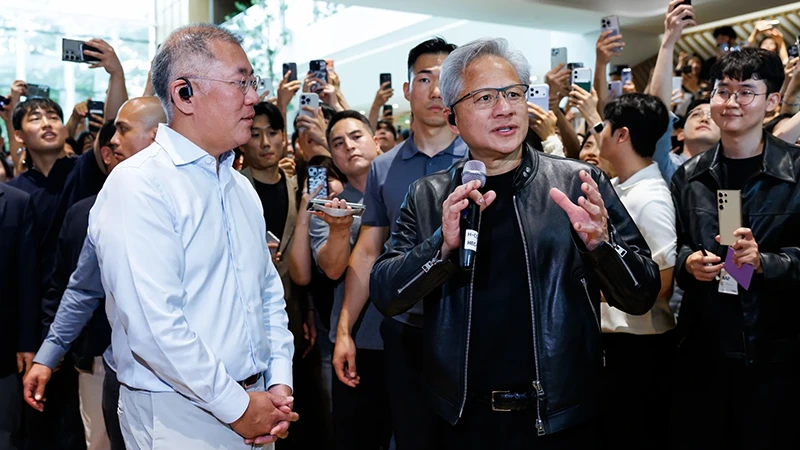
It was a photograph.
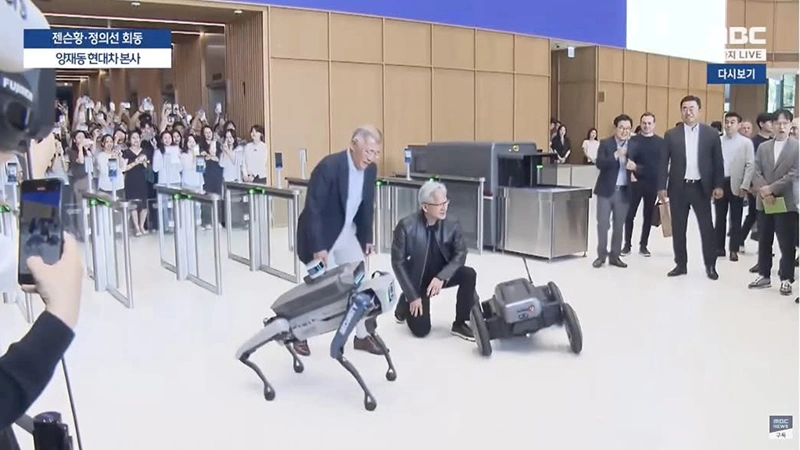
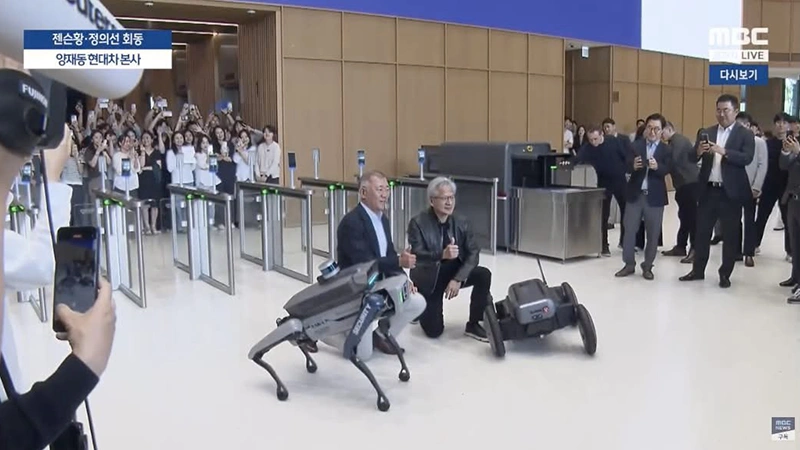
Standing alongside Chung in front of Hyundai's robotics displays, including Boston Dynamics' famous Spot robot, Huang reportedly motioned for everyone to crouch lower to get a better shot. In a scene that would have seemed almost unimaginable in an earlier era of Korean corporate culture, Chung complied and lowered himself beside Huang for the photo.
On the surface, it was a routine adjustment that happens in countless group photos every day.
Online, however, many Koreans saw something more symbolic.
Images of the moment quickly spread across social media, online communities, accompanied by jokes about the sight of a Hyundai chairman being casually directed into position by a foreign technology executive. Reactions ranged from amusement to disbelief. For many observers, the image felt less like a photo opportunity and more like a snapshot of changing power dynamics in the global technology industry.
To understand why the moment resonated so strongly, it helps to understand the place chaebols occupy in South Korean society.

The country's largest conglomerates, including Hyundai, Samsung, LG, and SK, were instrumental in transforming South Korea from a war-ravaged nation into one of the world's leading industrial economies. As a result, the founding families behind these corporate giants occupy an almost mythical position within Korean business culture.
Deeply influenced by Confucian values that emphasize hierarchy, seniority, and social standing, Korean corporate culture has traditionally placed enormous importance on preserving a leader's dignity and authority.
Top executives, particularly chairmen from founding families, are often treated as symbolic figures who embody the company itself. In many ways, they are regarded almost like corporate royalty.
This has given rise to what many observers describe as an unwritten but powerful rule of chaebol culture: it is intensely anti-anything-that-makes-the-chairman-look-undignified.
Maintaining chemyeon, or face, carries significant importance.
Public situations that could make a chairman appear awkward, overly casual, playful, or subordinate are generally avoided. While senior executives routinely participate in formal ceremonies and traditional bows, being casually told where to stand, how low to crouch, or how to pose for a photograph is not typically associated with the carefully managed image of a chaebol leader.
That is why the image of Chung crouching beside Huang attracted so much attention.
To many observers familiar with Korean corporate culture, it felt like a small but striking break from a longstanding unwritten rule.
For an older generation of chaebol leaders, being publicly directed by an outsider, especially a foreign CEO, to "get lower for the photo" would have been almost unthinkable. The gesture itself was harmless and lighthearted, but it contrasted sharply with the traditional image of Korea's industrial titans as distant, authoritative figures whose public stature is carefully protected.

What made the scene even more notable was Chung's reaction.
Rather than appearing uncomfortable, he seemed completely at ease throughout the visit. The two men hugged when they met, toured Hyundai's facilities side by side, joked with employees, and displayed a noticeably informal rapport. Huang repeatedly referred to Chung as a close friend and praised him as an exceptional leader.
The broader context helps explain why traditional hierarchies seemed less important that day.
Hyundai is no longer just an automaker.
Through its ownership of Boston Dynamics, the company has become one of the world's most ambitious robotics players. Nvidia, meanwhile, provides much of the computational foundation powering the AI revolution. As robots become increasingly dependent on advanced AI systems, the relationship between the two companies has become strategically important.
Huang went as far as saying there is "no one" better positioned in robotics than Hyundai, underscoring how highly Nvidia views the Korean firm's capabilities.
Throughout the tour, Huang appeared genuinely enthusiastic about Hyundai's technology. He marveled at the company's robotics demonstrations, joked with Spot by pretending to hand over a credit card when the robot requested identification, signed both Spot and Hyundai's MobED mobility platform, and even wrote "JENSEN loves HYUNDAI" on one of the robotic systems.

Viewed through that lens, the viral photograph was about more than a crouch.
It represented the meeting of two eras.
On one side stood the industrial hierarchy that helped build modern South Korea. On the other stood the culture of the AI age, where influence increasingly flows through technological leadership, computing power, and global partnerships rather than corporate pedigree alone.
Nobody's authority was challenged that day. Chung remained the chairman of one of Korea's most powerful conglomerates, and Huang remained a guest. Yet the image captured something many people instinctively recognized: the old rules are becoming more flexible.
In an era defined by AI, robotics, and cross-border collaboration, even the most deeply ingrained corporate conventions can bend. Sometimes all it takes is a billionaire in a leather jacket pointing toward the camera and saying, "Come on, this way."