The universe as humans know it, can be calculated using mathematics. But time is relative, and that despite researchers' best efforts to define how long a second is, the world just cannot deal with that universal duration.
It was back in 1968, where researchers agreed that the duration of a second is 9,192,631,770 vibrations of the unperturbed ground-state hyperfine transition frequency of the caesium-133 atom. Timekeeping researchers are always working on developing an even more stable atomic reference for the second, with a plan to find a more precise definition of the second as atomic clocks improve.
With that in mind, researchers found a requirement to adjust Coordinated Universal Time (UTC) in order to make up for the difference between the International Atomic Time (TAI).
To do that, in 1972, the leap second was introduced by the global time watchdog the International Earth Rotation and Reference Systems Service.
The leap second is a measurement used to combat the long-term slowdown in the Earth’s rotation, caused by the constant melting and refreezing of ice caps, and the imprecise nature of observed solar time.
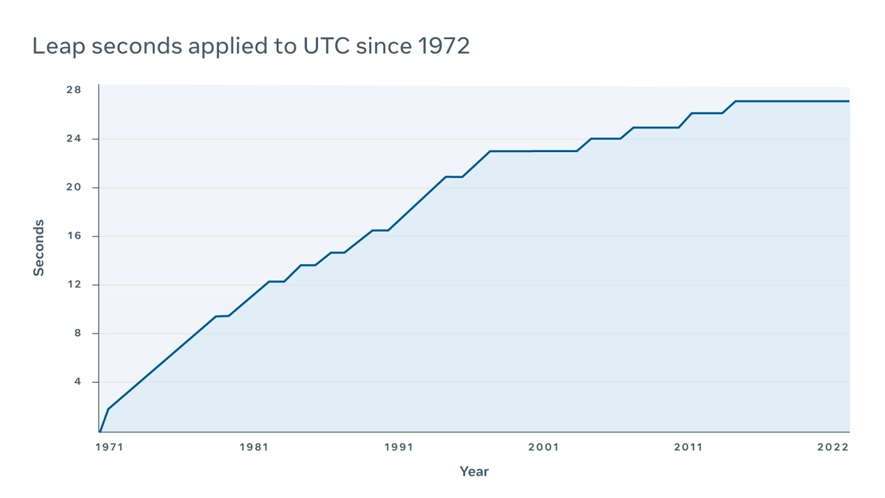
This leap second is occasionally added to an hour, whenever it is necessary. For example, instead of 23:59:59 changing to 00:00:00 at midnight, an extra second would make a day last a second longer, when 23:59:60 is tucked in.
While the extra second is meant to compensate the difference in time, allowing researchers to make observations, computers work differently when dealing with time.
According to tech companies, leap seconds can cause "devastating" results.
This is why U.S. tech companies have gathered and launched a campaign to scrap the leap second.
From Meta to Google, Amazon and Microsoft, have all joined the U.S. National Institute of Standards and Technology (NIST) and France’s Bureau International de Poids et Mesures (BIPM), to call the extra second that is occasionally added to atomic clocks and imprecise observed solar time (UT1) to be ditched.
According to the argument, since the first time the leap second was introduced, it has been used 27 times.
But despite that, adding one single extra second has caused major issues with computer networks.
For example, back in 2012, Reddit experienced a massive outage. This happened because the extra second confused their computer systems, locking up the servers and halting their CPUs.
Similar problems were reported by Mozilla, LinkedIn, Yelp, and Amadeus.
Another leap second that was added in 2017, affected Cloudflare. The content delivery network and DDoS mitigation company, had its DNS service disrupted because of the extra second.

According to Meta in a blog post:
"Leap second events have caused issues across the industry and continue to present many risks. As an industry, we bump into problems whenever a leap second is introduced. And because it’s such a rare event, it devastates the community every time it happens. With a growing demand for clock precision across all industries, the leap second is now causing more damage than good, resulting in disturbances and outages."
"As engineers at Meta, we are supporting a larger community push to stop the future introduction of leap seconds and remain at the current level of 27, which we believe will be enough for the next millennium."
The engineers at Meta, also warned that the Earth’s changing rotation pattern doesn't always require an additional second because sometimes, it could actually result in a negative leap second at some point in the future. If an extra second is added to a negative leap second condition, this could cause even more issues.
"The impact of a negative leap second has never been tested on a large scale; it could have a devastating effect on the software relying on timers or schedulers," the blog post stated.
"In any case, every leap second is a major source of pain for people who manage hardware infrastructures."
I didn't even realize we had leap seconds but our teams have a convincing augment as to why they should be left behind!https://t.co/zqqNcXsesw
— Mike Schroepfer (@schrep) July 25, 2022
But regardless, the "extra second" has to be added somewhere and somehow.
This is why Meta and other tech companies utilize a technique called "smearing." What this means, the companies "smear" the leap second by simply slowing down or speeding up the clock throughout a number of hours.
Meta smears a leap second throughout 17 hours, while Google uses a 24-hour smear technique that lasts from noon to noon.
Since smearing it means that it needs to be evenly distributed, the approach should be minimal to ensure that the difference between the two time is tolerable.
According to Meta, is the smearing steps are too big, the computers may consider that some devices are faulty, and will automatically exclude them. This may result to an outage. The smearing should also be made when no server is being restarted, in order to prevent the computers from ending up with either "old" and "new" time, which again may lead to outage.
By carefully smearing that extra second, the extra second won't create any weird time stamps that could confuse computer systems.
The International Telecommunications Union is expected to consider the proposal to end the leap second at its 2023 conference.






















































































































































































































































































