Breaking down the internet, all of its complexity is only based on how to transmit information over the distance.
When users access a website, use social media, or send an email, they generate data. This data is broken down into small packets, which travel independently across the network to their destination. Each packet contains the data, sender's address, recipient's address, and information for reassembling the packets.
And in order to travel from one place to another, this information is encoded in bits, which consists of zeroes and ones.
Quantum internet on the other hand, is expected to reinvent the way information travel on the internet.
And this time, research teams in the U.S., China and the Netherlands have independently reached nearly simultaneous breakthroughs that could bring nearly a far more superior internet closer to reality.

The peer-reviewed journal on Nature, published two of the studies, each from the U.S. team and the Chinese teams.
Each team used optical fiber cables that span tens of kilometers to establish a network within an urban environment, involving different cities as tests.
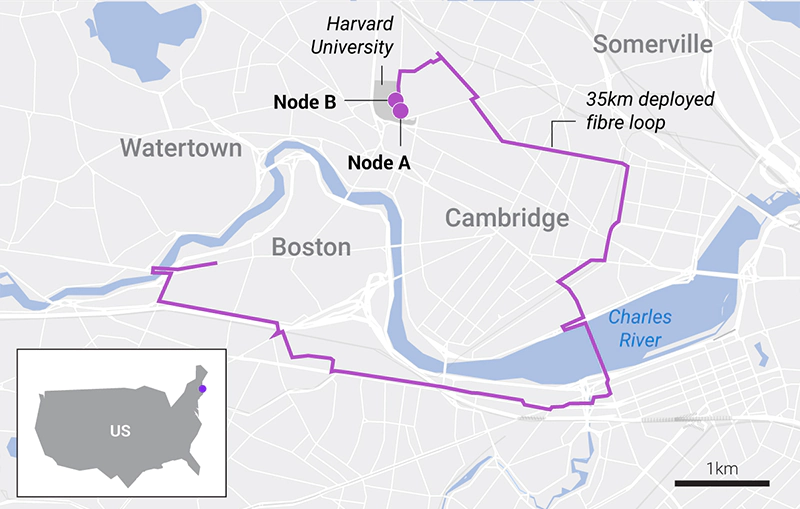
The U.S. researchers connected two nodes positioned side-by-side in the Harvard lab at Cambridge, Massachusetts using a 35 kilometers fiber loop that stretched into Boston.
In China, the researchers set up three nodes (named Alice, Bob and Charli), and connected them in a triangular network around Hefei, capital of Anhui province and home to the University of Science and Technology of China (USTC), with a central server lab in the middle, all at a distance of around 10 kilometers.
And in the Netherlands, the fiber optic cable spans a total of 25 kilometers from Delft to The Hague, connecting two nodes with a server at the midpoint.
While their approaches differed, the three teams demonstrated quantum entanglement by using the optical fiber cables to create secure connections between receiving node devices.
In China, the researchers used a single-photon scheme, using qubits encoded in an ensemble of rubidium atoms, to send one photon from each node to the server for entangling. If two photons arrived at the server at precisely the same time, an entangled state is achieved, the Chinese researchers said.
“Our work provides a metropolitan-scale test bed for the evaluation and exploration of multi-node quantum network protocols and starts a stage of quantum internet research,” according to the paper.
In the U.S., the researchers used diamond devices with the carbon atoms replaced by an atom of silicon, in order to entangle two small quantum computers.
The single photon was then sent to the first node where it entangled with a silicon atom before it was sent around the fiber loop to graze a second silicon atom at the other node, enabling entanglement.
The Dutch researchers used a similar approach to the U.S., but instead used nitrogen atoms embedded in diamond crystals.
Another difference is that the Chinese and the Dutch methods relied on extremely precise timing for the arrival of photons at a central server, requiring a level of fine tuning that the U.S. team did not use.
.
According to Nature, the Chinese team’s ensemble approach is a lot more efficient than the single atom method used by the U.S. and the Netherlands.
In a press release, the Chinese researchers said that they achieved an entanglement efficiency “two orders of magnitude” higher than their U.S. counterparts.

However, it's less adaptable as it cannot be used to perform basic computation.
Regardless of their differences, the achievement is a milestone.
The Chinese researchers, led by the country’s “father of quantum" Jian-Wei Pan from the USTC, described the achievement as “a pivotal milestone” in the transition to larger scale experiments.
The team from U.S., is from Harvard University. Led by physicist Mikhail Lukin, he said a "key challenge" in realizing practical, long-distance quantum communication "involves robust entanglement between quantum memory nodes connected by fiber optical infrastructure."
Lead author of the Dutch paper Ronald Hanson, a physicist at Delft University of Technology, said that "the step has now really been made out of the lab and into the field."
Quantum internet is an advanced form of internet technology that leverages the principles of quantum mechanics to enhance communication security and speed. Let's delve into its fascinating aspects:
Instead of using classical bits like in traditional internet systems, the quantum internet is a network that uses quantum signals, typically in the form of quantum bits (qubits).
Qubits have a superposition property, in which they aren't tied to just 0 or 1. Instead, they can be both 0 and 1 simultaneously. This property can potentially increase the amount of information processed and transmitted.
Then, quantum internet is considered superior to the traditional internet because it uses quantum entanglement, which can be described as a phenomenon where two particles become linked, and the state of one particle instantly influences the state of the other, regardless of the distance separating them.
This property can be used to create highly secure communication channels because any attempt to eavesdrop would disturb the entangled state, making it detectable.
So, no only that quantum internet is faster, but it's also far more secure.

It took researchers years to achieve the milestone because of the massive challenges to its implementation.
Creating and maintaining stable qubits is challenging due to their sensitivity to environmental disturbances, the infrastructure which requires unique and expensive hardware which are still in the experimental stage.
For example, super cold temperature is needed for ensuring superconducting qubits, because low temperature allows electricity to pass with far less resistance.
These qubits operate optimally at temperatures close to absolute zero (around -273°C or 0 Kelvin) to maintain their quantum properties without interference from thermal vibrations.
Then, there is the standardization which has yet to be universally accepted for widespread adoption.
Ronald Hanson told Nature that "it doesn’t mean it’s commercially useful yet, but it’s a big step."
Read: Milestone In Quantum Computing: The First Quantum Teleportation In A Computer Chip














































































































































































































































































