 Nokia, the Finnish multinational communications and information technology company, has been building its mapping and location for quite a long time. And for that, they are pretty good at it.
Before tech companies began map racing, people have long depend on standalone GPS devices to get around to places they're not familiar with. Since smartphones are GPS-ready and became more affordable, people can get anywhere they want to go with ease, thanks to their built-in mapping and navigation.
Google has long dominated the smartphone map race with Google Maps. Apple Maps, its primary competitor, at least in the U.S., has made great improvement over the year, recovering from glitches and disastrous introduction back in 2012 that CEO Tim Cook formally apologized. Both have now come somewhat more accurate, more reliable and more precise in each of their developments.
Both also add features to beat the other, all in the purpose of the mapping war between the two companies.
With all the effort and changes going into these mapping apps, both have their own advantages and disadvantages. For example, Google is pretty much flexible, and merge perfectly with other Google's services, and Apple Maps is the easiest option for iPhone users that tied to services like Siri and Spotlight search.
Nokia's mapping service may come new to many people. But the company has been mapping the globe for years. The company that has acquired location technology began its effort in mapping in 2001 as Smart2Go, a generic 3D-map interface for access to tourist information on mobile terminals. After acquiring a Chicago-based company NAVTEQ, Nokia owns the company's 25 years of experience in creating automotive-grade content and a deep knowledge in the automotive industry.
It was until May 2011 that Nokia began offering Nokia Maps as a rebrand of OVI Maps under the HERE flag. On 13 November 2012, Nokia further rebrand all its location offering as HERE.
Mapping is Nokia's current and future plan. Despite its mobile device's sales are falling after being overtaken by Samsung with the help of Android, and Apple's iPhones, Nokia is having success in other places, mainly in mapping, networking, and advanced technology. Nokia that has been investing billions of dollars in R&D for technology advancement, also has a rich collection of patents that it could license to partners such as Microsoft, Yahoo!, and Amazon. These are the fields where the company is putting all of its efforts in.
HERE Comes Nokia
Because Microsoft owns Nokia's mobile hardware division, HERE started its life on Windows Phone, starting version 8. With offline availability, 3D landmarks and indoor venue maps for many unique buildings in many countries, HERE's features are more or less, similar to Google Maps and Apple Maps.
If Google Maps is better integrated to Android, and Apple Maps to iOS users, HERE integrates well on Windows Phone. The suite is coded so users can access their destinations as live tiles, or tap into individual functions going from one app to another without going back to the home screen, for example.
But there is one thing that HERE has that it can proudly boast: traffic prediction.
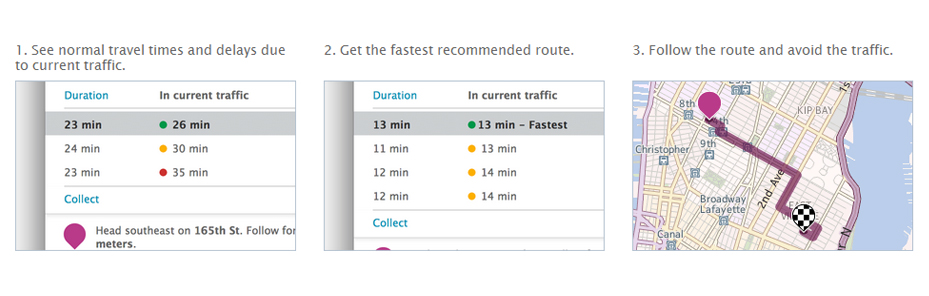
The most important thing for most people when they want to get from one place to another is to spend less time in traffic. Nobody likes sitting in traffic, but avoiding one is not easy as one may expect. To successfully avoid traffic, people need to have the local knowledge, the detour-shortcut experience, and a bunch of luck. Nokia saw this as an opportunity and tries to give the solution by taking those problems out of the equation. Nokia demonstrates a feature called Predictive Traffic, which is a part of its HERE Maps.
With its massive knowledge from years of experience, and with the help of Microsoft, Nokia is confident that the feature can be reliable in predicting how the traffic will be on a given route up to 12 hours into the future. To do so, HERE monitors 100 examples of traffic flow on that route to compare them with the current conditions to provide the fastest route.
Users just need to give HERE their preferred time of arrival, and let it do the job for them.
No one can predict the future, let alone traffic. But Nokia can predict estimated arrival times to be 20 percent more accurate for journeys over 30 minutes using the system. That has made HERE very much reliable, and making it a serious competitor for Google and Apple.
Predictive Traffic is aiming to make journeys in advance a lot easier. The HERE Maps monitors the planned route and send alerts to users' smartphones that have its app installed. Synced with the cloud, HERE can also be applied to a car's built-in navigation system.
Furthermore, HERE can also boast its LiveSight that is able to make augmented reality fit seamlessly into its digital maps. With millions of points-of-interest that include restaurants, cafes, shops and museums, gathered from local data from local guides and users, users can pause the view and freeze the screen to browse the area around them without holding up the phone. This can create a navigation that's a digital version of a paper map to a next-generation map that's much more contextual, much more active and dynamic.
Conclusion
Nokia's HERE Maps with its features, isn't going to replace Google Maps or Apple Maps on their corresponding devices anytime soon. But with its availability on Android, iOS, and others, HERE can certainly make the search giant and the iPhone maker on heat.
HERE Maps, as well as Google Maps and Apple Maps, all have their own advantages and disadvantages. All have their own market and their own highlighted feature. To compete, all need to keep improving for the moments to come.














































































































































































































































































