What does it take to stream thousands of film titles to hundreds of millions of viewers around the world in a quick and seamless experience? For Netflix, the popular streaming platform, it requires specialized cache servers it calls the 'Open Connect Appliance.'
Or also called the OCA, the custom-designed storage server solution is customized to Netflix's unique requirements.
These devices are shipped and distributed to to local Internet Service Providers (ISPs) to be closer to the end-user, enhancing the speed of delivery. After that, Netflix can monitor the health and performance of each OCA as soon as it is reachable from its Network Operations Center (NOC).
The purpose-built server appliances work by storing copies of Netflix video content, in order to serve them at high speeds (both geographically and from a perspective of network hops) to end users of the ISP partners.
"By optimizing our solutions for price and performance, Netflix was able to partner with hundreds of ISPs to localize substantial amounts of traffic with Open Connect Appliance hardware embedded deployments," said Netflix.
According to Netflix in a dedicated web page, OCAs are provided free of charge to partners, "but they are not for sale to other parties."
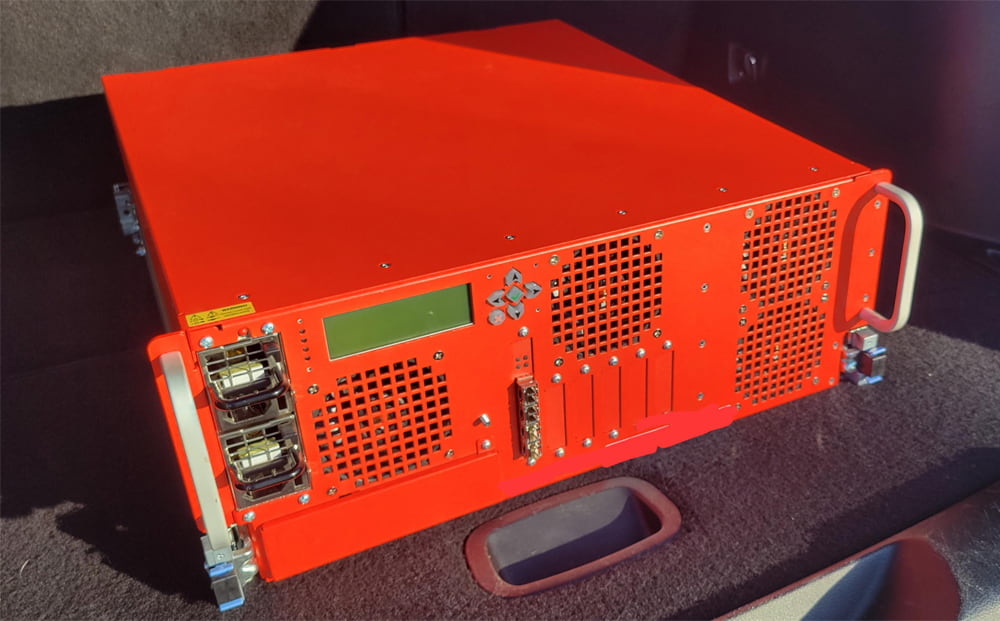
This time, A Reddit user named PoisonWaffe3 managed to get their hands on a 2013-era Netflix OCA that been decommissioned and wiped for disposal.
This marks a rare occasion, where the public can get a peek into mysterious device, and better understand the inner workings of Netflix.
According to Netflix on the web page, OCA is a storage appliance that has a large storage capacity. In 2022, its OCAs use Seagate for storage, in which each OCA has the capacity for storing 360TB. It also comes with enough NAND to reach 96GB/s operational throughput.
The single-processor device is AMD, powered using ~650W of electricity at peak operation.
OCAs work together in tandem in what's called Open Connect, which creates a network of OCAs around the world.
While Netflix provides plenty of high-level documentation about OCA on its website, the device is largely a mystery, since it's not meant for the public to see.
PoisonWaffle3 acquired the bright red Netflix cache server because they work for an ISP that was pulling the devices out of service.
"I work for a large ISP, and we are retiring/replacing quite a few 2013 era Netflix OCA caches, and I was offered one. Of course, I couldn't say no," he said in his post.
"I knew that Netflix had wiped them all in the decommissioning process, that they ran FreeBSD, that they were crammed full of drives, and that's about it. All I could find online was overviews, installation/config guides (for their proprietary software), etc."
PoisonWaffle3 had no clue about what's inside the red box, until he unscrewed the screws.
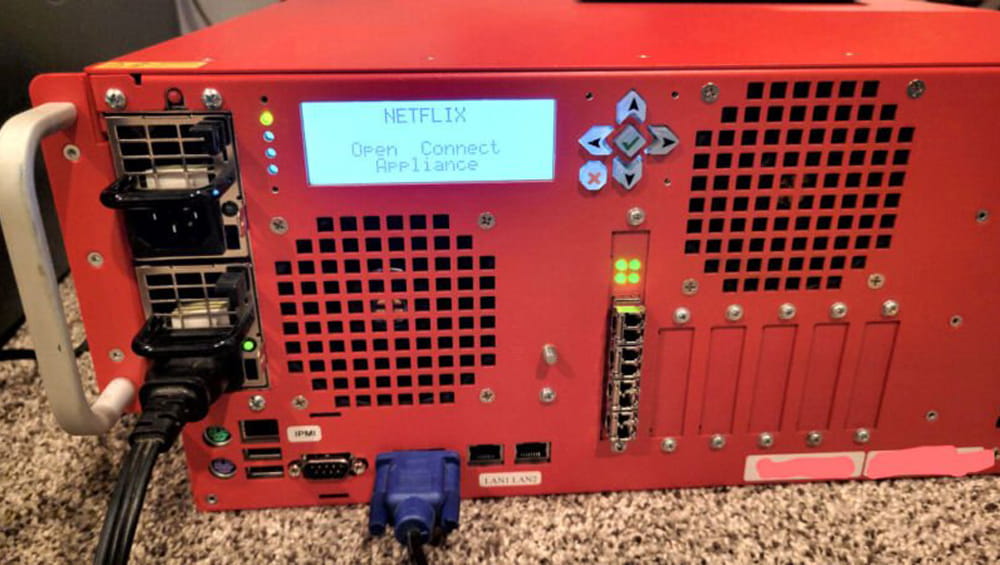
This particular OCA, which is about a decade old, is "pretty standard."
Even the cooling system uses standard fans.
In details, PoisonWaffle3 said that the 2013 device has a SuperMicro motherboard, an Intel Xeon CPU (E5 2650L v2) processor, a 64GB DDR3 RAM, a 36 7.2TB Western Digital hard disks (7,200 RPM), six 500GB Micron SSDs, a pair of 750-watt power supplies, and one quad-port 10-gigabit Ethernet NIC card.
In total, the cache server contains "262TB of raw storage."
On the Reddit post, PoisonWaffle3 asked other users on what to do with this particular OCA.
Suggestions include mining for cryptocurrencies, to running a media streaming server.
With 262TB to work with, PoisonWaffle3 has lots of storage for one person, even in 2022.














































































































































































































































































