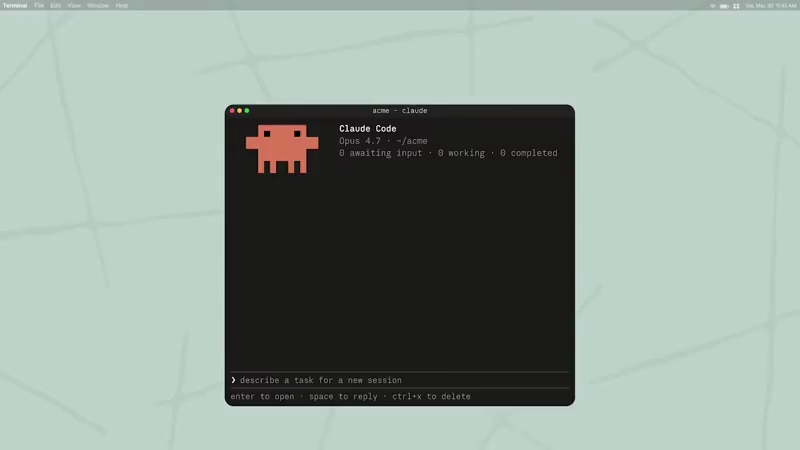
Anthropic has just released the latest iteration in its Opus line of models.
Calling it the 'Opus 4.8,' the version builds on Opus 4.7 by focusing on practical refinements that enhance reliability for extended, complex work. Opus 4.8 also emphasizes refined Developers and users gain improvements in judgment, a stronger tendency toward honesty when evaluating its own outputs, and the capacity to sustain independent operation over longer periods without constant oversight.
These changes aim to make the model more reliable for tasks that require sustained attention without frequent user intervention.
One of the clearest advances appears in how the model handles its own outputs.
Opus 4.8 is notably better at identifying and flagging potential mistakes in its work, particularly in coding scenarios, reducing the likelihood that errors go unremarked.
This improvement in self-awareness supports users who depend on the system for complex projects where accuracy matters over time.
Opus 4.8 is live in Claude Code today.
A few things worth knowing: https://t.co/HOgpJIp8ev— ClaudeDevs (@ClaudeDevs) May 28, 2026
Within Claude Code, the model now behaves more like an experienced engineer.
It can manage long-running sessions with fewer check-ins, staying on track while progressing through features or systematic bug sweeps. Users can hand off substantial portions of work and return later to review completed results rather than supervising every step.
A new research preview feature called dynamic workflows extends this autonomy further.
For especially demanding assignments, the model first creates a plan and then coordinates hundreds of parallel subagents to tackle subtasks.
The agents verify one another's results and iterate until the overall task reaches a consistent state.
In Claude Code, Opus 4.8 makes calls like an experienced engineer without needing constant check-ins.
It stays on track across long-running sessions and follows work through in your repo, so you can hand off a feature or a bug sweep while you focus on what's next. pic.twitter.com/9zkNzwPepO— Claude (@claudeai) May 28, 2026
This approach suits large-scale efforts such as migrating code across hundreds of files, conducting broad bug hunts, or performing security audits in legacy systems.
To improve responsiveness, Anthropic also introduced fast mode for Opus 4.8.
It runs the same underlying model at roughly two and a half times the previous speed while lowering the cost to about one third of the earlier rate. In Claude Code, users can activate it with a simple command. On the API side, access requires contacting an account manager or joining a waitlist.
Opus 4.8 defaults to high effort. For coding tasks, it spends similar tokens to the 4.7 default while delivering better performance.
For difficult tasks and long-running async work, use xhigh. We’ve increased rate limits in Claude Code to accommodate the increased token usage.— ClaudeDevs (@ClaudeDevs) May 28, 2026
Availability remains unchanged from the prior version.
Opus 4.8 carries the same pricing and is accessible today on the Claude web interface, the developer platform, and major cloud services including those offered by Amazon Web Services, Google Cloud, and Microsoft. It has also rolled out to GitHub Copilot for qualifying users.
The release reflects a wider trend in AI development toward models that prioritize sustained reliability and agentic behavior over isolated benchmark jumps.
We’ve updated Claude Code's built-in claude-api skill migration guidance for 4.8.
Run "/claude-api migrate" to update your model strings and suggest prompt improvements that are tuned for Opus 4.8.— ClaudeDevs (@ClaudeDevs) May 28, 2026
Rather than marketing dramatic leaps in overall intelligence, Anthropic has directed attention to qualities that matter in day-to-day professional use, such as the ability to operate independently on long-running projects and to communicate limitations transparently.
Early feedback from users and testers has been mixed.
Many appreciate the gains in coding reliability and workflow autonomy, while some express concerns about higher token consumption on complex tasks or note a preference for characteristics of earlier Opus versions that were removed from the primary interface.
A few developers have reported hitting rate limits more quickly during intensive sessions, though others highlight the practical value for tasks that previously required extensive manual supervision.
Also new in Claude Code: dynamic workflows (research preview).
For the hardest tasks, Claude makes a plan, runs hundreds of parallel subagents, and verifies its work before reporting back. Think a migration touching hundreds of files.
Read more: https://t.co/7gt06kGkDN— Claude (@claudeai) May 28, 2026














































































































































































































































































