 Mobile apps are what made up most of our time on mobile. As they become more common, people spend their time more on apps than they do on mobile browser. The decline can hurt many websites and services that depend on users using browsers.
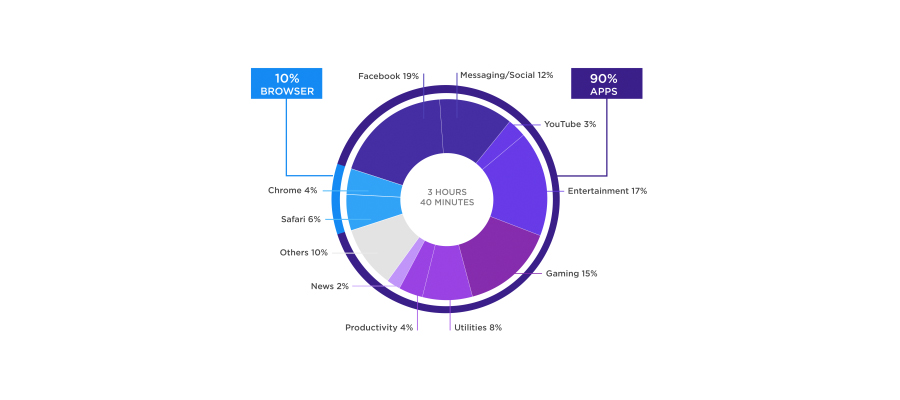
The mobile universe is indeed expanding. More people are going online on mobile than they ever do on traditional PCs. When apps can do pretty much everything their mobile website can do, a report from Yahoo! stated that in 2014, smartphone owners spent 14 percent of their mobile media time with the browser and 86 percent with apps. And the number of mobile browser users kept decreasing.
Because mobile browsers are becoming sidelined by mobile users, the digital industry in general, and particularly media contents, are affected the most. The media industry for example, has relied almost entirely on users using browsers visiting their sites.
Services in the online media industry have build a sophisticated strategy on SEO and SEM on both mobile and desktop as their marketing strategy. But as the most search queries are made on browsers, and most people on the media industry rely on search engines in order for their contents to be seen, the declining number of mobile browser users are hurting their income in one way or another.
For that matter, they must seek new approaches to content delivery and web traffic acquisition.
Most media industry rely on web visitors for revenue. Whether it's from ads they're showing, or referral traffic, affiliate marketing and others. Since visitors are now mostly coming from mobile, their contents won't be performing as good as they should.
In the chart made by Yahoo!, it's showing that "Social, Messaging and Entertainment apps and YouTube" are enjoying most percentage of mobile users' time. YouTube alone has grew from 13 minutes per day in 2014 to 44 minutes in 2015.
On July 2015, Google reported that YouTube watch time is up 60 percent year over year, and its mobile watch time has doubled since 2014. Google's Chief Business Officer Omid Kordestani said that YouTube now reaches more 18–49-year-olds than any U.S. cable network.
On the other hand, messaging and social app that are popular, grew from 45 minutes to 68 minutes per day. Yahoo!'s SVP Publishing Products Khalaf explained that "the majority of time spent inside messaging and social apps is actually spent consuming media."
The Ability to Dominate
What is making this mobile app phenomenon in continuing its reign? Mobile apps are made for easy access, better usability, faster because of having preloaded items, better interface to give more sophisticated user experience, while at the same time, making users willingly give more data if compared to those coming from mobile browsers. They are definitely powerful that internet services that don't have their own app can struggle just to get seen.
What apparently contradicts itself and yet is actually true, is that while users are spending more of their mobile time with apps, they're spending that time in a relatively small number of apps.
A survey from Forrester Research that was released earlier in 2015, found out that smartphone owners from the U.S. and UK "use an average of 24 apps per month but spend more than 80 percent of their [in app] time on just five apps."
For internet services that rely heavily on their contents to get visitors to their site, are the ones that are mostly affected. Because they rely on converting their visitors to make income, less people coming from search engines can translate to less percentage of internet users visiting their site. However, most may not see the decrease because the number of the global internet users are increasing.






















































































































































































































































































