Drupal is a free and open-source content-management framework written in PHP.
Providing the platform for websites, Drupal is used by more than 2 percent of all websites in the world, ranging from political, government to corporate and personal blogs.
On November 19th, 2016, Drupal version 8 is celebrating its one year anniversary. As the successor of Drupal 7, Drupal 8 at the moment of its launch, was the first new version of Drupal in over five years.
"I can't think of a better way to celebrate Drupal 8's one year anniversary than by sharing some incredible experiences that are being created with Drupal 8. Whether the project is big or small, features dinosaurs, or spreads awareness for an important cause, I'm proud to say that Drupal 8 is supporting an amazing array of projects," said Dries Buytaert, Drupal founder and its Project Leader, announcing the moment on his post on Drupal.org.
On the day last year, the community celebrated the release of Drupal 8 with more than 200 parties around the world.
And as it hits a year old, it has represented a significant rethink on the platform.
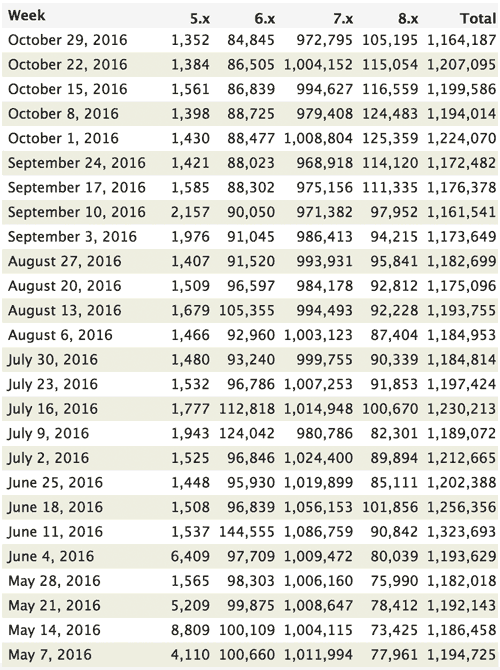
Drupal 7 was, and still is a well-defined CMS. The community will still provide users with a stable platform for more than the next couple of years. Drupal 8 on the other hand, is still maturing, and still on the move to extend its lifecycle beyond what it is at the moment.
For this reason, its first birthday is also its pivotal moment.
There are still many Drupal 7-powered websites, as well as Drupal 6. Even Drupal 5-powered websites are still around. Migration in Drupal is not an easy task.
Each change in version number marks a major upgrade, and at each major upgrade release, many developers are faced with the challenge of upgrading immediately, or wait until everything settles.
Just like upgrading from previous versions to newer versions, migrating to Drupal 8 is not an easy task for many developers. The more complex the website, the more prone it is for failure or encountering troubles. This is because modules on previous Drupal versions need to be ported to Drupal 8 before they can be used.
This is where the Drupal community is relying on a good faith and trust of its more than one million users.
From their commits to investments to the platform for the next few years, Drupal users from any versions are depending on each other for enabling a base for website using complex use-cases through a mature and sophisticated ecosystem of modules.
As now that Drupal 8 has been in the market for one year, its module ecosystem is having the opportunity to develop. And here, is where developers are generally in the phase where they're more tempted for an upgrade.

















































































































































































































































































