In quiet moments when screens light up with ready answers and systems anticipate needs before they are spoken, a subtle shift reveals itself in the way people move through their days.
Decisions once weighed carefully now arrive preformed, filtered through layers of code and calculation that few fully understand.
The convenience feels like progress, yet it carries an undercurrent of surrender that reaches back farther than any modern device.
Frank Herbert captured that undercurrent with piercing clarity in his novel Dune, first released in 1965 in Chapter 1 of the book.
The words land with the weight of a hard-won lesson, drawn from a distant future history that still speaks to the present.
In his words:
Once men turned their thinking over to machines in the hope that this would set them free. But that only permitted other men with machines to enslave them.
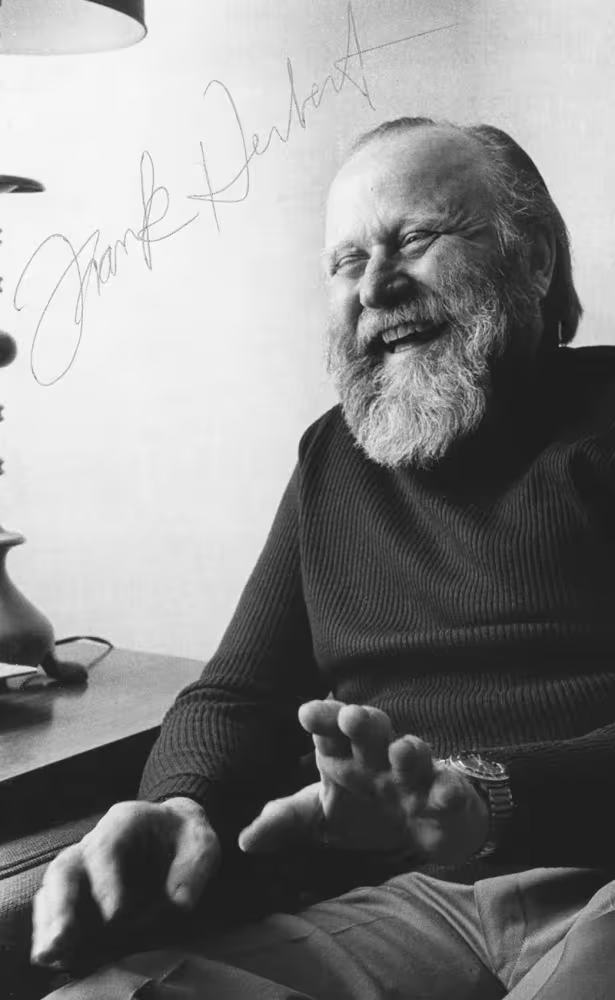
According to the history within Dune, humanity once depended heavily on advanced computers and AI. Over time, control over these machines became concentrated among a powerful few, leading to oppression and a gradual loss of human independence.
The conflict that followed, known as the Butlerian Jihad, destroyed the thinking machines and created a lasting cultural and religious ban against them.
That uprising stretched across nearly a century in the calendar of the Dune universe, beginning around 201 years before the founding of the Spacing Guild and ending in 108 B.G. with the total elimination of intelligent machines.
It arose not from simple fear of tools but from the recognition that machines making decisions had handed real power to those who owned and programmed them.
Humans rose in a near-religious crusade to reclaim the right to set their own guidelines, declaring that reasoning belongs to people rather than to hardware.
The principle is captured in the commandment from the Orange Catholic Bible:
Thou shalt not make a machine in the likeness of a human mind.
Because of this prohibition, any technology designed to replicate or replace human thought is forbidden.
Instead, humanity trained itself to develop abilities that machines once provided.
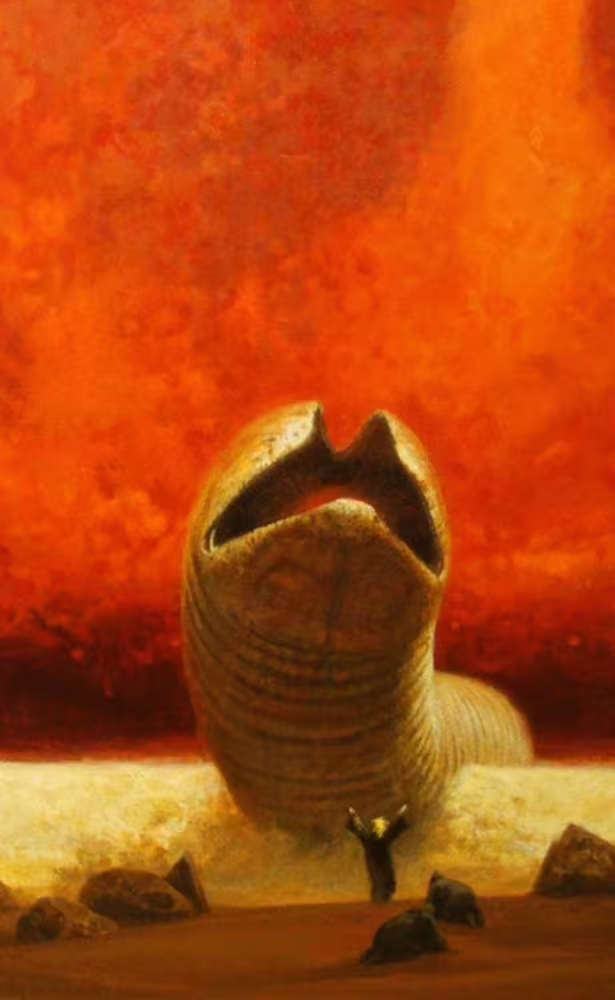
Mentats became living computers, capable of advanced calculations and analysis. The Bene Gesserit mastered extraordinary levels of mental and physical discipline. The Spacing Guild Navigators used spice-enhanced prescience to chart safe faster-than-light travel routes that computers would have previously calculated. Non-thinking devices remained in use, refined by groups such as the Ixians, while biological alternatives flourished under the Bene Tleilax, but the core rule held firm: no machine would ever again think in place of a person.
Herbert drew part of this vision from earlier warnings.
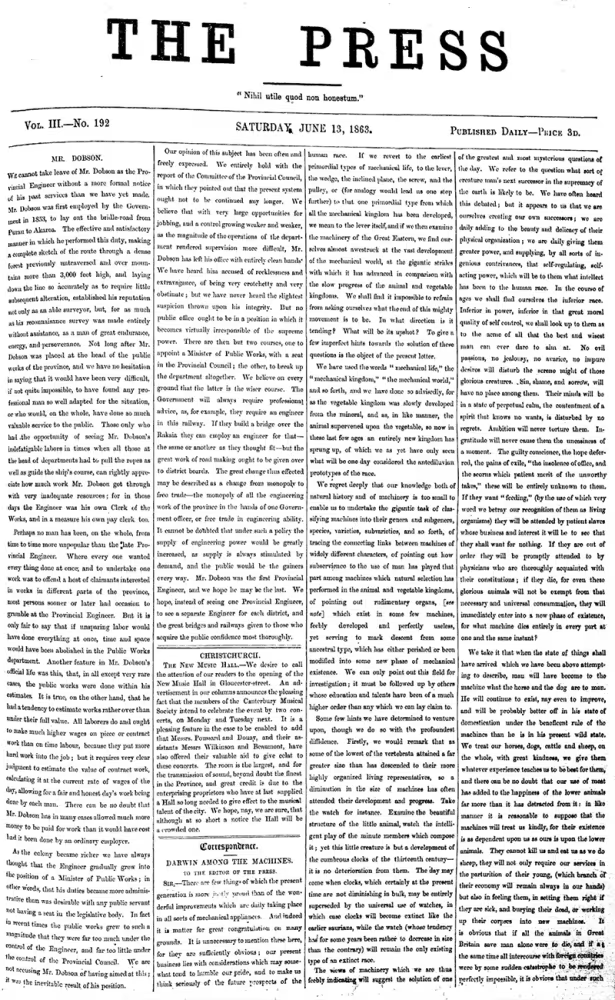
In the 19th century, Samuel Butler wrote about machines evolving beyond human control, first in his essay Darwin Among the Machines and later in his satirical novel Erewhon, which imagined a society choosing to dismantle advanced machines before they could dominate humanity.
Herbert expanded that idea to a galactic scale. In Dune, the ban on thinking machines forced humanity to develop its own intellectual and physical capabilities instead of relying on AI to solve its problems. Mentats became living computers, the Bene Gesserit mastered extraordinary mental discipline, and the Spacing Guild Navigators replaced computational precision with spice-enhanced prescience.
His concern was never technology itself.
Instead, tt was the concentration of power that can arise when people surrender their thinking to systems controlled by others. The more individuals trade critical judgment for convenience, the greater the opportunity for those who control the technology to shape decisions, influence beliefs, and exercise authority without resistance.
That is why the famous quote continues to resonate decades later.
Its message extends far beyond the fictional universe of Dune. It asks whether true freedom comes from allowing machines to think for us, or from preserving the uniquely human ability to question, reason, and choose for ourselves before someone else does it in our place.
The lesson endures because the temptation remains the same.
Whenever thinking is handed over in the hope of freedom, there is always the possibility that someone else, armed with the same tools, will claim the resulting authority. In the world Herbert imagined, that danger was answered with a permanent rejection of thinking machines, reshaping an entire civilization around the conviction that the human mind must remain its own.
The race to build increasingly capable large language models (LLMs) has brought Herbert's warning back into public conversation.
Companies are competing to develop AI systems that can write, reason, summarize, code, conduct research, and increasingly act on behalf of their users. Each new generation promises greater convenience, productivity, and accessibility.
Unlike the fictional world of Dune, modern society has embraced these technologies rather than rejecting them.
Millions of people now rely on AI to answer questions, draft documents, generate ideas, and make decisions that once demanded more of their own time and attention. Used thoughtfully, these systems can amplify human capability and remove repetitive work. Used uncritically, they can also encourage people to outsource judgment instead of simply outsourcing tasks.
That distinction is at the heart of Herbert's warning.
The issue was never whether machines could perform useful work. It was whether humans would gradually surrender the habit of thinking for themselves. As AI becomes more capable, the challenge is not merely to build smarter machines, but to ensure that human curiosity, skepticism, and responsibility remain at the center of every important decision.
Frank Herbert was writing science fiction, not predicting the future.
Yet his observation continues to provoke an uncomfortable question in the age of artificial intelligence: if machines increasingly shape how we learn, work, and think, who ultimately controls the direction in which they lead us?

















































































































































































































































































