Large language models have a long history that can be traced back to decades, but one of the biggest moment the redefined its future to what it is now, happened in a restaurant.
The foundational founding of OpenAI began in a strategic dinner hosted in mid-2015 at the Rosewood Sand Hill in Menlo Park. In this lavish, sprawling Silicon Valley hotel favored by tech elites and venture capitalists, Sam Altman, then president of Y Combinator, organized the meeting, framed it around a unique draw: the presence of Elon Musk, who frequently frequented the venue when traveling from Los Angeles.
Altman used Musk’s involvement as the ultimate hook to cold-email and gather a carefully curated group of top-tier AI researchers, including Google Brain scientist Ilya Sutskever, Stripe CTO Greg Brockman, and research scientist Dario Amodei.
At the table, the central proposal took shape: assembling an elite, non-profit lab dedicated to developing artificial general intelligence (AGI) as an open counterweight to private tech monopolies, most notably Google following its acquisition of DeepMind.
Yet the very structure formed that evening carried the seeds of its own dissolution.
In the years following OpenAI's official launch in December 2015, nearly every key figure recruited at that Rosewood dinner clashed with Altman over the direction, governance, and commercialization of the technology.
Eventually, those early pioneers departed one by one.
Amodei left to found Anthropic, Musk severed ties with the organization after a failed bid to take control, to then create xAI (SpaceXAI), and Sutskever, after leading a brief, dramatic board effort to oust Altman in late 2023, ultimately exited to launch Safe Superintelligence (SSI).
This happened as these people started to see Altman in a polarizing way.
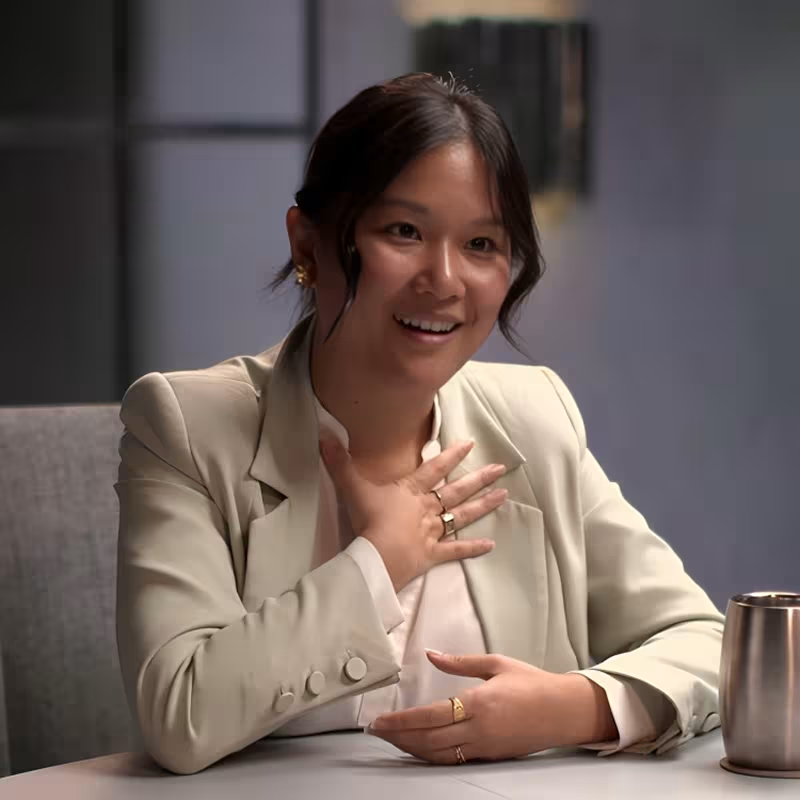
According to Karen Hao, a journalist specializing in AI, refer to Altman as a "controversial figure," saying that:
Well, this is what's so interesting about those interviews is people are extremely polarized on Altman there. No one has in between feelings about him.
Either they think he's the greatest tech leader of this generation akin to the Steve Jobs of the modern era or they think that he's really manipulative and an abuser and a liar.
Now, that many of these people, including Altman himself, Musk, Amodei, Mark Zuckerberg and others are tied up in the LLM war, they operate on huge capital they received from public's belief to something that has yet to happen.
And by doing this, they remain in control of their product they wish to create.
So this is so funny, as such a core part of the mythology that they create around the AI industry includes the belief that it could go very badly. It goes hand in hand. Like, they need that part of the myth in order to then say, "And that's why we need to be in control of the technology, because that's the only way that it's going to go really, really well."
And Altman has said publicly, you know, "the worst case, lights out for everyone, but best case, we cure cancer, we solve climate change, and there's abundance." And Dario Amodei, same kind of rhetoric, was like, "worst case, catastrophic or existential harm for humanity; best case, mass human flourishing."
So this is like two sides of the same coin. Like, they have to use both of these narratives in order to continue justifying an extremely anti-democratic approach to AI development, where there should not be broad participation in developing this technology. They must be the ones controlling it at every step of the way.
In the end, it’s a race between them, and them only.
Others who cannot catch up will be left behind, unable to compete, and die off. Those who pause to debate their decisions are condemned as uninformed or simply not smart enough.
Along the way, they scale their infrastructure faster than any companies in history, hiring like mad and firing left and right in a chaotic rush to accelerate.
These people want to create AI in their own image.
Altman with OpenAI, Musk with xAI (SpaceXAI), Amodei with Anthropic, Mira Murati with Thinking Machines Lab.
One of the things that is happening here is it is not a coincidence that every single tech billionaire has their own AI company. They want to create AI in their own image and that's why they keep not getting along. And in fact, it's not just don't get along, they end up hating each other after working together.
According to Hao, these people want to have control over their own vision of this technology.
And the best way that they have derived from their experiences of trying to put their vision into the arena is by creating a competitor and then competing with OpenAI and with all the other companies out there.
And this is where Hao refers to the AI Empire analogy.

Empire is the only metaphor that I've ever found to fully encapsulate all of the dimensions of what these companies do and the scale that they operate and what motivates them to do what they do. And there are many parallels that you see between what I call the empires of AI and the empires of old.
First, they lay claim to resources that are not their own in the pursuit of training these models. That's the data of individuals, the intellectual property of artists, writers, and creators. They're land grabbing in order to build these supercomputer facilities for training the next generation models.
Second, they exploit an extraordinary amount of labor. They contract hundreds of thousands of workers all around the world, including in the U.S., to ultimately make these technologies. We can talk about that more. And they also design their tools to be labor automating so that when the technologies are deployed, it also affects labor rights because it erodes away labor rights. And this is a political choice that they have.
Third, they monopolize knowledge production. And so they project this idea that they're the only ones that really understand how the technology works. And so if the public doesn't like it, it's because they don't actually know enough about this technology. They do this to the public. They do this to policy makers. And they've also captured the majority of the scientists that are working on understanding the limitations and capabilities of AI.
In the end, the fact that OpenAI began as a promise to democratize AI, yet the people who gathered around that first dinner table ultimately scattered to build competing empires. Each now argues that their own philosophy is the safest path toward AGI, but all pursue the same prize: building the most powerful AI before anyone else.
At the center of that story remains Sam Altman.
Whether history ultimately remembers Altman as the architect who accelerated humanity into a new era or as the executive who centralized too much power may depend less on what AI becomes than on who gets to decide its future.
As for Karen Hao, she argues that the real battle is not simply over AI. Instead, it's more about who gets to build it, who gets to control it, and who gets to define what "benefits humanity" actually means.

















































































































































































































































































