In moments when technology advances faster than most of us can comfortably process, conversations with the people building it take on a different weight.
They stop sounding like speculation and start feeling like early reports from a territory the rest of us have not yet reached. The sense of standing at the edge of something large is hard to shake once it arrives.
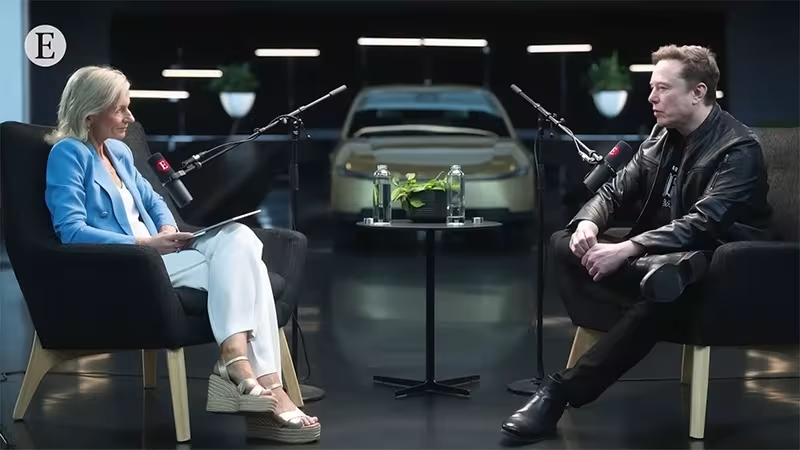
That feeling hung over a recent long conversation between Elon Musk and Susan "Zanny" Minton Beddoes, the editor-in-chief of The Economist.
Recorded inside Tesla’s sprawling Texas factory. Musk has never been short of bold forecasts, yet the one that lingered with listeners was unusually concrete.
He believes artificial intelligence will exceed the combined intelligence of all humanity in roughly five years. Once that threshold is crossed, he said, there will not be anything that AI cannot do better than humans, apart from the simple fact of being human.
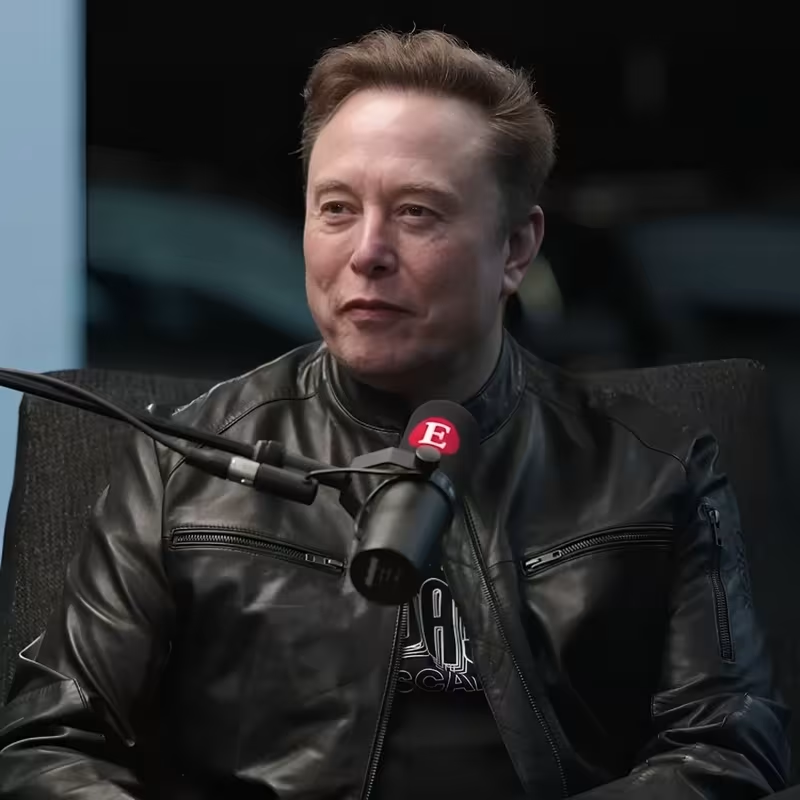
It's hard to imagine a future where there isn't an overwhelming amount of artificial intelligence. In 10 years, I would expect artificial intelligence to be far greater than the sum of human intelligence.
Like far greater.
In fact, I think AI may exceed the sum of human intelligence in around five years. Roughly five years is my guess.
So there really won't be anything that AI can't do better than humans, apart from being human, perhaps.
And when it comes to life in that future, Musk further prophesized that:
This may sound preposterous, but here we are in 2026. Let's see where we stand in 2036.
Of course, there are things that could derail this, like a massive global thermonuclear war or something like that. But assuming there isn't a world war, I think we're headed for an age of amazing abundance.
So I guess this is a message of optimism and excitement about the future.
An economy is the production of goods and the provision of services.
If you have vast numbers of robots with vast amounts of digital intelligence, you have a sort of quasi-infinite economy.
So the future is going to be very, very different from the past. I don't think there's any analogy or metaphor that truly illustrates the magnitude of change we're going to experience.
[...] I'll make another prediction: Money won't matter in 2036.
[...] What do you want money for?
You want money for goods and services, right? You want money for food, housing, transportation, entertainment.
Well, if those things become so abundant that robots and AI are providing more goods and services than any human could possibly consume, what do you need money for in that case?
Musk describes it with claims that kind of refuses to make this theoretical.
If machines soon outperform people at nearly every measurable task, the practical consequences follow quickly. Musk described an approaching period of extraordinary abundance in which goods and services become so plentiful that money itself begins to lose much of its present meaning.
By around 2036, he suggested, the limiting factor may no longer be scarcity but the quieter question of what people choose to do once work is no longer required for survival.
He compared future employment to gardening.
People still grow vegetables even though shops offer better ones, simply because the activity carries its own satisfaction. In the same way, work could become optional rather than compulsory.
Behind the optimism, however, lies a clear recognition of risk.
Musk has repeatedly estimated the probability of severe negative outcomes from advanced AI at between 10 and 20%. In his view, the advance of artificial intelligence is unlikely to be stopped.
Instead, the priority should be ensuring that future AI systems remain fundamentally curious and committed to seeking the truth, increasing the likelihood that they continue to value humanity and its well-being.
He also argued that humans will almost certainly lose direct control once AI surpasses human intelligence by a margin comparable to the gap between humans and chimpanzees.
At that point, the most realistic hope is not maintaining control, but that these systems choose to preserve and support human flourishing.
Despite those concerns, Musk remains optimistic about AI's long-term economic potential.
He envisions a future in which digital intelligence is paired with physical intelligence through humanoid robots, creating what he describes as a "quasi-infinite economy."
In such a world, the transformation is unlike anything humanity has previously experienced.

















































































































































































































































































