
Are private photos really private? Meta thinks they're probably not.
Meta, the parent company of Facebook, is quietly introducing a new feature to help users "generate new ideas." But to do what it's offering, it involves full access to users' camera roll. According to reports, the company is now prompting users to grant it full access to their phone’s photo gallery—including images that have never been shared on Facebook.
The reason?
So Meta’s AI can process them via “cloud processing” and offer creative suggestions like collages, stylized remixes, or themed memories.
This feature shows up subtly, often while users are trying to create a Story.
A pop-up invites you to “Allow” the Facebook app to continuously sync your phone’s photos to Meta’s servers. According to Meta’s AI Terms of Service, accepting gives Meta the ability to analyze every photo, using AI to detect faces, objects, dates, and locations—even though users haven’t posted them. Meta claims that everything stays private and won’t be used for advertising… for now.
But the fine print in their terms opens up possibilities.
In its earlier years, Facebook’s insatiable hunger for user data was driven by one core objective: to understand people deeply enough to predict what content would keep them engaged. By analyzing behavior, preferences, and interactions, Facebook could surface highly relevant posts in users' feeds—ultimately increasing the time they spent on the platform.
This strategy worked wonders.
The more users engaged, the more personalized their feed became. And within that feed, Facebook seamlessly embedded ads that felt native, almost indistinguishable from organic content—maximizing both user satisfaction and ad revenue.
Over time, Facebook expanded its data collection efforts beyond its main platform. Through its family of apps like Instagram and Messenger, and via tracking technologies like Facebook Pixel across the web, the company built one of the most detailed behavioral profiles in the tech industry.
Now, in the era of artificial intelligence and generative models, Meta’s data appetite has only intensified.
To fuel its next-generation AI systems, the company is seeking even deeper access—this time, into users’ personal photo galleries.
This forms the rationale behind Meta's latest move: requesting full, continuous access to your camera roll under the pretext of offering “cloud-based suggestions.”
What makes this troubling for many users is the passive, almost sneaky way this access is being requested.
According to reports, even users who casually hit "Allow" may not fully realize that their entire camera roll will be scanned regularly—far beyond what most apps require. And although Meta says it only stores these photos for 30 days, there's no clear limit on what types of analysis it might perform during that window.
Some themes or patterns can trigger Meta to store photo-based memories older than a month.
The backlash is already brewing.
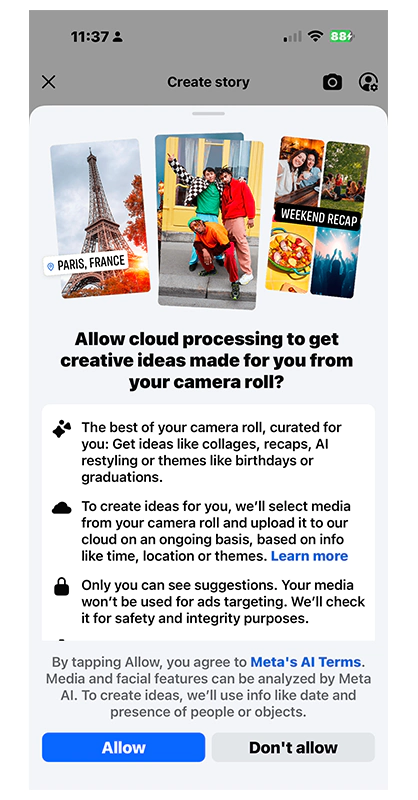
A lot of people urge users to “turn off this feature,” describing it as an unnecessary intrusion, some calls it a “bad idea” altogether, citing the unnecessary risk to users’ privacy.
In one notable case, a Reddit user discovered Facebook had automatically restyled her private wedding photos using a Studio Ghibli filter—even though she had never published those photos online.
That’s a chilling example of how far Meta’s algorithms can go, all while claiming to keep things “just between you and the AI.”
For those privacy concerned individuals who happened to have granted Facebook this access—or just want to double-check—they can simply open the Facebook app, go to the Story creation screen, tap Settings, then head to “Camera Roll Sharing Suggestions.”
From there, they can disable both the photo suggestion and cloud processing options.
It's a few extra steps, but well worth it if users value their privacy.
On the web, as always, privacy is always worth protecting. The tradeoff for convenience is access—and once a tech company has that, it rarely gives it back.
Further reading: Meta Found Quietly Using 'Meta-ExternalAgent' To Scrape The Web For AI Training Data




















































































































































































































































































