An image file packs all the necessary information to show the image within. To go beyond what it is stored inside the file, imagination is required.
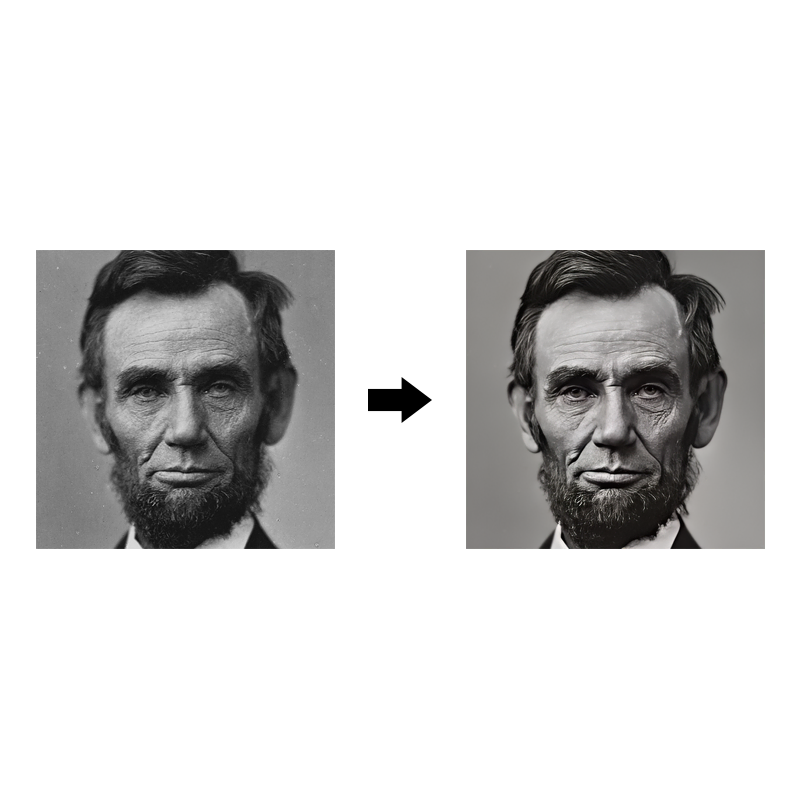
While humans definitely know how to imagine things, researchers managed to develop AI that can dream. Then, researchers managed to create an AI that could enhance the resolution of images, just like in the movies.
Researchers know that AI can be used to enhance images, and also improve photo editing tools.
The thing is, the results are often divisive.
Supporters see AI as being able to create new artistic ideas while at the same time, help reduce the time creators need to spend on monotonous works. Critics however, see AI has a technology that distorts reality and propagate artificial homogeneity.
This time, researchers want to at least address that issue, using what they call the 'GFP-GAN'.
What this system does, is improving low-quality images of people' faces., by implicitly encapsulating in pretrained faces with a high degree of variability.
The pretrained images provide "rich and diverse priors such as geometry, facial textures and colors," allowing the AI to restore facial details and enhance colors.
Created by researchers at the Tencent ARC Lab in China, GFP-GAN uses a generative adversarial network (GAN) architecture to enhance faces in old, damaged, and unclear photos, by creating new upscaled version of the same images.
"While previous methods struggle to restore faithful facial details or retain face identity, our proposed GFP-GAN achieves a good balance of realness and fidelity with much fewer artifacts," the study authors wrote in their paper. "In addition, the powerful generative facial prior allows us to perform restoration and color enhancement jointly."
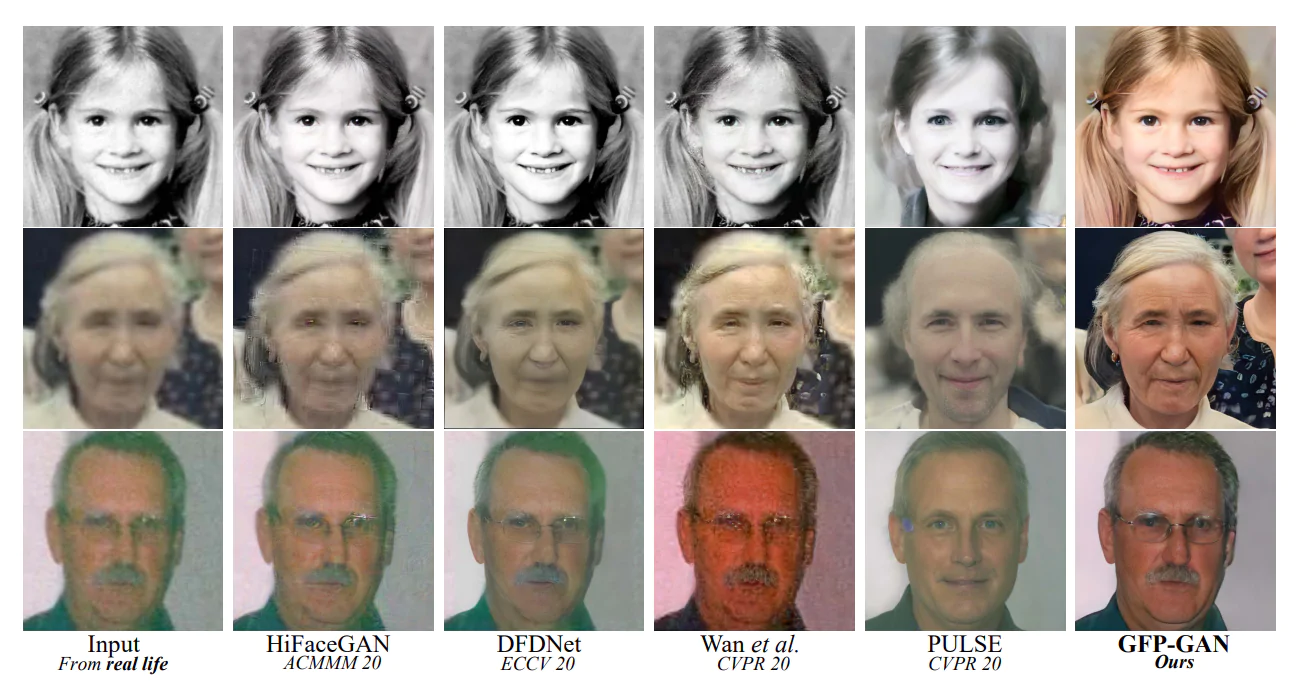
In the following image, results of the AI are compared with other state-of-the-art face restoration methods.
It is shown that GFP-GAN managed to achieve a better balance in realness and fidelity, with much fewer artifacts.
On the project' page on GitHub, the researchers wrote that "our method achieves superior performance to prior art on both synthetic and real-world datasets."
The method GFP-GAN uses, is called the 'Blind Face Restoration' method.
The method aims at recovering high-quality faces from the low-quality counterparts suffering from unknown degradation, such as low-resolution, noise, compression artifacts, and more.
This approach of enhancing the images usually relies on facial priors, such as facial geometry prior or reference prior, to restore realistic and faithful details.
But because low-quality images don't usually show accurate face geometric, due to more complicated degradation, diverse poses and expressions, the researchers proposed GFP-GAN, which leverages "rich and diverse priors" that are encapsulated in a pretrained face GAN for blind face restoration.
The researchers incorporated this Generative Facial Prior (GFP) into the face restoration process via spatial feature transform layers, which allow their method to achieve a good balance.
Not only that the AI can enhance blurry faces, as it can also enhance colors with just a single forward pass, whereas while GAN inversion methods require image-specific optimization at inference.
The researchers created this GFP-GAN by training the AI on the FFHQ dataset, which consists of 70,000 high-quality images.
The researchers resized all the images to 5122 during training.