
Things are heating up following OpenAI's announcement of new models release.
Since the debut of ChatGPT in late 2022, companies across the tech industry have been racing to develop increasingly capable AI systems that can write code, analyze data, and support complex knowledge work.
What began as simple conversational tools has expanded into a broader ecosystem of reasoning models, coding assistants, and agent-like systems that interact with software and external tools.
As these systems improve, the competitive pressure across the AI industry has intensified, turning large language models into the center of a fast-moving and highly contested space.
The latest development sits within that trajectory.
OpenAI has introduced 'GPT-5.5' and, alongside it, a lighter variant referred to as 'GPT-5.5 Instant,' which is being rolled out as a default model in ChatGPT.
GPT-5.5 Instant is more dependable, with significant improvements in factuality, especially in domains where accuracy matters most, like medicine, law, and finance.
It’s also stronger across everyday tasks, from analyzing image uploads to answering STEM questions to knowing when… pic.twitter.com/hkKwSs5eeq— OpenAI (@OpenAI) May 5, 2026
GPT-5.5 Instant is designed to be faster, more reliable, and better suited for everyday use, with a clear focus on reducing incorrect or fabricated information. Internal evaluations point to a significant drop in hallucinations, with reports suggesting reductions of over 50% in sensitive areas such as law, medicine, and finance.
Rather than introducing major new capabilities, this release centers on refinement. Improvements are focused on accuracy, responsiveness, and usability, alongside more concise outputs and stronger performance in tasks like coding, research, and data analysis.
The model also integrates more effectively with tools and past context, supporting a more personalized experience.
Overall, GPT-5.5 Instant reflects a broader shift in how progress is defined.
Earlier iterations often emphasized benchmark gains and expanded capabilities, while this version prioritizes dependability in real-world use, particularly in situations where errors carry meaningful consequences. It also shows better judgment in deciding when to retrieve external information, pointing to tighter coordination between language generation and tool use.
Changes are also visible in tone and interaction style.
Responses are more direct and avoid stylistic habits that were common in earlier models, such as excessive emoji use. At the same time, deeper personalization features allow the system to retain and apply context from previous interactions more effectively, supported by new controls that let users review and manage what the model remembers.
GPT-5.5 Instant is rolling out over the next two days as the default model to all ChatGPT users, and as ‘gpt-5.5-chat-latest’ in the API.
Personalization improvements are rolling out to Plus and Pro users on the web, and soon on mobile.
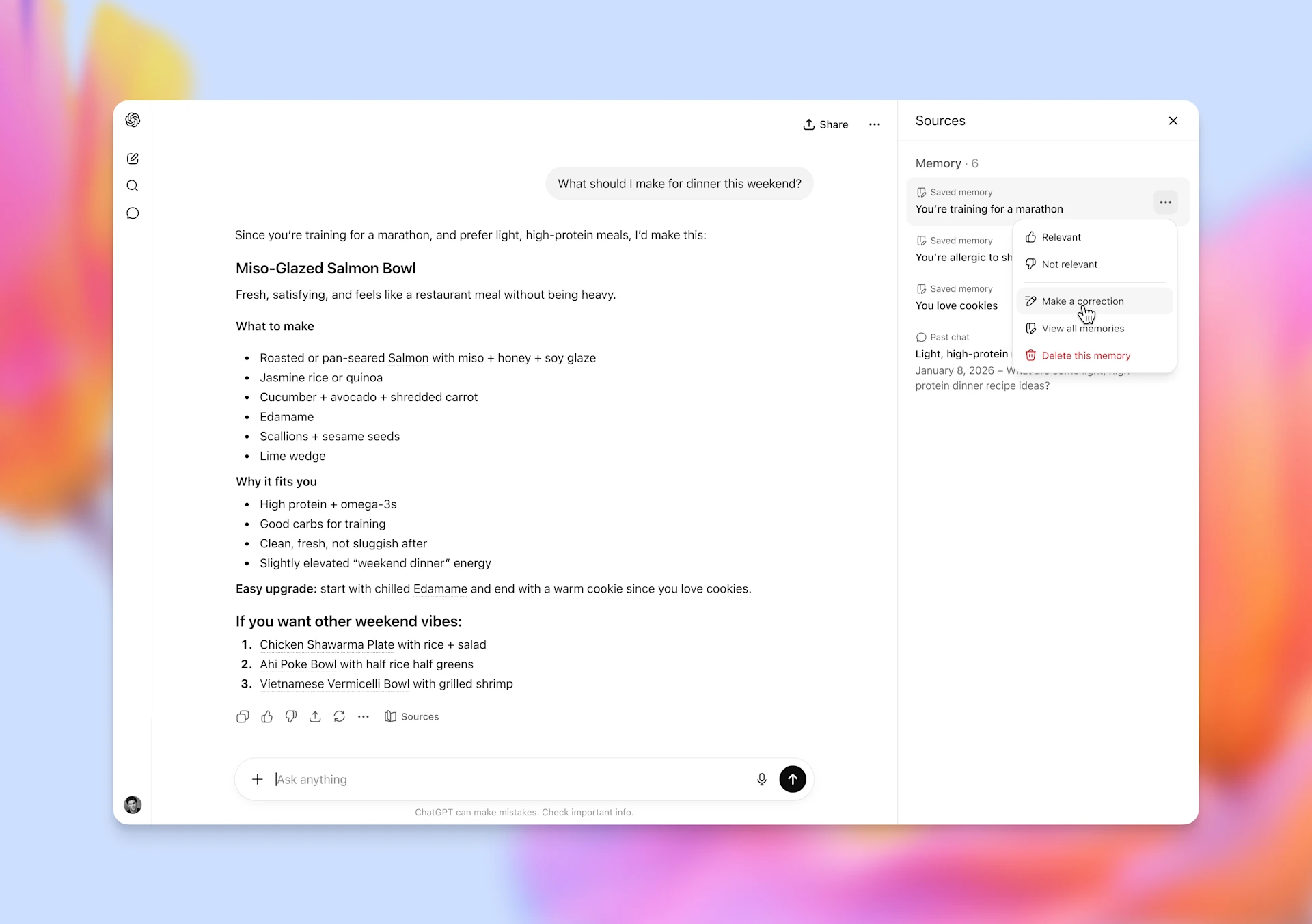
Memory sources are rolling out across all…— OpenAI (@OpenAI) May 5, 2026
The broader GPT-5.5 family, released in April 2026, builds on a series of rapid iterations that have defined OpenAI's recent development cycle.
Earlier versions such as GPT-5.4 and GPT-5.3 introduced improvements in reasoning, tool use, and reduced factual errors, but also highlighted persistent issues with hallucinations and overconfidence. GPT-5.5 appears to address some of those weaknesses while continuing to expand capabilities in coding, structured reasoning, and multi-step tasks.
OpenAI is also introducing memory sources across all ChatGPT models to make personalization more transparent and controllable.
When a response is tailored to a user, they can see which context was used, such as saved memories or past chats, and update or remove anything that is outdated.
These memory details are private and are not shared when they share a conversation. What this means, users stay in control by deleting chats, editing saved memories in settings, or using temporary chats that do not store or reference memory.
The feature is designed to clarify how personalization works, though it may only show the most relevant context rather than everything the system considered. OpenAI says this view will be expanded over time.
While GPT-5.5 introduces improvements, the model also sits within a more complex product structure.
Different modes, such as Instant, Thinking, and Pro, are designed for varying levels of task complexity and computational cost.
This reflects a broader shift toward systems that dynamically match model behavior to user intent, rather than relying on a single general-purpose model for all tasks.
Outside of official announcements, early reactions and anecdotes hint at how these systems are evolving in less predictable ways.
OpenAI CEO Sam Altman described interactions with GPT-5.5 as occasionally "strange" but detailed, noting instances where the model generated structured plans with aesthetic preferences and constraints. These kinds of behaviors point to increasingly complex internal representations, even if they are still bounded by the system’s training and design.
There are also signals that the model is being evaluated beyond consumer use, with reports suggesting that GPT-5.5 has been shared with government agencies for testing in national security contexts, reflecting growing interest in how advanced language models might be applied in defense, intelligence, and policy environments.
The social response to these updates, including posts from OpenAI and reactions across platforms like X, reflects a mix of anticipation and caution.
On one hand, incremental improvements in reliability and usability make these systems more practical for everyday workflows. On the other, increased personalization and memory features continue to raise questions about how user data is handled and how dependent users may become on AI systems that feel increasingly tailored to them.
Taken together, GPT-5.5 Instant does not represent a single dramatic leap, but rather a consolidation phase. The focus has shifted toward making AI systems more accurate, more context-aware, and more embedded in real-world tasks.
In a landscape where multiple companies are pushing toward similar goals, progress is no longer defined only by what models can do, but by how consistently and safely they can do it.






















































































































































































































































































