Large language models (LLMs) are reshaping more of the tech landscape than many initially expected.
Since the launch of ChatGPT by OpenAI in late 2022 that ignited what became known as the LLM war, Google, long dominant in search and a leader in AI research, appeared caught off guard by the chatbot's rapid adoption and its conversational style of delivering synthesized answers. Feeling the competitive pressure, the company accelerated its efforts, eventually releasing its own model.
First was Bard, and later refined and rebranded as Gemini.
As Gemini matured and gained capabilities, Google began integrating the technology more aggressively across its products. These changes often went beyond incremental improvements, fundamentally altering how the tools behaved and how users interacted with them. Features once centered on traditional links, algorithms, and direct results started defaulting to generative summaries, proactive agents, and multimodal processing.
The most significant shift came in May 2026 with Google's announcement at I/O of a major redesign to its search engine: the first substantial evolution in over 25 years.
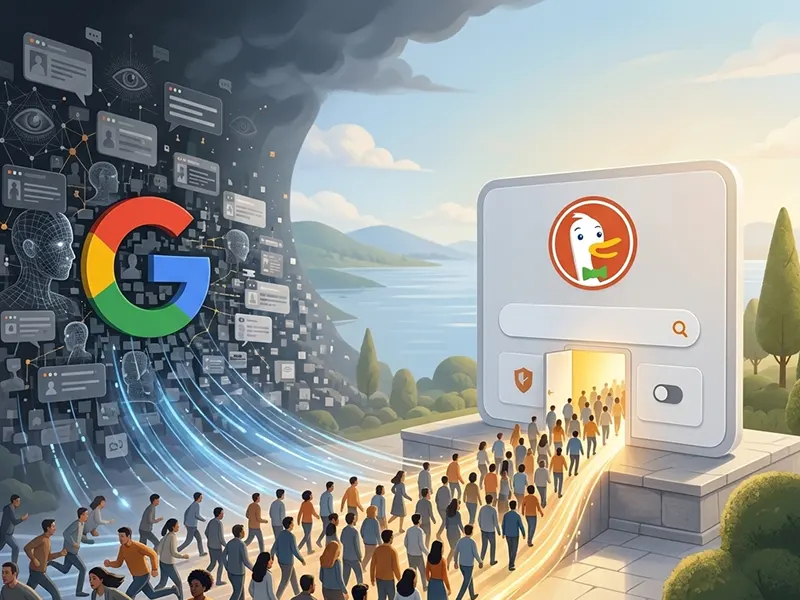
Public reaction has been divided. Many users welcome the efficiency, enjoying quick synthesized answers and the reduced effort needed for research or comparisons. Others, however, are unhappy with the changes, preferring the clarity of ranked web links and feeling that AI summaries can obscure sources, introduce inaccuracies, or limit visibility for original content. This dissatisfaction has prompted a noticeable migration away from Google.
For those leaving Google in what some have described as an exodus, DuckDuckGo is presenting itself as a more controlled and user-driven alternative: a place where people can escape forced AI integration.
Related: Google Bard Becomes Gemini, And How Google Plans For A Post-Search Future
Google just announced they are redesigning search around AI. Here's how to get actual search results again. pic.twitter.com/qc6bZQYIEg
— DuckDuckGo (@DuckDuckGo) May 22, 2026
The search engine that has long challenged Google through its privacy focus and frequent public jabs now finds itself in a position of having the last laugh, as growing numbers of users turn toward it amid the backlash.
In the wake of the announcement, visits to DuckDuckGo's dedicated No AI search page tripled and continue to climb.
Read: 'Yes AI Or No AI': DuckDuckGo Lets People Choose Their Side In The AI Divide
Since Google revealed its plans for an AI search overhaul, visits to our "No AI" search page have tripled…and they’re still rising!
Want to make it your default on Chrome or Firefox? Grab our No-AI extensions and banish AI-assisted answers, chat, and AI images. pic.twitter.com/6RHzHRi9DJ— DuckDuckGo (@DuckDuckGo) May 29, 2026
The company has also released browser extensions for Chrome and Firefox that allow users to make this stripped-down experience their default, removing AI answers, chat elements, and generated images entirely.
Reports indicate week-over-week install growth reaching 30% in the U.S. on peak days, signaling real momentum among those seeking greater choice.
Google: "What if search… was all AI?"
DuckDuckGo: "What if we just let users choose?" pic.twitter.com/VzYRcgK3aM— DuckDuckGo (@DuckDuckGo) May 28, 2026
This episode highlights a deeper tension in today’s technology environment.
As powerful AI models become embedded more tightly into everyday tools, they promise convenience and intelligence but also spark debate over transparency, reliability, and user autonomy. Whether the future favors fully AI-driven experiences or platforms that keep such features clearly optional will likely depend on how well companies balance innovation with respect for differing preferences.
With Google now force feeding AI in their search, DuckDuckGo (where AI is always optional) is moving up the charts!
Now is the time: Fire Google. pic.twitter.com/ac5JGEvOmK— DuckDuckGo (@DuckDuckGo) May 27, 2026
But what makes the current moment particularly notable is that DuckDuckGo's growth appears to be driven less by privacy concerns, which historically formed the core of its appeal, and more by dissatisfaction with the direction of mainstream search itself.
For years, alternative search engines struggled to convince users to leave Google because the differences often felt marginal. Privacy was important to some audiences, but not enough to trigger a mass migration. The arrival of generative AI has changed that equation.
Search is no longer simply about which engine provides the best index of the web. It is increasingly becoming a debate over how much AI users actually want between themselves and the information they are seeking.
DuckDuckGo has positioned itself at the center of that conversation by emphasizing user choice rather than outright opposition to AI. The company offers AI-powered features of its own, including AI chat tools and answer generation, but unlike some competitors, it continues to allow users to disable or avoid those features entirely. That distinction has become a major part of its marketing message.
People aren’t just complaining about Google's AI search overhaul, they’re leaving.
Yesterday alone, our week over week installs surged 30% in the U.S.
Momentum is growing. It’s time to Fire Google.— DuckDuckGo (@DuckDuckGo) May 26, 2026
The company's recent social media campaign reflects growing confidence.
Rather than merely promoting privacy protections like it frequently did in the past, DuckDuckGo has openly challenged Google's strategy, encouraging frustrated users to "Fire Google" and portraying itself as a refuge for people who want traditional web search. The messaging suggests that the company sees a genuine opportunity to expand beyond its long-standing niche audience.
Industry observers note that the significance of the trend extends beyond the fortunes of any single search engine.
If meaningful numbers of users are actively seeking AI-free experiences, technology companies may be forced to reconsider assumptions that more AI integration automatically results in a better product.
This is important to say right now.
Not liking the direction Google is headed? Come to the Duck side. pic.twitter.com/QyuvaKcYuN— DuckDuckGo (@DuckDuckGo) May 20, 2026
Google, Microsoft, OpenAI, and other major players are investing billions of dollars into making AI the primary interface through which users access information. Yet the backlash now benefiting DuckDuckGo demonstrates that a substantial segment of the market still values direct access to sources, visible ranking systems, and the ability to independently evaluate information without an intermediary generating a summary first.
For DuckDuckGo, the challenge now shifts from capturing curiosity to retaining users.
What began as frustration with AI-generated search results is increasingly evolving into a broader question about control.
Users are not necessarily rejecting AI altogether. Instead, many appear to be demanding the ability to decide when, where, and how AI participates in their online experience. The companies that recognize that distinction may ultimately be the ones best positioned for the next era of search.






















































































































































































































































































