
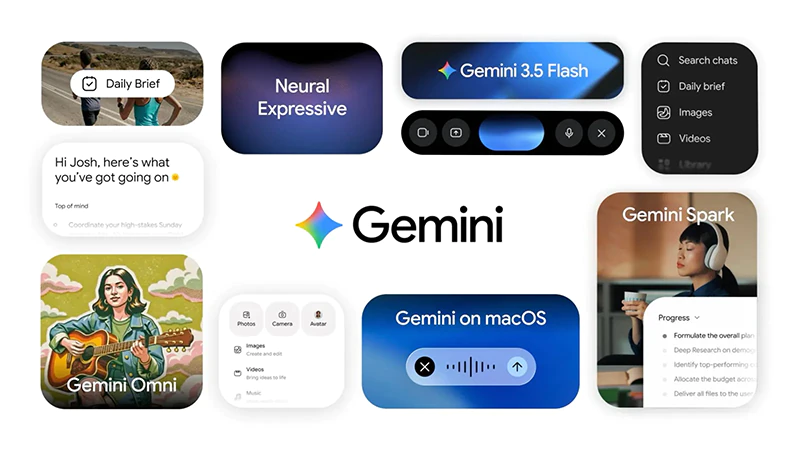
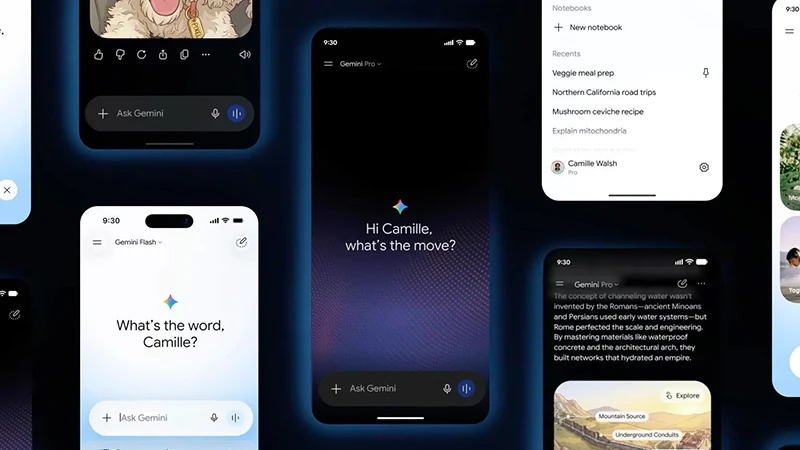
Google has introduced 'Neural Expressive' as the new design language for its Gemini app.
Marking one of the company's biggest interface overhauls since launching the AI assistant, the design that was announced during Google I/O 2026 brings fluid animations, vibrant colors, refreshed typography, haptic feedback, and dynamic visual layouts aimed at making AI interactions feel more natural and responsive.
Google says the redesign is intended to move Gemini beyond the traditional "wall of text" chatbot experience that has become common across AI platforms.
Instead of static replies, Gemini can now generate more interactive responses that include images, timelines, graphics, narrated videos, and adaptive layouts tailored to different types of queries.
The company has also integrated Gemini Live directly into the main chat interface, allowing users to switch more seamlessly between typing and real-time voice conversations without opening a separate screen.
The update is rolling out across Android, iOS, and the web alongside the company's newer Gemini 3.5 Flash model.
Built for the AI era. Meet Neural Expressive, Gemini’s new design language featuring fluid animations, vibrant colors, updated typography, haptic feedback, and visual responses.
— Google Gemini (@GeminiApp) May 22, 2026
The Neural Expressive approach reflects a broader shift in the AI industry, where companies are increasingly focusing not only on model performance but also on how AI systems feel during everyday use.
Smooth transitions, tactile feedback, and visually adaptive interfaces are becoming part of efforts to make AI interactions appear more conversational and immersive.
Google executives and designers have described the redesign as a way to make the interface reorganize itself around generated information instead of presenting long streams of plain text responses.
The update arrives as competition between major AI platforms continues to intensify.
Companies including OpenAI, Microsoft, and Anthropic have all expanded the capabilities and presentation styles of their AI assistants over the past year.
Google appears to be positioning Gemini as a more visually expressive and proactive assistant, particularly with the introduction of new tools such as Gemini Spark and enhanced multimodal responses capable of handling text, voice, images, and video together.
User reactions to Neural Expressive have been mixed.
Many users have praised the modernized appearance and the more energetic feel of the interface, particularly the richer visuals and conversational flow. Others, however, argue that cosmetic improvements do not fully address ongoing concerns around Gemini's practical limitations. Discussions across social platforms and community forums frequently mention rate limits for paid users, occasional reliability issues, and bugs affecting features such as screen sharing and language handling.
Some users say they would prefer stronger improvements in consistency and functionality before major visual redesigns.
Despite the criticism, Neural Expressive represents an important step in Google’s broader AI strategy.
The company is increasingly integrating Gemini across its ecosystem, including Search, Android, Workspace, Chrome, and other services, while simultaneously refining how users interact with AI on a visual and emotional level.






















































































































































































































































































