
Ask a stupid question and get a stupid answer. Sometimes, this is what describes Google Search.
Google Search is the largest search engine in the world and everyday. No matter what users are searching for, Google aims to connect them with the most relevant, high-quality information. That, in order to help users understand and evaluate that information.
However, the search engine is seeing many new queries it has never seen before, every single day.
While many of users' queries are real questions that have answers everyone on the web can all agree, like "what is the capital of Indonesia." Other questions however, are literally 'stupid' and that don't have answers, like "when did snoopy assassinate Abraham Lincoln?"
Google has what it calls the featured snippets, which are descriptive box Google Search can show at the top of the page to prominently highlights a piece of information from a result and the source, in response to users' query.
"They’re helpful both for people searching on Google, and for web publishers, as featured snippets drive traffic to sites."
However, this feature can sometimes highlight nonsensical answers to users' nonsensical queries.
Google wants to change that.
To do that, according to Google on its blog post, the search engine is calling its MUM:
"Our systems can check snippet callouts (the word or words called out above the featured snippet in a larger font) against other high-quality sources on the web, to see if there’s a general consensus for that callout, even if sources use different words or concepts to describe the same thing."
"We've found that this consensus-based technique has meaningfully improved the quality and helpfulness of featured snippet callouts."
What this means, Google Search is utilizing AI to highlight word or words, by comparing that word or those words, with other high-quality sources on the web, to see if there’s a general consensus for that callout.
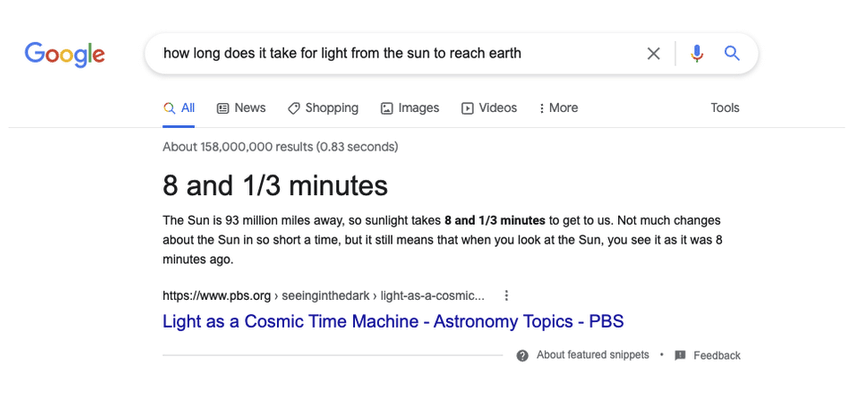
In an example, a query for "how long does it take for light from the sun to reach earth," will make Google Search bold a callout saying that it takes "8 and ⅓ minutes."
It's through this consensus-based technique, that Google is trying to improve its search engine featured snippets.
"AI models are also helping our systems understand when a featured snippet might not be the most helpful way to present information," with the company adding that the approach "is particularly helpful for questions where there is no answer."
Through this method, users should see fewer answers to questions like when snoopy as "when did snoopy assassinate Abraham Lincoln?", to which the service would respond with "1865," which is the real date Lincoln died.
"This clearly isn’t the most helpful way to display this result,” said Google
"We’ve trained our systems to get better at detecting these sorts of false premises, which are not very common, but are cases where it’s not helpful to show a featured snippet. We’ve reduced the triggering of featured snippets in these cases by 40% with this update."
Read: Google Brings Its 'MUM' To Improve Its Search Engine's AI
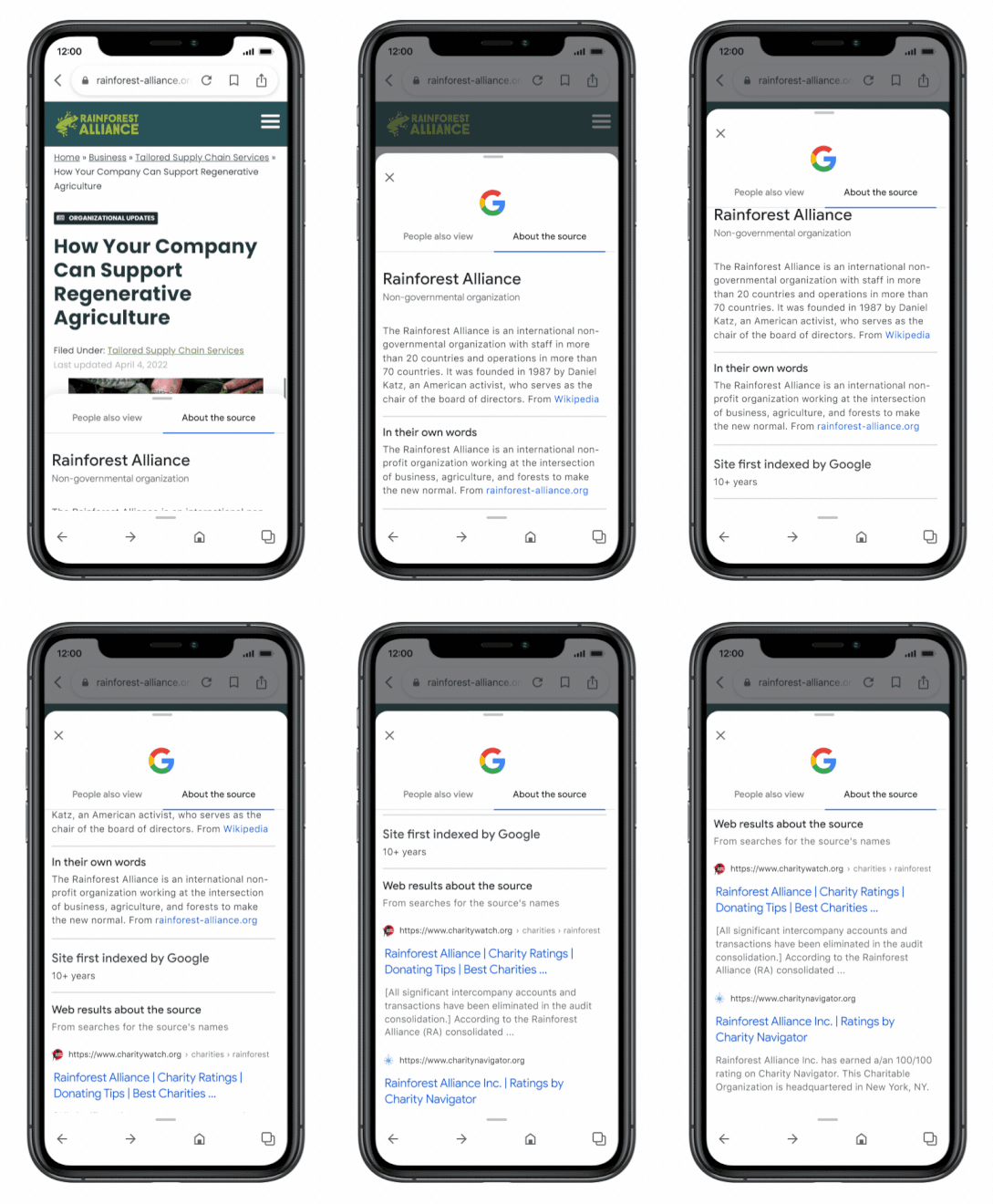
In another update, Google is bringing 'About this result' to eight more languages.
The feature was introduced in 2021, used to provide more context about a site before visiting.
Here, About this result is adding new information like: “how widely a source is circulated, online reviews about a source or company, whether a company is owned by another entity, or even when our systems can’t find much info about a source.”
Lastly, Google is also updating its content advisories to appear when Google’s "systems don’t have high confidence in the overall quality of the results available for the search."

When "It looks like there aren’t many great results for this search" is triggered, due to "data void," it doesn't mean that there is no information.
Google is showing that warning simply because results are low in quality.
"These notices provide context about the whole set of results on the page, and you can always see the results for your query, even when the advisory is present," Google said.

















































































































































































































































































