Google has quietly rolled out one of the most meaningful updates to Google Translate in years.
The tool has long been its speed and convenience, but it has also carried a familiar limitation: translations were often technically correct yet awkward, overly literal, or stripped of cultural nuance. Idioms, slang, and context-heavy phrases frequently lost their meaning, leaving users to guess how something would actually sound to a native speaker.
That gap is now being addressed with a new AI-driven approach that prioritizes understanding intent, tone, and real-world usage.
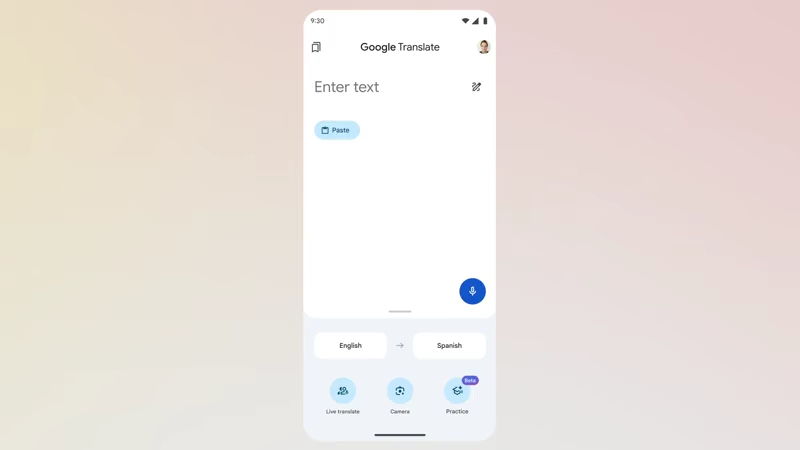
Powered by Google's Gemini models, the update introduces contextual assistance directly into the translation experience.
Instead of presenting a single definitive result, Translate can now surface multiple alternatives and explain how each one differs. Users can explore why one phrasing sounds more formal, why another feels conversational, or how the meaning subtly changes across regions. This turns translation into an interactive process rather than a one-click answer.
One of the most noticeable improvements is how the app handles idioms and colloquial expressions.
Phrases that once appeared as confusing literal translations are now paired with culturally appropriate equivalents. Rather than simply converting words, the system aims to convey what a speaker actually means, reflecting how people talk in everyday conversations, messages, and social settings.
"Thanks to Gemini’s rich multilingual capabilities, Translate now offers helpful alternatives, which is especially useful for translating idioms and more colloquial phrases. So if you’re looking for more options to convey a phrase like 'It’s raining cats and dogs,' you’ll see clear tips on when and why to use different expressions so you pinpoint the right phrasing for your conversation," said Google in a blog post.
The update also allows users to ask follow-up questions about translations, effectively turning the app into a lightweight language guide.
Users, for example, can clarify usage, request region-specific phrasing, or understand when a sentence might sound too blunt, too polite, or out of place.
This makes Translate more useful not just for travelers, but for professionals, students, and anyone communicating across languages with higher stakes.
Taken together, these changes signal a shift in how Google sees translation tools evolving.
The focus is no longer just accuracy, but usability and cultural awareness. By blending AI reasoning with language expertise, Google Translate is moving closer to how humans actually communicate. Not just what they say, but how and why they say it.
For learners, travelers, or professionals who work across languages, the result is a tool that feels more like a tutor or conversation partner than a simple dictionary.






















































































































































































































































































