 Humans are taught to speak at an early age, and for that many of us are taking it for granted. We tend to forget how difficult it was to understand certain phrases in a sentence to get the whole meaning of it.
Computers, not matter how good they are today, they're still far behind humans in understanding natural languages. Google first took its step to understand and answer questions with natural languages back in 2008 using Voice Search.
As it introduced Knowledge Graph in 2012, Search has undergone several changes that made it better. For example, using Knowledge Graph, Google started "providing information on individual entities like 'Barack Obama' or 'Shah Rukh Khan,'", and started to relate things that are based on them.
On November 16th, 2015, Google announced that its Search is just getting better.
In its blog post, Satyajeet Salgar, Google Product Manager, announced that Google Search is getting better at understanding our natural language searches by specifically better handling superlatives, times and more complicated questions.
Below is some examples of complex questions Google can now answer provided in its blog post considering its ability to include superlatives - "tallest," "largest,", etc. - and ordered items:
"Who are the tallest Mavericks players?"
"What are the largest cities in Texas?"
"What are the largest cities in Iowa by area?"
And also questions that concern particular point in time:
"What was the population of Singapore in 1965?"
"What songs did Taylor Swift record in 2014?"
"What was the Royals roster in 2013?"
As well as more complex combinations:
"What are some of Seth Gabel's father-in-law's movies?"
"What was the U.S. population when Bernie Sanders was born?"
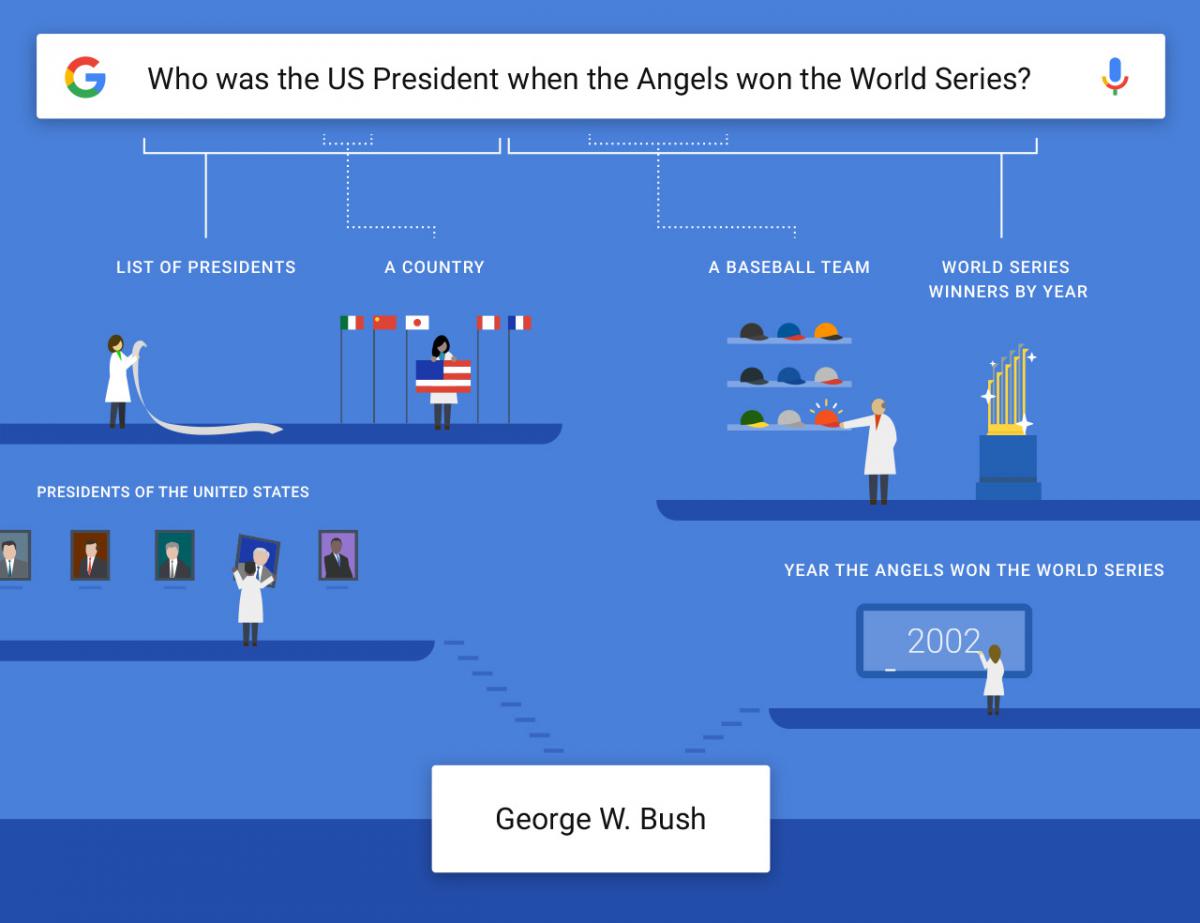
"Who was the U.S. President when the Angels won the World Series?"
"We graduated to answering simple questions about those entities, so you could ask 'How old is Stan Lee?' or 'What did Leonardo da Vinci invent?' We soon got a little smarter, so if you asked 'What are the ingredients for a screwdriver?', we understood you meant the cocktail and not the tool."
What Google did behind the scene is to break the whole question to bits. Each of the broken down pieces are then searched for their meanings according to their category. After getting a whole bunch of explanation about each of the pieces from the database, Search then relate them to one another to see if they match as a whole sentence.
"We can now break down a query to understand the semantics of each piece."
To highlight the ability, Google provided a graphic to explain how its Search performs.
A Learning In Progress
Google indeed has become more useful by each new ability introduced in its Search feature. But no matter how good it has become, Search is still making frequent mistakes. The reasons for this is because it's still learning how to "translate" human's natural languages and how they are spoken.
The company is still working hard on it, and this is all a work in progress. The more people are using it, the more Google will understand, and the better it will be able to answer complex questions that were once naturally impossible for computers to understand.
Further reading: Google's Open-Sourced TensorFlow AI Software: Signaling A Big Change




















































































































































































































































































