
Social media platforms were once places where people communicate and share information, so those who care for them can follow their activities.
But gone are those days, because in the modern-era of social media, the platforms have morphed into a global-reaching, corporate-controlled, mega-powered tech companies that thrive for not only competition, but user count and engagement.
By giving people free access to their platforms, these social media platforms offer likes and followers as currencies to determine users' popularity.
The result of this, is competition.
As more and more users began to realize the euphoric feeling when gaining those "currencies," they created the trend, where they are all racing to become influencers.
The result of this, is negative, abusive, and stress-inducing content, misinformation, malinformation and disinfomation, clickbaits, and more.
And with social media platforms' algorithms prioritize users and posts with high engagement, this affect the mental health of many users.
As a matter of fact, mental health experts, regulators, and many internet users themselves have called out the damage that social media can do their wellbeing.
In this chaotic moment, 'Maven' was born.
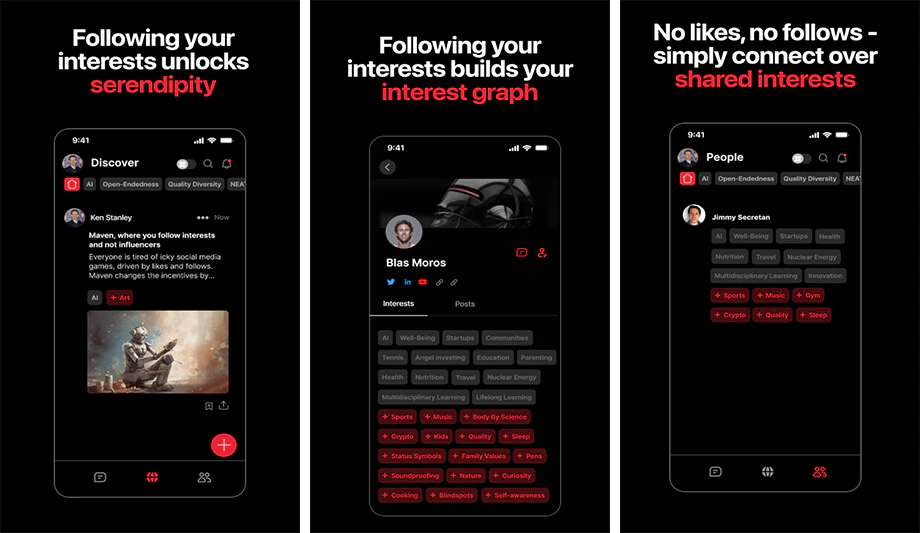
Maven is a social network that takes a unique approach to online interactions, with some key features that include:
- No Likes, No Follows: Instead of chasing likes and followers, Maven encourages users to follow their deepest curiosities. Posts are automatically connected to anyone with overlapping interests, so there’s no need to choose the right group.
- Community Without Followers: Since Maven users connect around interests, they don’t need followers to reach their community. Conversations aren’t siloed, creating a network without borders.
- Serendipity Without Popularity Contests: Every eligible post circulates evenly, exposing more ideas to more people. There’s no like count, click-bait, or domination.
It wants to provide an anxiety-free social media experience where meaningful, thoughtful conversations thrive.
To become a healthier alternative to mainstream social media platforms, Maven is built around a concept called open-endedness.
This approach is in fact inspired by one scientist’s work in AI.
Computer scientist and AI researcher Kenneth Stanley, one of the startup’s three cofounders, wrote an AI model to achieve specific objectives, such as driving a car without crashing or generating humanlike text. And through his work, he found that sometimes, AI would turn to its own solution.
What Stanley did here is that, he created systems that evolve, by seeking novelty for its own sake.
This is where he concluded that that some of lives' greatest achievements cannot be planned. He then encouraged people to seek serendipity in their everyday lives.
Because Stanley’s concluded that the best way to create more serendipity in people’s lives was through a social network, he teamed up with Jimmy Secretan, a former grad student who had worked on open-endedness in Stanley’s lab at the University of Central Florida, and Blas Moros, a like-minded entrepreneur.
They founded Maven together, with Stanley as CEO, Secretan as CTO, and Moros as COO, and formally announced it on Twitter in January.

Stanley argues that most social networks suffer from the weight of objectives, because of the way they incentivize likes, follows, and attention.
It turns people into brands and creates flame wars.
On Maven, users don’t have followers, so they don’t have to worry about what their followers want to hear from them, or how to gain more of them. Instead, if user shave question about something, for example, they can just post it, without stress, and let the platform find an appropriate audience, automatically.
The platform's AI will analyze the post, tags it, and serves that content to a community of users who have also shown interest in that topic.
From there, users can engage in a dialogue on the topic without worrying about whether their posts will get likes.
"It’s really radical," Stanley said. "We got rid of likes and follows. That’s like insanity."
Additionally, Maven uses a content discovery filter that allows users to decide whether they want to see content only focused on the topics they've shown an interest in, or additional topics that Maven's AI has determined they may like.
Users can also mute topics they don't care about and flag other users' posts if they find them abusive.
"It’s not just getting in some great one-liner or dunking on the other person, because that just doesn’t get you much on this site," said Secretan.
By eschewing likes and follows, Maven favors of letting pure chance play more of a role in what appears in users’ feeds.
Stanley and his team believe that instead of achieving something through a direct path, open-endedness allow better results.
Maven’s network is still small, and is a far cry from Instagram or TikTok, or Clubhouse, or ChatGPT, or other platforms and apps that were able to gain significant users in a short amount of time.
But regardless, it's backer include big names, like Twitter co-founder and former CEO Evan Williams, who also founded Medium, and OpenAI CEO Sam Altman.