
Google successfully built a reputation by organizing the world’s information, and making money from ads shown to people who wish to see that information.
It was good and smooth for Google, until the world finally realized how trackers on the internet literally follow people everywhere they go, making them a privacy concern. At its I/O 2022 developer conference on May 11th, Google made a range of privacy measures.
Among them, the company said that the privacy measures are to help users retain more control over how their data is used by Google applications.
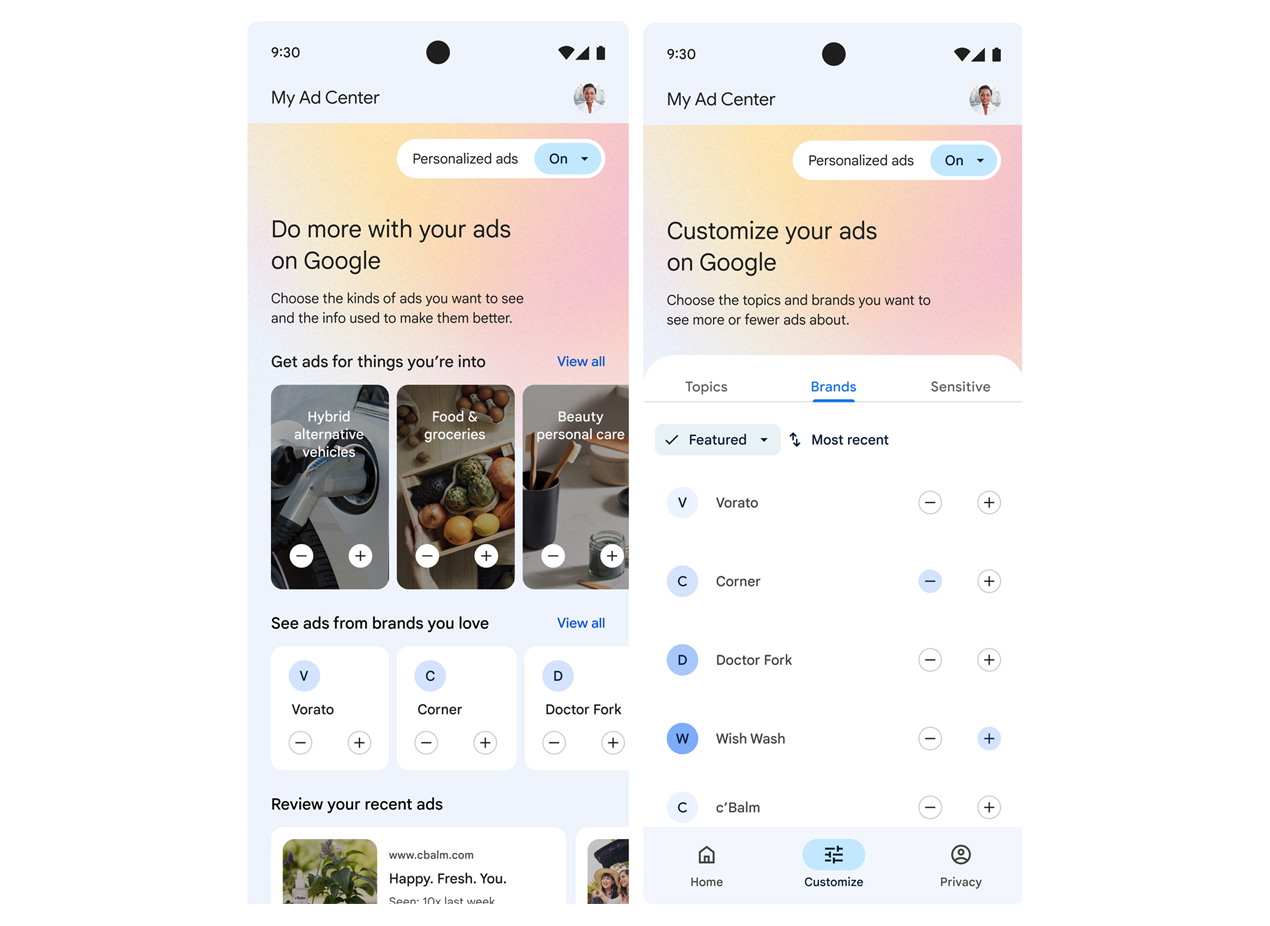
The biggest change here, is the introduction of the 'My Ad Center' interface.
The feature is essentially a hub to let users customize the types of ads they see by selecting from a range of topics they are interested in or opt to see fewer ads on a given topic.
According to Google, the My Ad Center will not only help users control their data, but also how their own data affects their experience while using the web.
Read: The Many Ways Google Tracks You. Knowing How Invasive It Is Can Help You Protect Your Privacy
My Ad Center should give users more granular control over the topics and types of data they end up sharing with brands and ad companies.
For those who care about privacy and how Google is tracking them, this feature is certainly a welcome improvement. It's like a way towards making users to volunteer to provide their data, rather than forcing users for a cookie-based profiling that people have all been subjected in the past.
The method allows Google to slowly rely less on third-party cookie-based web tracking, by replacing it with its Topics API.
Topics doesn’t share visit information across the web and doesn’t even need to know a user’s identity to show relevant ads. Nor does it mass-collect data either, instead, websites are assigned topics and relevant ads are created based on a small selection of the topics a user chooses to be associated with.
This tracking method is less intrusive, but websites can and likely will opt out.
In other words, My Ad Center allows users to customize their ad experience.
This move follows Google's previous move, in which YouTube decided to let users hide more sensitive ad categories to protect their privacy. Things like ads pertaining to alcohol, dating, gambling, pregnancy and parenting, or weight loss can be limited while signed in to a Google Account on YouTube so long as these have been toggled.
Ultimately, My Ad Center is how Google wishes to deal with "privacy-conscious" individuals, as well as initiatives like GDPR-mandated popups and app permissions more generally.
With more and more people becoming annoyed by the aggressive data harvesting practices by tech giants, Google in giving users a way to fine-tune their preferences suggests that Google is starting to realize how awful the industry has become, in terms of privacy.

But still, Google's business relies heavily on ads and trackers.
So here, despite signs of progress, Google's approach on privacy, is still not a 100% privacy.
While the company does love to talk about changes in app permissions, encrypted data, and user toggles, in the end is that, Google is still a data harvesting machine.
That’s Google’s business model, after all, and that is how it operates.
Google can not operate properly without user data, and this is why it needs to find a way to balance data collection with revenue generation.
It's an internal struggle that Google is experiencing.
In other words, through the Google I/O 2022, what Google is doing in the privacy sector, is to try finding the right balance without upsetting its core business model.
In another announcement, Google also said that users would be able to request their personal information, such as email or address details, to be removed from search results through a tool that can be accessed from users' Google profile page.
Google is also giving users better ways to hide more specific personal information in search.
During the event, Jen Fitzpatrick, Google’s SVP for core systems and experiences, emphasized the concept of “protected computing,” which is a set of technologies that Google said represent a transformed approach to where and how data is processed.
In summary, protected computing means that more data will be processed on devices (e.g., Android phones) without being sent to Google’s cloud servers.
This way, Google can ensure that users that their data is safe, simply because their data never reaches Google for processing.
Even in cases that data needs to be sent to Google, Google said that the data will be anonymized through techniques like the use of differential privacy and edge computing.
Fitzpatrick said that the changes were about justifying the trust that users put in Google to keep them secure.
"Protecting your privacy requires us to be rigorous in building products that are private by design," she said.




















































































































































































































































































