AI is no longer confined to chatbots or specific large language models (LLMs). It's now moving into browsers, the very place where most people live when they’re online.
Since the arrival of ChatGPT, it’s become clear that the battle for AI dominance isn’t just about who builds the smartest model, but who creates the most capable digital agent: one that can act on behalf of users, not just interact with them.
The so-called agentic browsing using AI is now a something a number of tech companies are actively developing.
And this is where Opera Neon enters the picture.
It’s Opera’s bold statement: a reimagined browser designed to challenge the industry’s biggest players by embracing what it calls agentic browsing.
Long known as a creative yet niche player in the browser world, Opera has often been praised for its innovation but never for its dominance. With Neon, however, Opera is stepping out of that shadow. The company positions it as a direct competitor to new AI-powered challengers like Perplexity’s Comet and The Browser Company’s Dia.
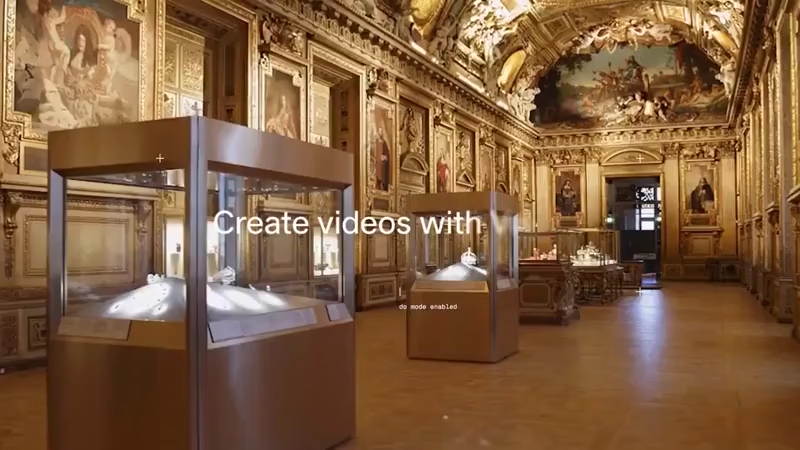
Now, to enhance this AI experience even further, Opera Neon introduces a 'Deep Research' feature, and also an integration with Google's highly-capable video generator, the Veo 3.1.
Veo 3.1 works directly in Neon Make letting you create short, polished videos with rich audio and precise control.
— Opera (@opera) October 23, 2025
First off, in order to use Veo 3.1 in Opera Neon, users must open Neon Make, and type in their prompt. They must then include either "use Veo" or "use Google" to tell the browser which model they would like to use for video generation.
For example, choosing Veo will make Neon use Veo 3.1 to generate the video based on users' prompt, and any reference images they attach.
While users can attach two images for more control, Veo 3.1 can also work with just one, or even none at all. The model is designed for creators who want professional-looking results from a single, well-phrased prompt.
Opera created a video with this using two images, and using the prompt:
For users who prefer more cinematic approach and lifelike physics, they can try OpenAI Sora 2 instead.
All users have to do, is append "use Sora."
In this example, Opera gave an image, and used the prompt:
Each video generation model offers its own creative strengths. Veo 3.1 excels at producing short, polished videos with high visual fidelity, precise control, and integrated audio.
It supports the use of multiple reference images, typically the first and last frames, allowing users to describe what happens between them for smooth, cinematic transitions.
While Veo 3.1 excel in realism, Sora may suit better if users want Neon go generate videos for storytelling, creating ambient scenes, or projects that demand natural movement and believable lighting.
Whether users prefer Veo 3.1’s precision or SORA 2’s cinematic power, both are directly available in Opera Neon under a single subscription.
Veo 3.1 can generate videos from two reference images as first and last frames. Ideal for short, polished videos with rich audio and control.
— Opera (@opera) October 23, 2025
Opera also introduces the deep research feature, through the launch of the Opera Deep Research Agent (ODRA), its fourth AI agent designed to enhance user experience and redefine how people interact with the web.
The addition of ODRA underscores Opera’s growing commitment to agentic browsing, which can be described as a concept where multiple intelligent agents work together inside the browser to perform complex tasks on behalf of the user.
Alongside ODRA’s debut, Opera is also previewing new ways for users to interact with these agents, laying the foundation for a more intuitive and scalable browser architecture.
With deep research, users can ramp up their web browsing experience to a whole different level.
Traditionally, users would go to search engines to find recipe, a song lyric, or another adorable cat video. But increasingly, the web has become a workspace where users expect more powerful tools to support deep research. This is where Neon Deep Research comes in.
Opera’s AI Engine is both model-agnostic and tool-agnostic, allowing it to seamlessly combine the strengths of multiple LLMs such as Google's Gemini and OpenAI's GPTs. On the backend, Opera parallelizes operations across its servers, splitting complex research tasks into smaller problems and running multiple “researchers” simultaneously.
This approach not only accelerates the process but also improves accuracy.
Opera Neon introduces ODRA - Opera Deep Research Agent
Purpose-built for complex research tasks, ODRA is the 4th browser agent we add in Opera Neon, and it will work hard to resolve your deep research tasks!
• Works alongside Neon Chat, Do & Make
• Parallel “researcher”… pic.twitter.com/NX3CHtForE— Opera (@opera) October 20, 2025
Opera shared that ODRA’s benchmark results show it outperforming several leading AI research agents in the percentage of correct answers achieved.
When Opera Neon launched, it introduced three core agents: Chat, Make, and Do.
Each of these agents are tailored for a specific user need.
But for Opera, the company’s long-term plan is far bigger than that, and much more ambitious. The company wishes to build a browser capable of supporting dozens of specialized agents that can be dynamically called upon for any given task.
To make this system manageable and natural for users, Opera is developing a new orchestration layer, internally codenamed Symphony.
ODRA acts like a built-in research team. It breaks your query into smaller tasks, checks multiple sources at once, and compiles a detailed report - saving hours of manual searching. pic.twitter.com/Wf0uVIKUu9
— Opera (@opera) October 20, 2025
"The idea we are working on is what we internally call Symphony - an orchestration layer that fundamentally changes how users interact with multiple AI agents," said Krystian Kolondra, EVP Browsers at Opera.
"Instead of having users figure out each agent individually, we are creating a unified intelligence layer where one master AI helps manage all these different agents."
"This isn’t just about reducing confusion," Kolondra added.
"It’s about amplifying human capability. When you have 50 specialized agents at your disposal, you shouldn't need to remember what each one does. You should just express your intent, and the system should orchestrate the solution."
Opera's vision is clear, but its ambitious for having an AI-powered browser that blends different agents, each designed for different kinds of user interaction, can be an overkill. Since the AI is integrated deeply into its core, acting more like a digital coworker than a passive tool, early users found its multitiered AI system both powerful and confusing:
With one master agent, some users said that it misfires the agents or simply ignores user corrections.
Despite its creative approach and premium build, Opera Neon feels more like a promising prototype than a polished AI assistant, at this time at least.














































































































































































































































































