In the dim glow of Monday evening, rush hour was beginning to fade. It seemed, at least for a moment, like another ordinary end to a hectic weekday in Jakarta.
Then, without warning, the rhythm of one of Indonesia's busiest commuter corridors was shattered by chaos at Bekasi Timur Station. Located on the eastern edge of the capital region, the crowded station was transformed within minutes into the scene of one of the country's most harrowing railway disasters.
A packed KRL Commuter Line train, carrying workers heading home or toward Cikarang, struck a green taxi that had stalled on a nearby level crossing. The collision forced the commuter train into an emergency stop at the station platform. On the adjacent track, another commuter train also came to a halt as operations were disrupted.
Moments later came the second, far deadlier impact.
Soon, the night became one of fear, confusion, and frantic rescue efforts, while online, the tragedy spread just as quickly.
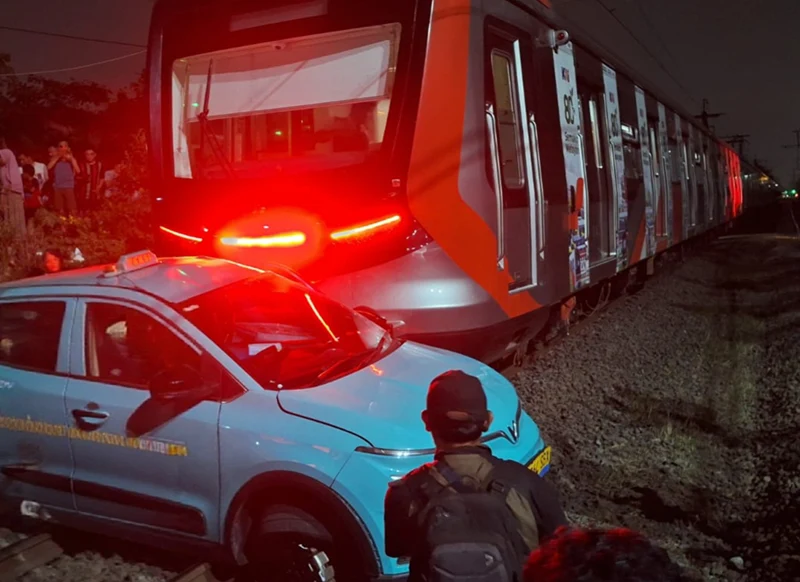
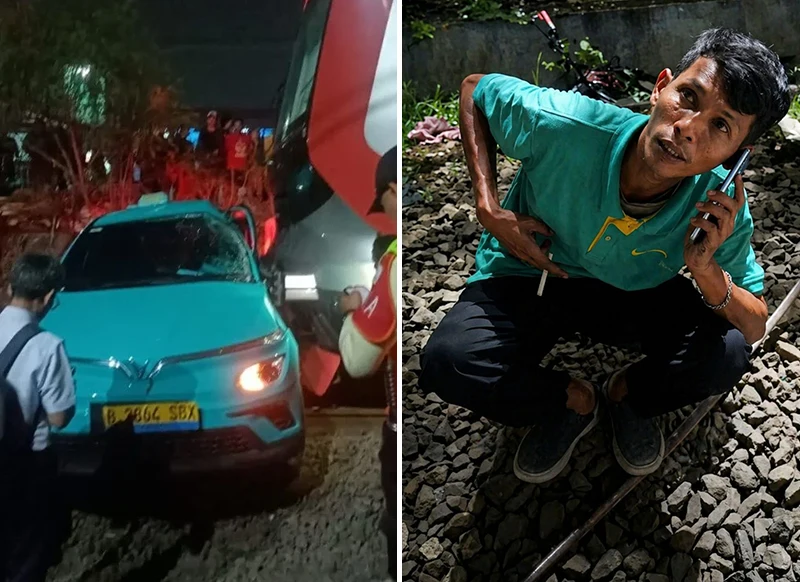
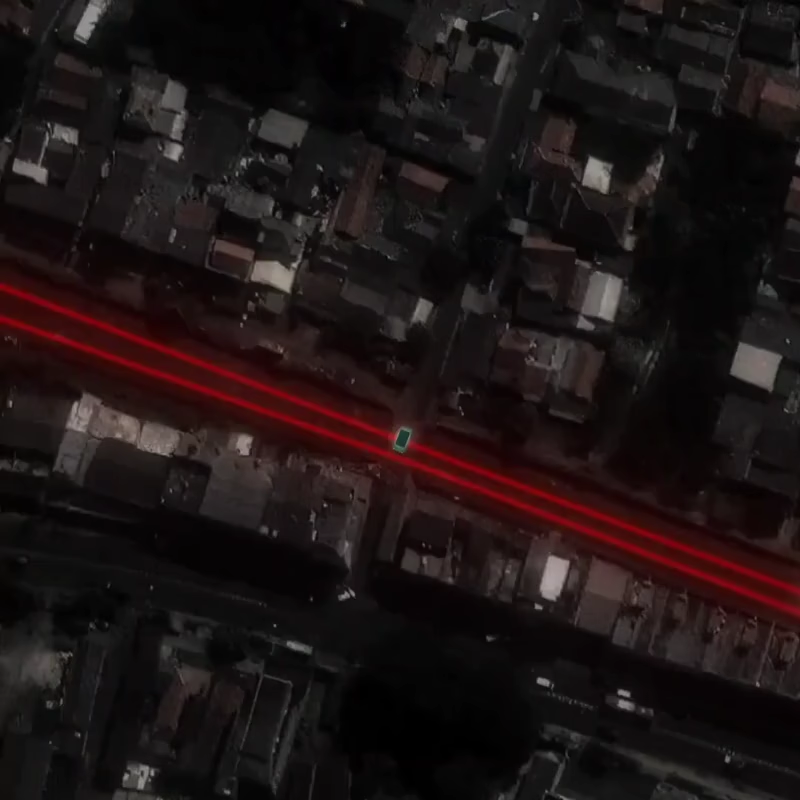
The disaster began with what first appeared to be a smaller incident: a green SM electric taxi, identified as a VinFast e34, reportedly suffered a mechanical failure and became stranded in the middle of an unguarded level crossing near Bulak Kapal/Ampera, just before Bekasi Timur Station.
The taxi was struck by a passing commuter train and dragged several dozen meters. Despite the dramatic scene, the initial damage was limited.
But the stalled crossing created wider disruption.
On the adjacent track, another commuter train was unloading passengers. After boarding its next group of commuters and closing its doors, it remained at the station longer than scheduled because the line ahead had not yet been cleared.
That was when the Argo Bromo Anggrek approached.
Traveling on the same track as this second commuter train, the larger, long-distance express traveling from Gambir to Surabaya Pasarturi, continued forward and crashed into the rear of the stationary commuter train.
The force of the collision was devastating: its 90-ton GE Class CC206 diesel-electric locomotive tore into the final car of the second commuter train, the women-only carriage, crushing steel, shattering windows, and trapping passengers inside a mass of twisted wreckage.
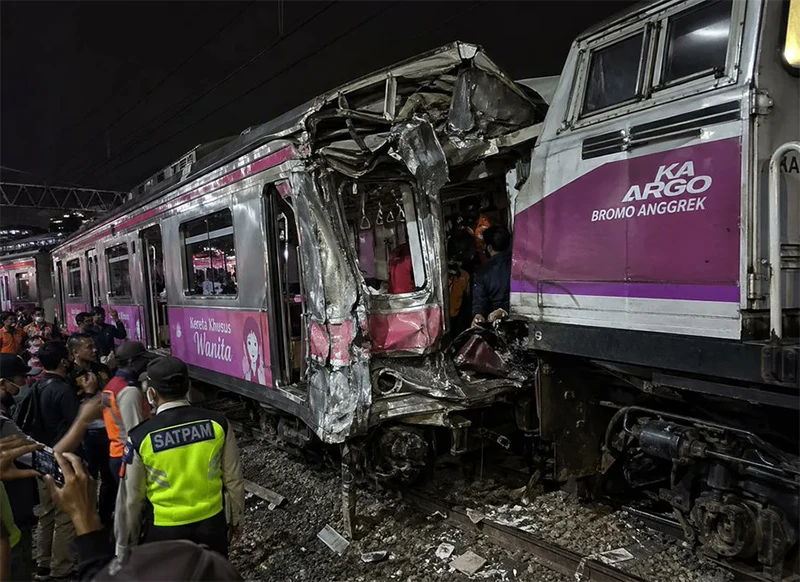
The force of the collision echoed through the night, a thunderclap that would soon reverberate far beyond the rails.
Eyewitnesses described chaos unfolding in seconds: the sickening crunch of metal on metal, sparks flying under the station lights, and then the piercing cries of the injured rising above the hiss of damaged brakes.
Four, then five, and reports climbing toward seven souls lost their lives in that brutal instant.
Ordinary commuters, many of whom just wanted to return home to their families, ended their journey tragically.
Dozens more suffered broken bones, deep lacerations, and crushing injuries.
Rescuers from Basarnas, police, military, and Red Cross volunteers worked frantically through the night, wielding cutters and stretchers to pry victims from the debris.
Some passengers remained pinned for hours, their voices weakening, limbs twitching, as teams carefully cut through the destroyed carriage.
All 240 travelers aboard the Argo Bromo Anggrek emerged physically unscathed, but the psychological scars of watching the horror unfold from just meters behind would linger.
By dawn on April 28, the station had become a battlefield of flashing emergency lights, scattered belongings, and the heavy silence that follows disaster.
Yet what made this tragedy uniquely modern was how swiftly and powerfully the internet seized it.
Within minutes of the crash, shaky smartphone videos exploded across TikTok, X, and Instagram. Grainy clips captured the moment the commuter train crashed into the electric taxi, the immediate aftermath that followed the halt of the commuter train, to the Argo Bromo Anggrek that rear-ended the commuter train, and then the rescuers in orange vests climbing over wreckage, flashlights piercing the darkness, bloodied survivors being carried on makeshift stretchers.
The haunting sight of the Argo Bromo Anggrek's locomotive buried deep into the KRL’s mangled end, a horror to anyone who witnessed it.
Hashtags like #Bekasi, #TabrakanBekasi, #BekasiTimur, #BekasiTrainCrash, and some others rocketed to the top of trending lists, amassing millions of views overnight.
Commuters who used those very lines daily shared their own stories, like tales of near-misses at the same poorly guarded level crossings, frustrated warnings ignored for years about inadequate safety barriers and outdated signaling. Viral threads dissected the sequence: the taxi's fatal mistake, the possible delay in emergency signals, the absence of modern automatic train protection systems that could have prevented the rear-end catastrophe.
Anger boiled over online, directed at PT KAI for what many saw as preventable lapses in one of the world's busiest commuter corridors.
The digital storm did more than just spread grief. Instead, it fueled a raw, collective response.
Live streams from the scene drew thousands watching in real time as families arrived, phones in hand, desperately scanning for loved ones amid the cordoned chaos. Crowdfunding campaigns for victims' families launched and filled within hours, shared relentlessly by influencers and ordinary netizens alike. Blood donation drives organized via WhatsApp groups and Instagram stories saw long lines forming at hospitals by morning.
Passenger testimonies flooded comment sections: one survivor recounted the sudden jolt, the lights flickering out, and the terrifying crush as the carriage folded inward.
Others posted final messages they had sent loved ones just before the crash, now haunting reminders of life's fragility.
Even as authorities promised a full investigation by the KNKT and police, the internet kept relentless pressure alive, demanding accountability, better safety protocols, and an end to the dangerous dance between trains and unregulated level crossings that plague Indonesian rails.
Telah terjadi insiden operasional di wilayah Stasiun Bekasi Timur, yang berdampak pada perjalanan kereta api.
Saat ini, KAI memfokuskan upaya pada… pic.twitter.com/EzjnGw3mfT— Kereta Api Indonesia (@KAI121) April 27, 2026
As the sun rose over Bekasi on April 28, at least 14 people have been confirmed dead, thirteen long-distance services had already been canceled, commuter lines rerouted or halted, and the mangled trains still sat locked together like frozen combatants.
PT KAI issued apologies and pledged to cover all medical costs, but for many scrolling through their feeds, words felt hollow against the images of twisted steel and grieving families.
This was no isolated accident.
It was the deadly culmination of rushed urban growth, aging infrastructure, and human error meeting at full speed.
The sudden stop and what officials suspect was a delay or failure in the emergency signaling system, the Argo Bromo Anggrek could not brake in time and slammed directly into the rear of the already-stopped KRL, crushing the back woman-only carriage. It was a chain-reaction crash involving the same commuter train at the center of both incidents.
The Argo Bromo never touched the taxi; it only hit the KRL that had already been forced to halt because of the taxi.
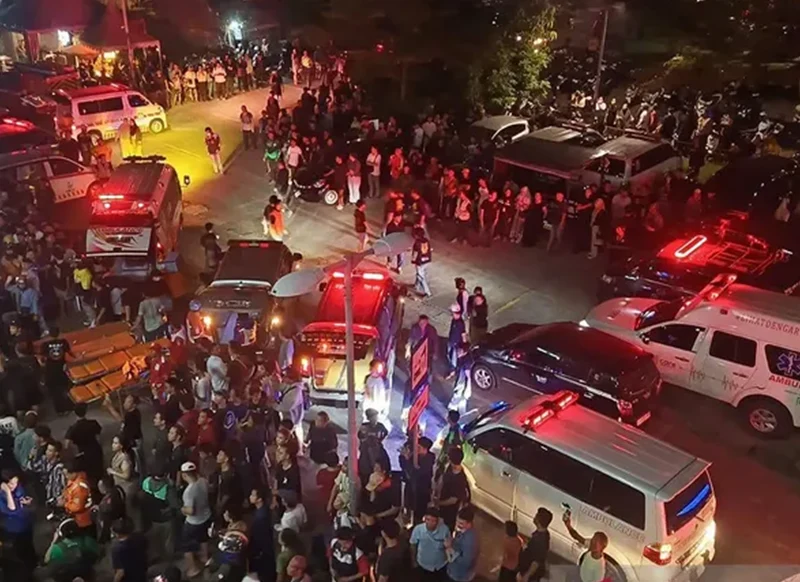
The internet had turned a local disaster into a national reckoning, forcing the nation to confront how many more lives must be lost before the railways truly protect those who depend on them daily.
The tracks may eventually clear and trains resume their journeys, but the viral images, the shared heartbreak, and the unanswered questions will echo long after the wreckage is hauled away.
This, is a stark digital memorial to the night when routine travel became unthinkable tragedy.
KAI menyampaikan permohonan maaf atas ketidaknyamanan yang terjadi.
Bagi pelanggan yang terdampak pembatalan berhak mendapatkan pengembalian bea tiket 100% dengan masa pengajuan hingga 7 hari ke depan.
Untuk informasi lebih lanjut, pelanggan dapat menghubungi Contact Center KAI… pic.twitter.com/NwKvXp5kJK— Kereta Api Indonesia (@KAI121) April 28, 2026
Untuk membantu keluarga dan pelanggan, KAI telah menyiapkan Posko Informasi di Stasiun Bekasi Timur dan Gambir serta layanan Contact Center KAI 121.
Sebagai dampak dari kejadian ini, sejumlah perjalanan kereta api mengalami penyesuaian. KAI juga memberikan pengembalian bea tiket… pic.twitter.com/g7U2XU19iy— Kereta Api Indonesia (@KAI121) April 28, 2026
As for the taxi driver, the person who caused the first chain reaction was seen safe and sound. When he was approached, he was seen trying to calm himself down by smoking a cigarette.
He managed to survive because he immediately got out of the car when the vehicle stalled on the tracks.
In response to this tragic incident, Indonesia's President, Prabowo Subianto, said that he is preparing IDR 4 trillion to help repair 1,800 unguarded railway crossing points across Java.
He has ordered the construction of guard posts up to flyovers so this classic problem from the Dutch era can be resolved quickly and there are no more accidents that claim victims.
Hari ini, saya menjenguk langsung para korban kecelakaan antara Kereta Api Argo Bromo Anggrek dan KRL Commuter Line di Stasiun Bekasi Timur.
Saya menyampaikan duka cita yang mendalam atas peristiwa ini, khususnya atas adanya korban jiwa. Semoga para korban yang meninggal dunia… pic.twitter.com/gIsk799Cvz— Prabowo Subianto (@prabowo) April 28, 2026






















































































































































































































































































