
YouTube has begun testing a new conversational search feature called 'Ask YouTube,' and things are going to be different.
The idea of having this feature, is to let users ask questions in everyday language and receive responses that blend AI-generated text summaries with selected video clips, longer videos, and Shorts from across the platform. The experiment is positioned as a way to make searching feel more like an ongoing discussion rather than a one-time list of results.
Unlike the standard YouTube search that primarily ranks videos by keywords and relevance, this approach pulls together information into a structured overview, using text as the main guide while embedding videos at specific timestamps to illustrate points or provide examples.
Early testers have described it as generating full pages of content that include bullet-point lists, thematic galleries, and direct links to video segments, allowing for follow-up questions within the same session.
Access to the test is currently restricted to YouTube Premium subscribers in the U.S. who are at least 18 years old and searching in English on a desktop browser.
To participate, eligible users must opt in through the YouTube Labs page, an have the Ask YouTube button appear next to the regular search bar.
Clicking it or entering a query and selecting the option opens a dedicated interface that starts with a brief loading animation on what appears as a mostly blank page before populating with results. The page often includes suggested prompts at the top, such as queries about historical events, product explanations, or travel planning, and ends with a text box for continued interaction. If no query is entered initially, the button leads to a page with example prompts to get users started.
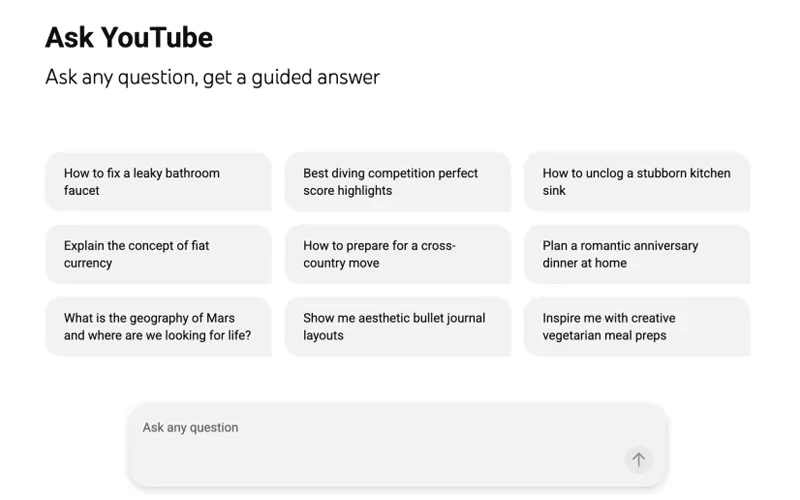
The way responses are formatted marks a noticeable shift from conventional video search results.
Instead of a vertical scroll of thumbnails, the system creates a synthesized page that begins with an overview title and subhead, followed by paragraphs or bulleted summaries drawn from video content.
Videos and Shorts appear as supporting elements, often embedded directly with timestamps that jump to the most relevant portion.
For instance, a query like "plan a three-day road trip from San Francisco to Santa Barbara" produces a step-by-step itinerary that mixes written descriptions of stops, local tips, and must-see locations with embedded clips from travel videos and Shorts. Users can then ask a follow-up such as "where can I find good coffee along the route," prompting additional segments that include video titles, channel names, and precise timestamps for easy navigation to the suggested spots.
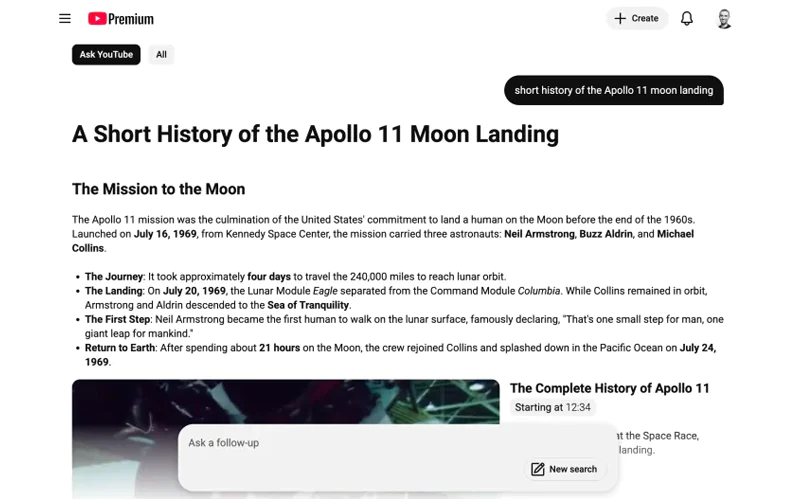
Similar structured outputs have been observed with other topics.
Asking for a "short history of the Apollo 11 moon landing" generates a top section with a bulleted timeline of key milestones, such as the launch date and Neil Armstrong's first steps on the Moon, accompanied by a timestamped video clip from a relevant documentary.
Below that, the page organizes related content into galleries with headers like "From Launch to Splashdown" or "Historic Footage and Behind-the-Scenes," pulling in longer videos alongside a dedicated Shorts section highlighting surface moments.
Follow-up questions within the thread, such as "Who were the Apollo 11 astronauts," can lead to a grid layout detailing the backgrounds of Neil Armstrong, Buzz Aldrin, and Michael Collins, complete with linked video sources.
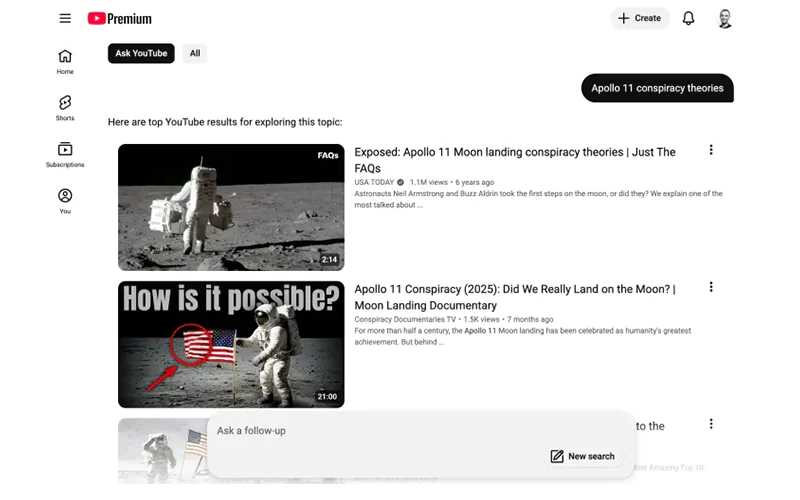
In some cases, however, certain follow-ups like inquiries into conspiracy theories have reverted to a more traditional list of video results rather than maintaining the synthesized format.
Product-related questions demonstrate another side of the feature.
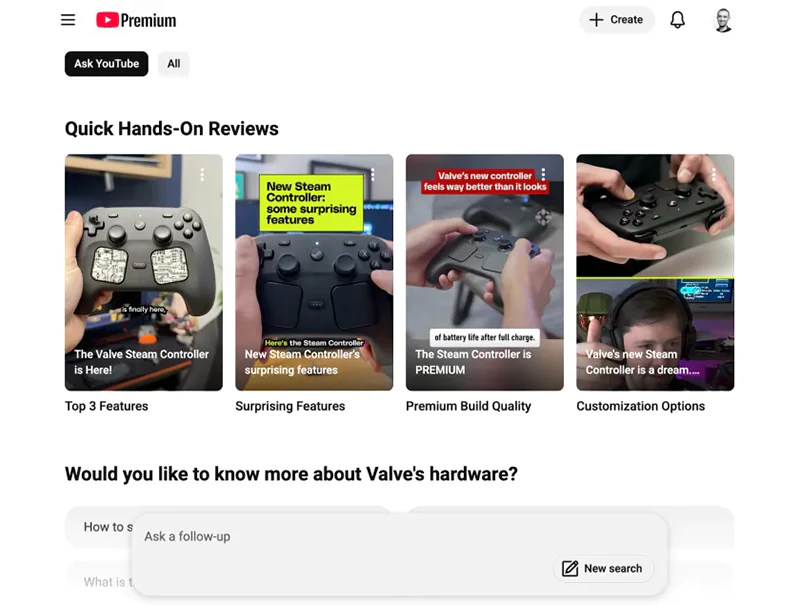
A search for "What is the Steam Controller" yields an overview paragraph describing the device, along with a link to an official Valve video and sections featuring hands-on reviews from Shorts and longer critiques.
n one reported instance, the generated text contained a small inaccuracy, stating the controller lacked joysticks when it actually includes one which highlights how the system, while helpful for discovery, still relies on pulling and summarizing from existing videos.
Related video galleries and timestamped embeds help users jump straight into reviews or demonstrations, with channel details provided to encourage exploration of new creators. Another test involved reactions to a newer AI model, where the response included a generated title, summary paragraph, embedded clip, and even a comparison table for a follow-up question about competing models, linking back to the source videos for each data point.
YouTube has emphasized that this remains an experimental feature, noting on its opt-in page that "quality and accuracy may vary." Users are encouraged to provide feedback through thumbs-up or thumbs-down buttons after each response, with the option to add comments explaining their rating.
The test is set to run through June 8, 2026, unless extended, and the company has indicated it is already preparing to broaden availability beyond Premium subscribers, though no specific timeline for wider rollout has been shared. At present, the feature operates only on desktop and in English for the qualifying group in the United States.
This conversational approach builds on earlier YouTube experiments with AI elements in search, such as brief video clips appearing in overviews for certain queries.
It aligns with broader efforts across Google properties to handle multi-part or complex questions in a more interactive manner, though the focus here stays on surfacing and contextualizing video content rather than replacing it.
Regular search continues to function as before for those who prefer keyword-based results or when the Ask YouTube format does not apply.
For now, the test offers a glimpse into how the platform might evolve to support users looking for guided answers on topics ranging from travel planning and history to product explanations and creative ideas, all while keeping the core library of videos as the foundation. As feedback comes in during the testing phase, adjustments to accuracy, formatting, or expansion could follow, but the current version prioritizes a blend of text guidance and direct video access to help users navigate and discover content more fluidly.

















































































































































































































































































