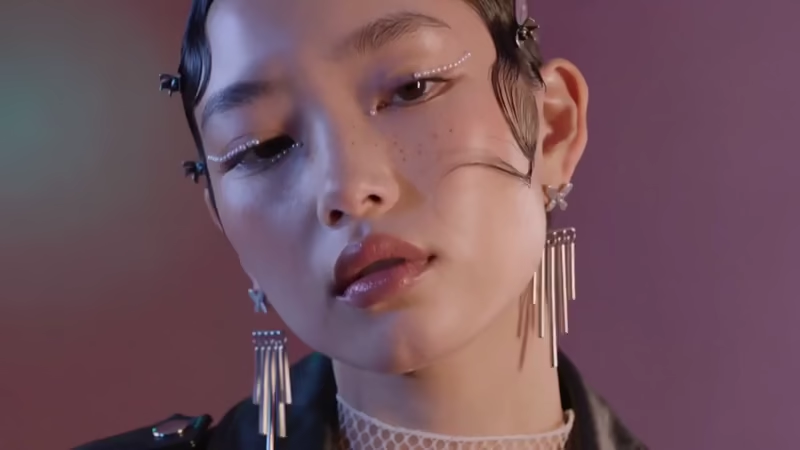
The development of large language models (LLMs) continues, and things get increasingly, scarily real.
What began as the AI revolution that began with OpenAI ChatGPT's arrival in late 2022 quickly escalated into what many describe as the LLM war, described as a rapid expansion of generative tools that soon stretched from text and images into full video creation.
As others flooded the market, promising to turn prompts into moving visuals, yet most early efforts struggled with basic issues like inconsistent characters, unnatural motion, or the need for heavy post-production fixes.
Into this competitive arena stepped Kling AI, a platform developed by the Chinese company Kuaishou, which has stood out for its consistent focus on realistic physics simulation, strong subject continuity across frames, and a unified multimodal approach that integrates text, images, audio, and editing without requiring users to juggle separate tools.
Unlike many Western counterparts that prioritize quick clips or stylized effects, Kling has built its reputation on practical, cinema-grade output that mimics real-world dynamics: gravity, inertia, balance, and fluid interactions, while supporting longer sequences and native audio syncing in its latest iterations.
Its Video 3.0 series, powered by an upgraded architecture with 3D spacetime attention and chain-of-thought reasoning, already delivered hyper-realistic 1080p results with director-level controls like multi-shot storytelling and precise camera movements.
Now, the platform has taken a notable step forward by rolling out native 4K mode directly within that same 3.0 framework, allowing one-click generation of videos at true high resolution rather than relying on upscaling.
Read: From Prompt To Film: Kuaishou Releases 'Kling 3.0,' Now Anyone Can Be A Director
Kling 4K Mode is now live in Video 3.0 series.
Generate stunning 4K videos in one click with sharper visuals, richer details, and cinematic-level quality.
Built for big screens and high-end production, with strong visual consistency across subjects, texts, style and lighting.… pic.twitter.com/7mNqQYWrgk— Kling AI (@Kling_ai) April 23, 2026
The update promises sharper visuals, richer textures, and cinematic-level detail suitable for large screens or professional productions.
It emphasizes exceptional consistency across elements: subjects, text overlays, lighting, and overall style, while reducing the common artifacts that plague other generators during complex scenes or transitions.
720p saw the light beam, but 4K sees every ray carving through dust.
See more in Kling 4K. pic.twitter.com/KJAKUcGcUn— Kling AI (@Kling_ai) April 25, 2026
Clips can run up to 15 seconds in this mode, with support for start-and-end frame referencing, multi-cut editing, subject locking, and even sound effects or localized prompts, making it more versatile for creators experimenting with everything from intimate close-ups to dynamic action sequences.
A temporary 20 percent discount on 4K generation for subscribers and team plans runs through early May, lowering the barrier for testing the higher-resolution output.
720p saw the silhouette, but 4K sees every hair lit against the sun.
See more in Kling 4K. pic.twitter.com/yAImISaxpd— Kling AI (@Kling_ai) April 26, 2026
Early examples shared online highlight the upgrade's impact: intricate details like the fine patterns in a peacock feather's eye, the subtle textures of human skin and irises, a child's frosty window view, a crowded subway platform, or a dramatic savanna scene with wildlife all render with heightened clarity and depth.
720p saw the bottle, but 4K sees every letter on its skin.
See more in Kling 4K. pic.twitter.com/zS6eYnOsOR— Kling AI (@Kling_ai) April 27, 2026
Creators have noted how the native 4K preserves fine elements, like hair strands, fabric weaves, environmental particles, which are often blurred in lower resolutions, while maintaining motion that feels grounded rather than artificial.
Social feedback ranges from excitement over the quality jump for ads, short films, and social content to practical observations about credit consumption (roughly 360 for a 15-second clip) and the fact that longer multi-scene projects still benefit from careful prompting to avoid minor drifts in character appearance or physics.
720p saw the rainy city, but 4K sees every strand of light inside the rain.
See more in Kling 4K. pic.twitter.com/OJlWrgcOCI— Kling AI (@Kling_ai) April 28, 2026
In a landscape where AI video tools continue to evolve at breakneck speed, competing on everything from generation length to audio integration, Kling's emphasis on native high-resolution output without extra steps reflects a maturing phase for the technology.
It positions the platform as a balanced option for both hobbyists seeking quick, polished results and professionals who value efficiency in pre-production or asset creation.
As more users experiment with these capabilities, the real test will be how seamlessly they fit into broader workflows, but the direction is clear: higher fidelity is becoming the baseline rather than a premium add-on, potentially reshaping how stories are visualized from idea to screen.






















































































































































































































































































