The thing people wear on their wrists is no longer used to tell time. With touchscreen and sensors, watches become smartwatches.
These gadgets were once received by many with huge pessimism. How can smartwatches disrupt the decades-long industry dominated by those Swiss-made watches?
How can analogue watches made with laser-precise cogs and precious metals can beat computerized watches that are built with silicon chips, touchscreens and a bunch of sensors? How can the dominance of mechanical watches in the fashion industry, considered as products with the highest-level of craftsmanship, be disrupted by brands that also make smartphones?
It was once said that those who love Swiss watches, or any traditional analogue-mechanical watches for that matter, won't or may have just a little interest in smartwatches.
But in the second quarter of 2021, the smart watch's market has grown fast, and Apple as one of the manufacturers of smart watches is seeing more than 100 million units sold.
According to a report by Counterpoint Research's Global Smartwatch Shipments Tracker, Apple hits the milestone, thanks to the device's design, health features, and related services.
During the quarter, the Apple Watch Series 6 was the most popular smart watch overall, followed by the Apple Watch SE.
At third place, was Samsung Galaxy Watch Active 2, followed by the Apple Watch Series 3 in fourth and the Imoo Z6-4G in fifth.
Among the top five smartwatch brands globally, Samsung and Garmin, showed a significant shipment growth of 43% and 62% year-on-year, respectively.
Samsung was not performing well, as its sales were sluggish in 2020. But thanks to the Galaxy Watch 3 and Galaxy Watch Active 2, Samsung quickly caught up, as per Counterpoint.
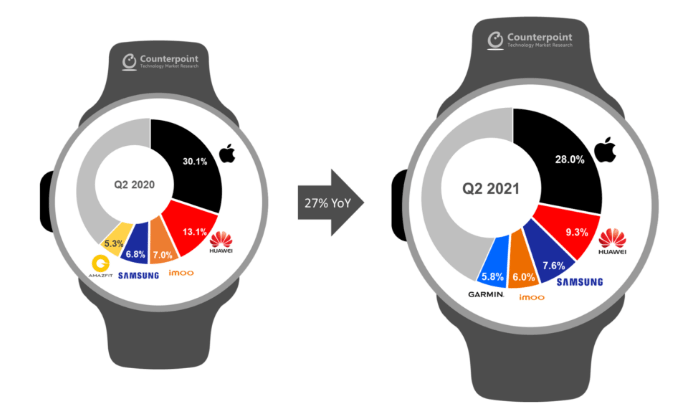
The South Korean giant managed to grow its market share to 7.6% in the second quarter from 6.8%.
Garmin, on the other hand, is also noted to have recorded its highest shipments ever in the 2021's second quarter, with a market share of 5.8%.
The American fitness tracking-focused wearables manufacturer managed to take on Chinese smartwatch brand Amazfit that had a 5.6% market share.
As for Huawei, it continued to be in the second position in the top five global smartwatch brands chart, but experienced a decline to from 13.1% to 9.3%.
Counterpoint believes that the decline in Huawei's smartphone business has affected its smartwatch sales globally.
Apple reached this milestone weeks before it is set to debut its Apple Watch Series 7.
While Apple is the largest, its share was at 28%, down slightly from 30% in the year-ago quarter.
This happened because of the “intensifying competition” from sub-$100 products from Chinese brands such as Xiaomi, Realme and Oppo, and Indian brands such as Boat and Noise.
What makes it even astonishing is that the sub-$100 smartwatch segment grew to a massive 547% annually.
While the U.S. remains the largest market for smart watches, India has emerged as the fastest growing smart watch market.
Overall, sales of smartwatches are getting back to pre-'COVID-19' coroanvirus pandemic, helped by online sales.
Read: Smartwatches Against Mechanical Watches: The Smart Vs. The Mighty






















































































































































































































































































