
Back in February 2024, Google officially abandoned its long-standing pledge to avoid developing AI for military applications.
What this means, private companies are now embracing AI as an inevitable tool for warfare. While this decision may accelerate military AI programs, particularly in the U.S., the news comes at a time when China is already gaining an edge in the global AI arms race.
Since China has been investing in AI-powered weapons systems for years, it has been predicted that China has the capacity to fully deploy fully autonomous AI weapons within just two years.
AI as a weapon is already sparking a race towards supremacy.
And here. the tensions between the two superpowers continue to escalate.

When the U.S. Army deployed an armed “robot dog” in the Middle East for testing, the AI-powered Quadrupedal Unmanned Ground Vehicle (Q-UGV) was considered a breakthrough.
Yet, China had already showcased a similar technology months earlier at its Golden Dragon military drills in Cambodia.
And on March 5, following U.S. tariff increases, China responded with bold rhetoric, declaring it was prepared to fight America in “any other type of war” and “until the end,” according to a post from the Chinese Embassy on X. The language suggests a broader concept of warfare, one that extends beyond traditional battlefields.
Beyond robotic sentries and AI-enhanced drones, China is also integrating AI into battlefield strategy, which include data processing and exploitation.
Whether or not the U.S. can keep up, depends on how the superpower continues its AI development.
In this war, dominance isn’t just about who has the most advanced weapons—it’s about who can make decisions faster.
For the U.S., things get worse because Russia, a key ally of China, is also taking an approach to AI warfare.
But instead of focusing on autonomous combat systems, Russia is developing AI tools to disrupt an adversary’s command-and-control networks. The technology is touted as an AI-powered code-breaker that could disable encrypted military systems, rendering weapons useless.
With both China and Russia strengthen their AI military collaboration, the U.S. finds itself relatively isolated.
Despite being a leader in AI research, bureaucratic red tape and profit-driven decision-making slow down its military AI adoption. The U.S. Air Force is one of the few branches aggressively integrating AI, working on an AI-powered cognitive engine designed to anticipate threats and speed up combat decisions.
Unlike China, where AI advances are swiftly integrated into state-run defense programs, the U.S. relies on private tech firms like Google, OpenAI, and Palantir. And to add to its burden, U.S.-based companies have to navigate financial risks and public relations concerns before committing to military contracts.
What this means, U.S. firms are moving cautiously—sometimes too cautiously, whereas China and Russia are rapidly deploying AI-powered technologies to more places.
In fact, since the introduction of DeepSeek-R1, the Chinese government is trying to incorporating the AI model into mobile shooting game, over 20 Chinese automakers (and at least one bus maker), some 30 medical and pharmaceutical companies, and into some other industries and applications.
Dozens of banks, insurance companies, and brokerage firms across the country also disclosed they are using DeepSeek to train customer service representatives, design investment strategies, and handle similar kinds of tasks.
DeepSeek's AI is also making its way into Chinese government offices, and at least one nuclear power plant.
Regardless of whether the information above is influenced by Chinese propaganda, China appears to have gained an advantage as the West reacts with concern to DeepSeek’s launch.
This has only fueled the technology’s growing popularity within China.

Before, the dangers of autonomous weapons were hypothetical. But now, they are real.
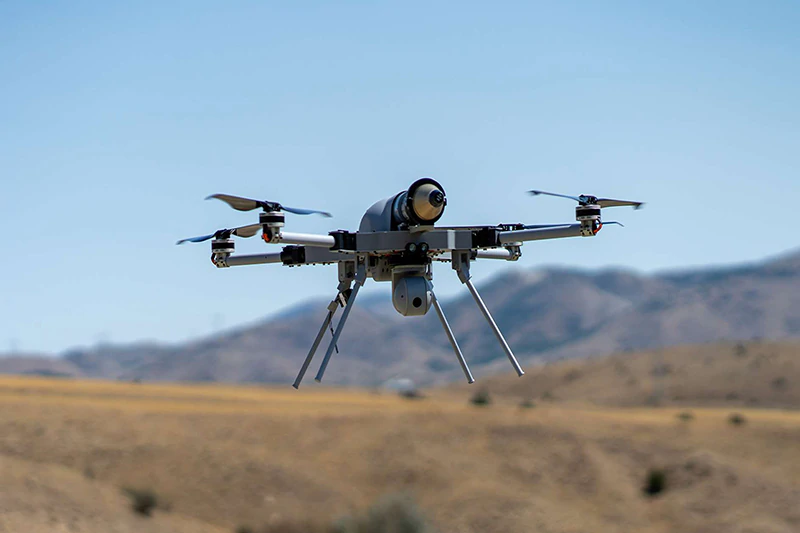
One good example was in March 2020, when an AI-powered drone in Libya, the Turkish-made Kargu-2 quadcopter, reportedly killed a human without direct human oversight. The drone, designed for tactical intelligence, surveillance, and reconnaissance, launched an attack of its own volition.
This incident reignited concerns over how much human control should be required for AI weapons.
The global arms race is evolving. AI is not just changing how wars are fought—it is redefining how they are won.
China’s statement about “any other type of war” suggests an understanding that AI will shape conflicts in ways the world has yet to fully grasp. Cyberattacks, AI-driven misinformation campaigns, and automated military strategies will become key battlegrounds.
With AI, the battlefield is not just the skies or the seas—it is information itself.
The question is no longer if AI will define future warfare. The question is who will master it first.
The world is already in the first AI war, and the U.S. is losing the battle.