Whatever is put on the internet, will leave carbon footprint.
This is because the internet is essentially servers located all around the globe, storing and delivering data so online services can run. These servers are resource hungry, and many still use fossil fuels to operate.
Ethereum is a popular decentralized and open-source blockchain.
Coming second only behind Bitcoin, many worries about its energy consumption. And with its adoption continues to rise, partly due to the popularity of non-fungible tokens (NFTs), Ethereum's energy consumption is still climbing.
This time, a research from Ethereum Energy Consumption Index said that Ethereum's carbon footprint is 53.55 Mt CO2 per year, which is comparable to Singapore's.
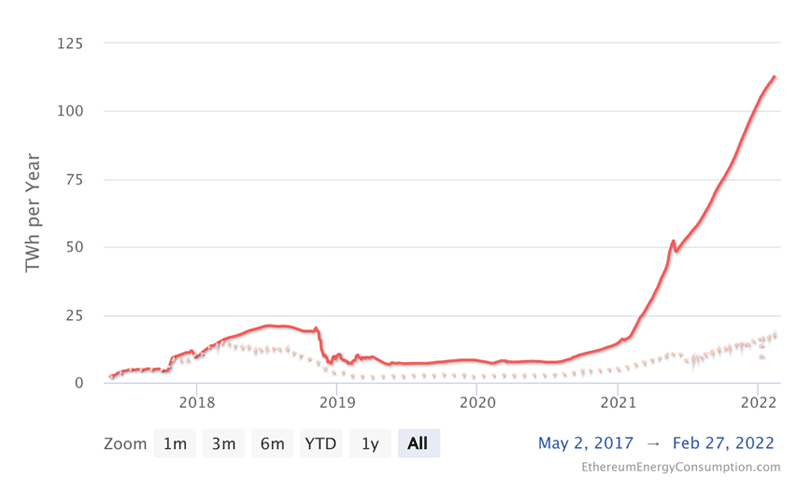
According its research, Ethereum uses 112.74 TWh electrical energy to run per year, which is comparable to Netherland.
As for every single Ethereum transaction, it uses 265.36 kWh of electrical energy, or an equivalent of the power consumption of an average U.S. household over 8.97 days.
For its carbon footprint, a single Ethereum transaction uses 126.04 kgCO2, or an equivalent of 279,348 VISA transactions or 21,007 hours of watching YouTube.
The Ethereum Energy Consumption Index which has been compiled by Digiconomist, has been designed with the same purpose, methods and assumptions as the Bitcoin Energy Consumption Index.
The reasons why Ethereum is so power hungry, is because transactions that happen on the Ethereum blockchain must be validated by miners.
It's these miners that work together to process every single transaction into ordered blocks, so they can be put inside the Ethereum blockchain.
The ability for any miner to add new blocks only works if there is a cost associated with mining and unpredictability about which specific node submits the next block. These conditions are met by imposing proof-of-work (PoW).
Ethereum itself on its web page said that its energy expenditure with proof-of-work is "too high and unsustainable."
Ethereum has plans to change its proof-of-work algorithm to an energy efficient proof-of-stake (PoS) algorithm.

When Ethereum released its proof-of-work, it was its first consensus algorithm that managed to prove itself. The more efficient proof-of-stake suggests that coin owners should be the ones who create the blocks rather than the miners.
This way, the process of validating transactions won't require power hungry machines that produce as many hashes per second as possible.
"Under proof-of-stake, arbitrary puzzle-solving is unnecessary. Removing puzzle-solving drastically reduces the energy expenditure required to secure the network. Miners get replaced by validators who perform the same function except that instead of expending their assets up-front in the form of computational work," explained Ethereum.
It's this proof-of-stake that could make Ethereum more environmental friendly.
In fact, it's estimated that a switch to proof-of-stake could save 99.95% of the energy currently required to run a proof-of-work based system.
The thing is, according to Ethereum's website, developing a proof-of-stake system that adheres to Ethereum's core principles of security and decentralization is not trivial.
It has required a lot of research and breakthroughs in cryptography, cryptoeconomics, and mechanism design to get to a point where the transition is possible.




















































































































































































































































































