
This 2020, Apple revieled a significant change to its MacBook computers.
While the computers appear to look the same as their predecessors, the chips that power them aren't anymore from Intel.
Apple has embedded its own 'Apple Silicon' M1 chip to replace Intel's, marking the end of a 15-year partnership where Intel processors powered Apple's laptops and desktop computers.
As opposed to Intel's x86 architecture, Apple's M1 chips are based on ARM technology.
This makes the MacBook lineup compatible with iOS and iPadOS apps.
And with that, one MacBook Air has been tested using the AnTuTu benchmarking app, to see how the processor compares to others in the competition.
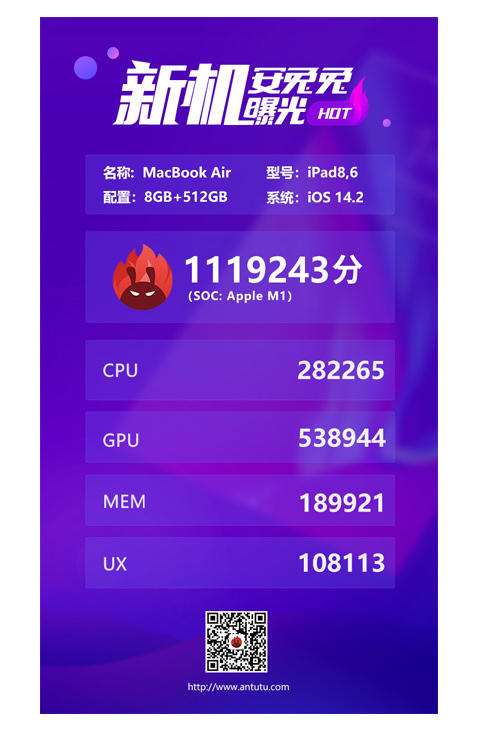
The findings is out of the ordinary, especially because the chip managed to push the benchmark to a new height, of over 1 million points on AnTuTu v8 iOS app.
AnTuTu has published the scores of the M1-based MacBook Air, and it manages to reach 1,119,243 points that includes a CPU score of 282,265, GPU score of 538,944, MEM score of 189,921, and UX score of 108,113.
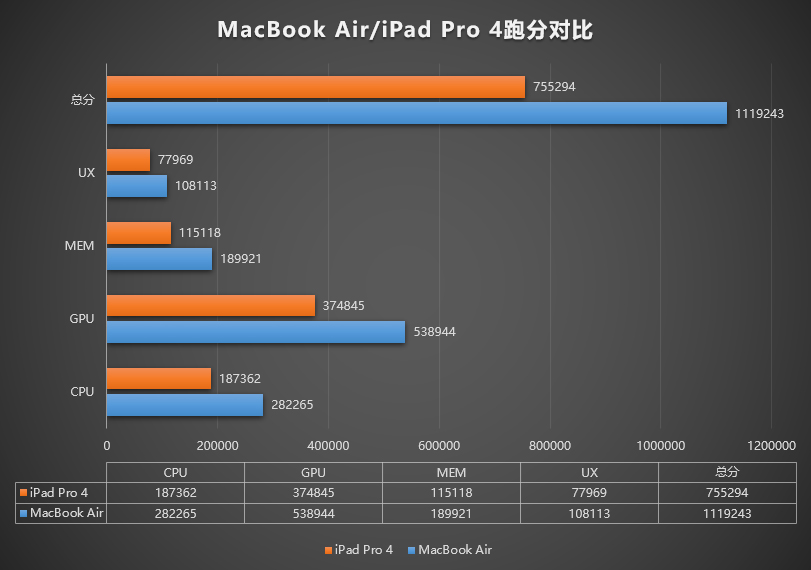
On its blog, AnTuTu compares the M1-powered MacBook Air with the 2020 iPad Pro 4 512GB storage version and claims that the MacBook Air leads by 50.65% in CPU score, 43.78% in GPU score, 64.98% in MEM score, 38.66% in UX score, and 48.19% in total score.
AnTuTu compares the M1-powered MacBook Air with the iPad Pro 4, because the latter is powered by the A12Z Bionic, a beefed up 64-bit ARM-based chipset of the original A12 presented in the iPhone XS.
While it is still a 7nm chip with old generation cores, the chipset is actually faster than the A14 present on the iPhone 12 family.
The M1 shares similarities with the A14, sharing the same 5nm architecture, but outperforms it in all segments.
This happens for a reason: efficiency.
Because phones have smaller batteries and bodies, Apple downgraded the A14 chipset on the iPhone 12 lineup from its maximum potential, in order to prevent it from consuming too much battery and overheating.
On paper, the M1 CPU is 78% faster and the GPU is 2.5 faster than the chipset inside of the iPhone 12 family.
In other words, the A12Z chip was one of the best chipsets available on Apple products, before the arrival of the M1.
And in this test, the M1 chip trumps the A12Z chip by a lot of points, making the MacBook Air touted to be the first to ever achieve one million points in AnTuTu v8 iOS app. These benchmarks stand as testimony to the performance capabilities of the M1 processor.
It should be noted that during the test, despite having macOS Big Sur full compatibility, AnTuTu recognized the MacBook Air as an iPad Pro running on iOS 14.2.
This is a confusion the the iOS app.
Another thing to consider is that, at the moment of the test, the score for the iPad Pro 4 is based on an average result of likely thousands of tests whereas the score for the M1-powered MacBook Air can be considered a maximum result.
Following the AnTuTu test, the MacBook Air with M1 chip was also spotted on Geekbench as well, also boasting impressive scores.
On Geekbench, it was revealed that the MacBook Air has a 8GB RAM, running on macOS 11.0.1.
The M1 Apple Silicon processor managed to achieve a single-core score of 1,687 and a multi-core score of 7,433. The listing also reveals that it has a base frequency of 3.2GHz, which is significantly higher than the base clock speed of 2.3GHz of the Intel Core i9-9880H processor found in the 16-inch MacBook Pro.
It has been for a long time that Intel is compared to ARM.
Traditionally, the x86 architecture of Intel targets peak performance. Intel can fully do this knowing that the chips are originally meant and designed for computers that prioritize speed over battery consumption. Intel manages this using CISC (Complex Instruction Set Computing)
This is a contrast to ARM, which is RISC (Reduced Instruction Set Computing). Traditionally, ARM chips target energy efficiency rather than performance.
ARM processors tend to rely more heavily on software for performance features while Intel relies on the brute of its hardware.
But this started to change when the 64-bit architecture was introduced.
ARM's iteration of the 64-bit architecture came in 2011. And this was when its low power approach is perfectly suited to the 3.5W Thermal Design Power (TDP) requirements of mobile. ARM managed to this, while delivering performance that matches Intel’s chips.
What's more, ARM managed to greatly reduce efficiency by creating smaller CPU transistors. During the time that ARM managed to create a 5 nm chipsets, Intel was still stuck at 7 nm.
Smartphones didn’t make the switch to 6-bit until 2012, around a decade after PCs. In a nutshell, 64-bit computing leverages registers and memory addresses large enough to use 64-bit long data types. Apple was first in introducing the first 64-bit processor for its phones, ahead of its Android rivals.
The move didn't change how computing works inside the phones. However, the 64-bit helped phones run calculations and processing much more efficiently. It also improve 3D rendering accuracy, encryption speed, and simplifies addressing more than 4GB RAM.
It was since then that ARM's low power approach isn't necessarily holding back its chipsets' performance.