Devices made by Apple aren't cheap. In fact, they are considered amongst the most expensive for their respective market.
And yet people keep buying them, and keeping them for years.
As a brand capable of creating "cults," Apple managed to dominate the U.S. market by controlling more than 50% of all smartphones available in the country.
For the first time since the original iPhone was introduced by Steve Jobs, Apple pulled ahead in the U.S., by selling more its phones than all Android manufacturers was capable of, combined.
The achievement was reached during the quarter that ended in June, after Apple managed to maintain steady gains for years, according to data from Counterpoint Research, as reported by Financial Times.
What this means, while Samsung maintains its title as the world’s biggest smartphone manufacturer, Apple continues to have a stronger grasp on the U.S. market than the South Korean conglomerate giant.
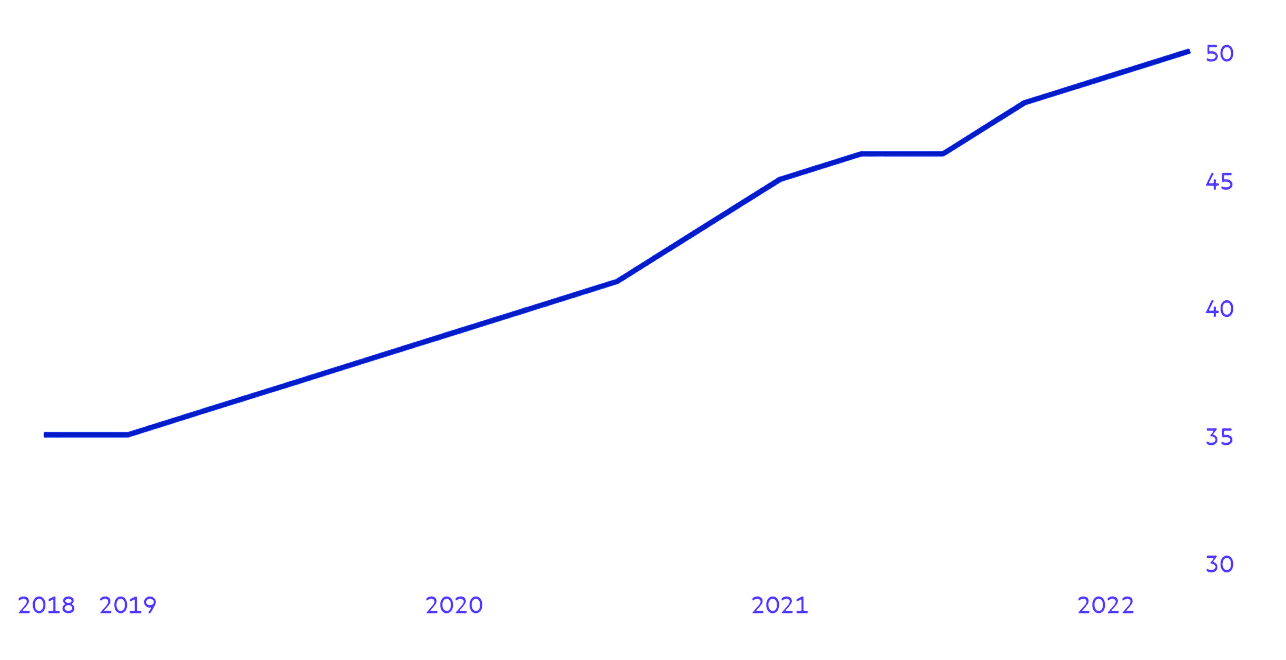
According to Counterpoint’s metric, called “active installed base,” it includes people who bought new iPhones, and also second-hand iPhones. This means that the number is not limited to 2022 smartphone shipments.
This is only another word of saying that 50% of all smartphone users in the U.S. are iPhones.
So here, the people included in the research, are those that aren't spending hundreds or thousands of dollars for new phones, but still subscribed to Apple services.
In other words, anyone who buys an iPhone - whether it’s second-hand, third-hand, or fourth-hand - is certainly giving Apple money and/or at the very least, data.
And with that business model and approach, Apple is making a success that nothing can replicate.
The recurring revenue has helped CEO Tim Cook build Apple into the world’s most valuable company with a market capitalization of more than $2.5 trillion.
Android, as the operating system from Google, is a very capable operating system. It's very versatile, flexible, and powerful.
The operating system is so customizable that it is installed on a wide variety of devices, including phones made by Samsung, Sony, Redmi, Lenovo, OnePlus, Oppo, Xiaomi, Vivo, and the list goes on.
This is very different from Apple, which makes and sells its iPhones by itself.
Apple first introduced the iPhone in 2007, when the American phone market was dominated by competitors like Blackberry and Nokia.
Apple quickly rewrote the rule book, giving a chance for developers to thrive in the soon-to-be-competitive mobile world.
At that time, Android phones were about to be released, and because of that, Apple's head start gave the company about a year to create a strong foundation to build its empire.
It's worth noting that the news of the milestone came just days before the company is set to unveil its 2022 iPhone models.
Just when Samsung has already released its last high-end devices for 2022, which include the Galaxy Z Fold 4 and Galaxy Z Flip 4. And with Samsung Unpacked event out of the way, all eyes are turned to the iPhone 14 launch.
While Apple's achievement is a huge mock to Samsung, the tech titan is not there on its own.
While the company does control both hardware and software for its iPhones, Apple does have lots of suppliers, which also include Samsung.
For the 2022 iPhones, Apple uses Samsung Display on 80% of the iPhones' panels.
It's also worth mentioning that even through Apple managed to sell more iPhones in the U.S., elsewhere worldwide, Android phones tend to be far more popular in terms of units sold, in which Samsung tops them all.
Globally, Android phone share has declined to just under 70%, down from a peak of over 77% in 2018. By contrast, iPhones have grown to over 25% of phones around the world, up from under 20% in 2018.




















































































































































































































































































