War is never a good thing for the people that suffer from it first hand.
The physical consequences of war include in injury, illness, malnutrition, disability and death. Civilians, especially women and children, suffer atrocities in particular.
The widespread trauma caused by these atrocities and suffering of the civilian population is another legacy of these conflicts, creating extensive emotional and psychological stress.
Present-day internal wars generally take a larger toll on civilians than state wars, due to the increasing trend where combatants have made targeting civilians a strategic objective. In Israel's war against the Palestinian's Hamas, after the latter's surprise attack to the former, the effects of the assault is far-reaching.
And this is when a photo of a uniform patch depicting a map of "Greater Israel" during operations in Gaza goes viral, raising the alarm to what could be the Zionists' true goal.

In what appears to be the sleeve of an Israeli Defense Force soldier's uniform, a patch displays a map that includes not only Israel but also large portions of neighboring countries.
These territories encompass all of Palestine, Lebanon, Jordan, as well as parts of Syria, Iraq, Saudi Arabia, and Egypt.
The Hebrew inscription beside the map clearly reads: "The Promised Land of Israel."
The image of the soldier wearing the controversial patch quickly surfaced on social media, sparking widespread reactions. Many online comments suggested that the map symbolizes the expansionist goals of Zionist Israel. Critics argue that the map reflects Israel's grand vision, comparing it to historical imperial ambitions. Some have even drawn parallels to Nazi Germany’s "Lebensraum" concept, which promoted territorial expansion to secure living space for a "chosen race."
The notion of "Greater Israel" and "The Promised Land of Israel" has been a point of contention since the establishment of the Israeli state in 1948.
Proponents view it as a fulfillment of religious prophecy, while critics condemn it as a pretext for territorial expansion at the expense of neighboring countries' sovereignty.
The concept of "Greater Israel" is rooted in particular interpretations of Zionist ideology, which suggest that the biblical Promised Land extends from the Nile River in Egypt to the Euphrates River in Iraq, and from the Litani River in Lebanon to Medina in Saudi Arabia.
This idea is often linked to a biblical passage from Genesis 15:18-21, which states: "On that day the Lord made a covenant with Abram and said, 'To your descendants I give this land, from the Wadi of Egypt to the great river, the Euphrates- the land of the Kenites, Kenizzites, Kadmonites, Hittites, Perizzites, Rephaites, Amorites, Canaanites, Girgashites, and Jebusites.'"
However, the concept of the Promised Land has evolved over time and carries multiple interpretations, both biblical and political. Its meaning can vary significantly depending on historical context or ideological stance.
In modern times, the most widely accepted definition of the Promised Land includes the current State of Israel along with the Palestinian territories.
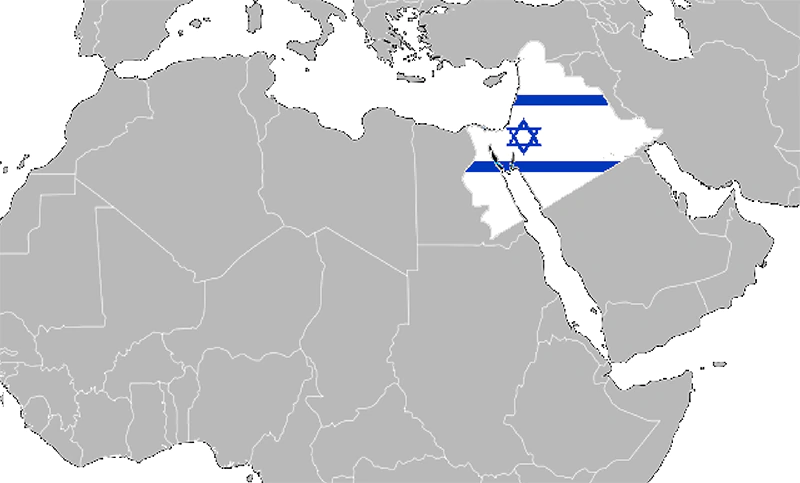
More expansive definitions, favored by some Revisionist Zionists, envision the Promised Land extending to include territories such as the former Emirate of Transjordan and even the Sinai Peninsula.
While the concept remains deeply symbolic for many, it also continues to spark controversy, as it is seen by some as a reflection of historical ambitions for territorial expansion, while others interpret it as the fulfillment of religious prophecy.
Pro-Zionists, far-right Israelis and their supporters have openly expressed their territorial desires, and here, the war between Israel and Palestine's Hamas is fueling their ambitions even more.
It's worth noting that the web only sees one photo of this uniform patch, which created the speculations. Some suggest that it's just a campaign created against the Israel, but others believe otherwise.




















































































































































































































































































