It's estimated that there are millions of species living on Earth in the past and present, and that more than 10,000 new ones are discovered per year.
Out of that many, only a fraction of them are known and documented. And among them, only a small number are publicly known. And among them, an extremely small amount can create rounds of virality on the internet, due to whatever reason.
One of these extremely rare exhibits, include Sacabambaspis, an extinct animal living in the Ordovician period.
When a reconstructed model of the animal was completed In August 2022, and is then displayed at The Natural History Museum of Helsinki, Finland, it quickly caught the attention of netizens at Twitter after a user shared a photo of it to the platform.
It didn't take long after that, that the internet responded to the species by creating fan arts, nail art, memes, and more.
Absolutely dying pic.twitter.com/RhbIPBl3sQ
— Kat Turk (@kat_scans) August 30, 2022
Sacabambaspis was first discovered back in 1986, but it only gained the internet's attention, starting in Japan, when some Japanese internet users around Futaba Channel (2chan) noticed the unique traits of this Sacabambaspis model.
In response, some users started recreating the model, and draw illustration of the animal.
Then, in June 6th, a Japanese blog for natural science, cited that the model of Sacabambaspis is too low in quality, and may not depict how it really was when it was living.
On June 8, a Japanese online journal propelled the Sacabambaspis meme even further by publishing an article titled “The pathetic state of this reconstructed model of the Sacabambaspis at the Helsinki Museum of Natural History is going viral.”
Since then, many online illustrators and artists started reimagining the species, but this results in a series of cute fan art of the animal.
Artists have then released stickers of the animal for the short-messaging app LINE, while some others started merchandising the animal on SUZURI, a Japanese e-commerce site for individuals.

The species of fish has since gone rival because of its looks.
Users seem to have found the cuteness side of the animal, and made an amusement in the botched reconstructed model.
This online trend of the extinct animal received great attention among other social media users, that the "Sacabambaspis" term becomes a trending topic on social media platforms.

It's worth noting that the main reason why Sacabambaspis became viral in Japan, is because the public in Japan has become so fond of the looks of yuru-chara.
Yuru-chara can be described as Japanese mascot characters distinguished by their cute (kawaii) and unsophisticated designs, which often incorporate motifs that represent local culture, history or produce.
In Japan, yuru-chara is often created to promote a place or region, event, organization or business.
In the end, because such characters, which have slightly dumb and uncanny-looking ones, have a tendency to become popular due to their meme-potential.
And Sacabambaspis here checks all the boxes.
Sacabambaspis clearly fits the Japanese culture.
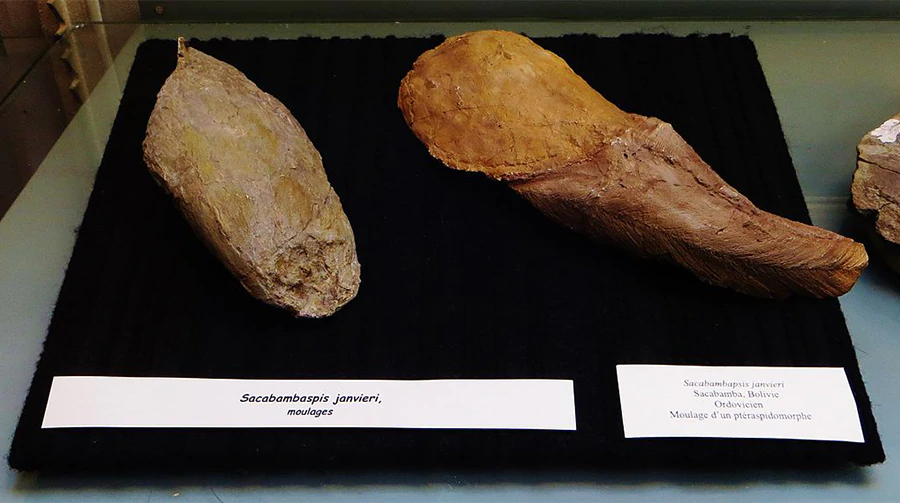
Sacabambaspis, considered as a species of a jawless fish, lived about a million years ago, and can be described to have tadpole-like resemblance with an oversized head, and frontally flared nostrils and bulging eyes that resemble a car’s headlights.
And with its uncanny triangular grin, together, the depiction creates an unspeakable expression that deserves attention.
It’s said that the species of the fish may have lived with a mouth that cannot be closed, sucking in scraps of food.
From the look of it, the fish's lack of fins means that it might not be a good swimmer.
But making up for what it lacked, it's said that the fish is moderately armored, and has a open nerve endings as lateral lines to help it detect predators.
Because this fish lived in the Paleozoic era, it was living in the thriving moment where rich variety of marine life flourished in the vast seas.
The era was when the first primitive plants began to appear on land, and it happened before the second largest mass extinction of all time ended the period.






















































































































































































































































































