When Age of Empires II first launched in the final months of 1999, it carved out a defining chapter in the real-time strategy genre.
Players spent hours managing complex chains of resources, building massive stone castles, and commanding vast historical armies across rich isometric battlefields.
The late 1990s were a golden era for PC gaming, yet few titles from that era managed to retain their original magic quite like this one.
What made the game an everlasting classic was its precise balance of deep economic management and tight tactical combat, combined with a highly active community that refused to let the title fade into obscurity.
Decades later, the launch of Age of Empires II Definitive Edition proved that its fundamental appeal spans generations, successfully bridging modern visual enhancements with the identical, finely-tuned mechanics that hooked players in the late nineties.
Yet, maintaining a live game ecosystem that spans decades introduces modern security challenges that developers back in the days could never have anticipated.
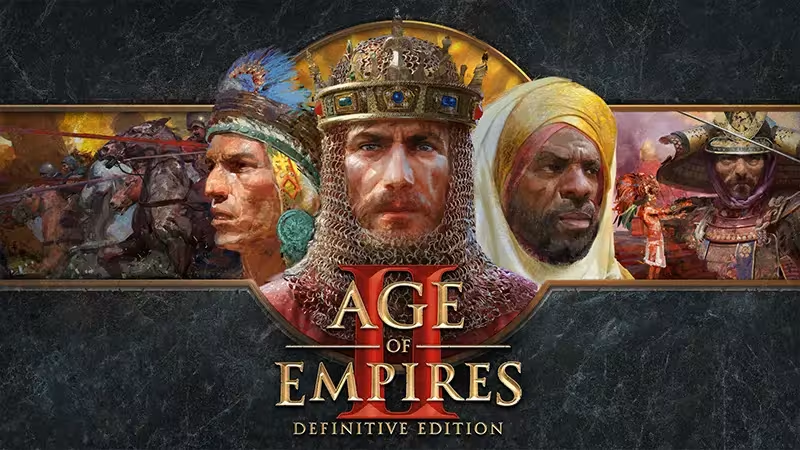
As part of its July 2026 update cycle, Microsoft addressed a critical remote code execution vulnerability tracked as CVE-2026-50663 within the Definitive Edition client.
The flaw involved a relative path traversal issue where a malicious user could exploit user-generated content systems.
By inviting an unsuspecting victim to a custom multiplayer lobby or sharing a booby-trapped scenario file, an attacker could potentially write unauthorized files outside the designated game directory.
This specific loophole allowed for arbitrary code execution, which could theoretically give remote attackers complete control over the victim's operating system.
The discovery and resolution of this vulnerability highlight a broader shift in how legacy software environments are secured.
This particular patch arrived during a record-breaking month for Microsoft security updates, which saw the remediation of nearly 600 distinct vulnerabilities across various platforms.
The sudden surge in security discoveries is largely attributed to Microsoft's deployment of a new internal security scanning system known as MDASH, a multi-model agentic scanning system powered by AI.
By using autonomous AI agents to scan complex codebases, uncover subtle flaws and architecture exploits across its massive software portfolio, and patches record number of security vulnerabilities, much faster than traditional human review teams could achieve alone.
By applying these advanced automation tools to classic franchises, the tech giant ensures that nostalgia does not come at the cost of cybersecurity.
Gamers who continue to play Age of Empires II are advised to update their game clients via Steam or the Microsoft Store to the latest version to ensure they remain protected against this exploit.
This ongoing support proves that Age of Empires II is no longer just a piece of software from the past, but a living, breathing platform that receives the same level of security enterprise attention as modern operating systems.
This level of technological investment makes sense when looking at the unique legacy of the franchise.
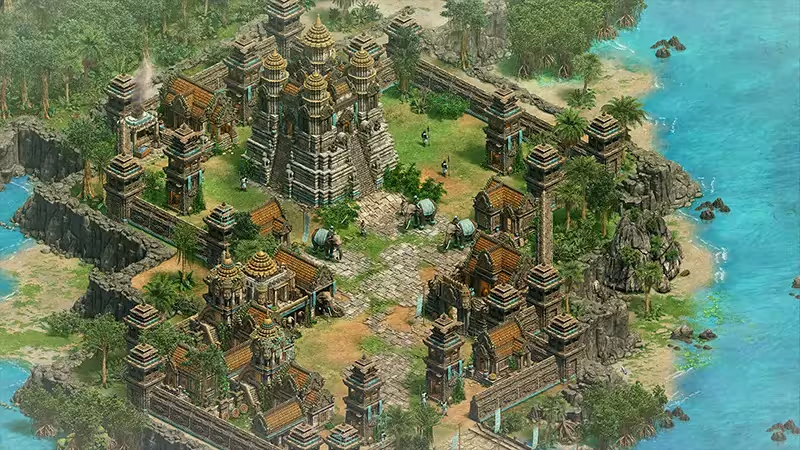
Age of Empires II has achieved a rare, mythic status in gaming history, surviving the rise and fall of LAN parties, the death of its original MSN Gaming Zone matchmaking service, and the transition of PC gaming into the digital distribution era.
While other strategy titles faded away, this game fostered a competitive scene that evolved from standard dial-up matches into massive global tournaments with significant prize pools.
Players dedicated years of their lives to mastering the hyper-specific build orders of 39 different historical civilizations (45 if all the expansion packs added), memorizing exactly how many villagers to assign to sheep, wood, or gold in the opening minutes of a match.
Each of these factions features unique architecture sets, specific military bonuses, distinct team bonuses, and unique units trained directly from the Castle.
The enduring magic of the game lies in how its core loop rewards both brute-force speed and deep intellectual strategy.
A casual player can enjoy the thrill of guiding the Britons or the Franks through the Dark Age up to the Imperial Age, slowly constructing a beautiful walled city.
Meanwhile, grandmaster players operate at hundreds of actions per minute, micro-managing individual archers to dodge incoming mangonel stones while simultaneously orchestrating a massive global economy.
This multi-layered depth is why the game remains a staple on streaming platforms and continues to receive brand new official expansion packs nearly thirty years after its conception.
By deploying cutting-edge AI to patch and protect this legendary title, Microsoft is not just updating a video game, but preserving an active cultural touchstone for millions of strategy fans worldwide.














































































































































































































































































