
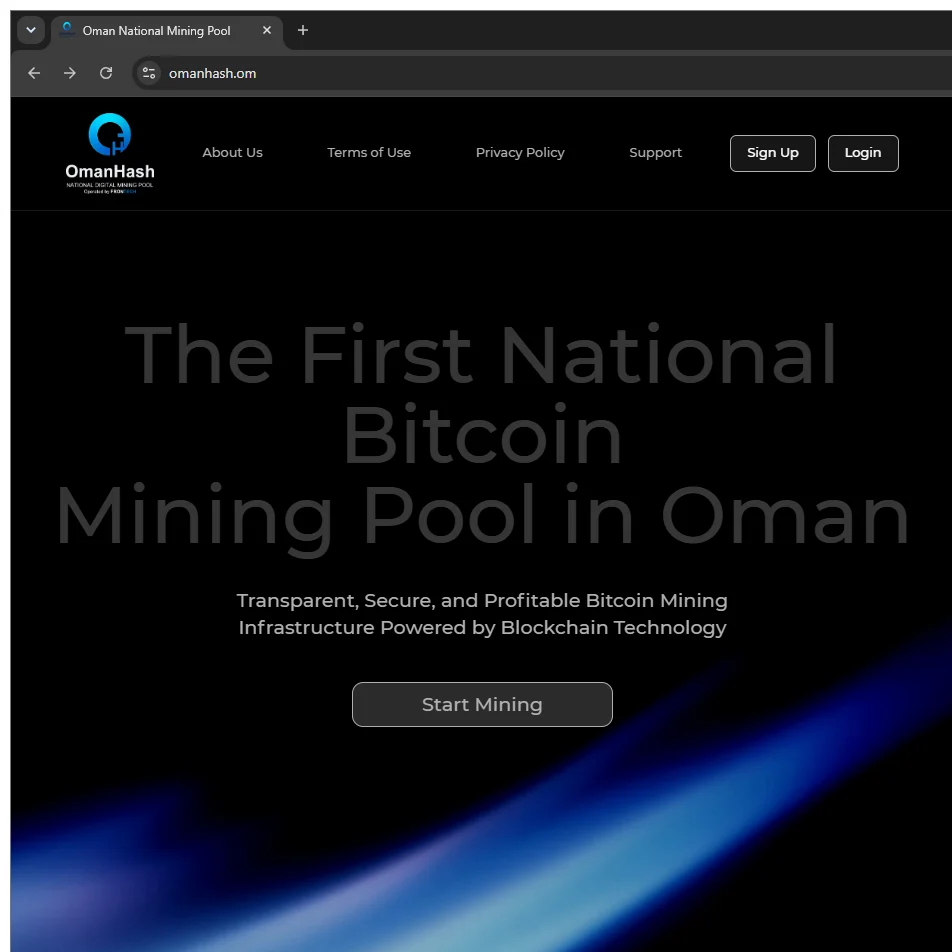
Oman’s Ministry of Transport, Communications and Information Technology officially launched Omanhash.om as the sole mandatory national Bitcoin mining pool for all licensed operators in the country.
According to the announcement, it is operated in partnership with the local Omani company Frontier Technologies LLC and uses technology and liquidity infrastructure from Enegix Global (which previously handled a similar sovereign project in Kazakhstan).
This fits into Oman’s longer-term push.
The country has already seen more than $700 million invested in Bitcoin mining and data center infrastructure, particularly in the Salalah Free Zone, including major facilities launched in prior years.
The national pool represents the next regulatory step: consolidating operations under a transparent, locally hosted framework aligned with Oman Vision 2040.
Oman’s motivations extend well beyond simple crypto enthusiasm.
As a nation seeking to reduce its traditional dependence on hydrocarbon exports, the country views Bitcoin mining as a practical way to monetize its abundant energy resources, stimulate technological development, and generate new revenue streams. The initiative aligns closely with Oman Vision 2040, which emphasizes building modern digital infrastructure, attracting foreign capital, and creating high skill employment opportunities in emerging sectors.
And by making a mandatory national pool gives Oman's authorities better visibility and oversight over energy consumption, mining revenue, and newly created bitcoin, turning what could be fragmented private operations into a coordinated, regulated national asset.
It also positions Oman as a serious player in the regional digital economy.
The official site (Omanhash.om) is live and emphasizes real-time monitoring, analytics, API access, and secure data hosting within Oman.
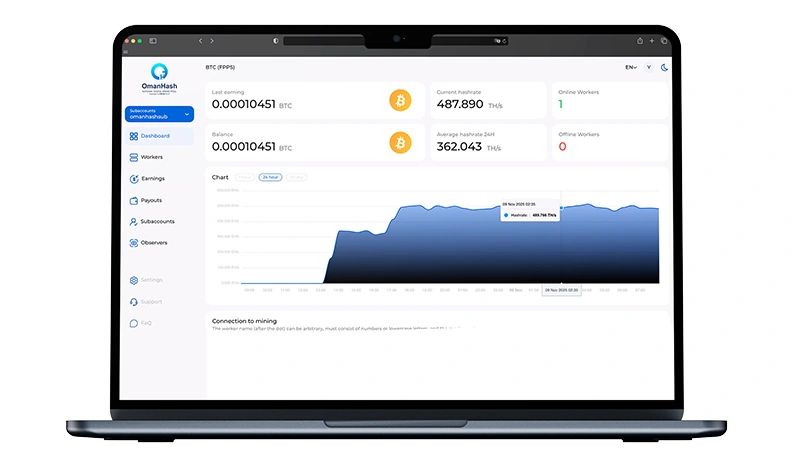
The pool itselfuses a Full Pay-Per-Share (FPPS) reward model with daily automatic payouts once the minimum threshold of 0.001 BTC is reached, delivering predictable rewards based on contributed hashrate rather than block luck. Participants can monitor performance through dashboards, access real time analytics, and receive automatic daily payouts once they reach the modest minimum threshold.
The pool targets an initial hashrate of roughly 10 EH/s.
Everything is designed for local compliance and security, with the platform currently focused on Bitcoin mining.
At the same time, the broader Bitcoin market continues its steady evolution.
As of mid June 2026 the leading cryptocurrency trades near $64,500 after a period of consolidation following earlier swings in the cycle.
Network hashrate sits in the approximate range of 830-950 EH/s, indicating continued strong mining activity and network security even as price action remains range-bound.
Oman’s approach stands out because it combines economic pragmatism with regulatory control.
Rather than leaving mining entirely to unregulated private actors, the government has created a structured environment that can scale existing investments while maintaining sovereignty over a growing slice of global hashrate.
For miners already active in Oman this means adapting to a new centralized routing requirement, yet it also offers the benefits of local infrastructure, clearer rules, and potentially more stable long term operations within a supportive policy framework.
Globally this development adds to the conversation about how nation states are increasingly treating Bitcoin mining as legitimate industrial activity. Some observers see risks of concentration, while others view it as evidence that more governments recognize the value of participating directly in the network rather than remaining on the sidelines.
Either way, Oman’s launch demonstrates a deliberate strategy to turn energy resources and regulatory authority into a competitive advantage in the digital age.