
In the fast-paced world where everyone is seemingly in a hurry, speed is everything.
And in the era where people are literally connected to the internet 24/7, the demand of faster connection is always high.
After 4G LTE and 5G, and just when the world is expecting to see 6G, researchers in Japan just set a staggering speed record for data transfers.
With a speed of up to 1.02 petabits per second, the researchers managed to utilize the speed to transfer data over a distance of 51.7 kilometers.
What this means, the technique is compatible with existing cable infrastructure, allowing real-world implementation that is entirely possible, and not just limited to a laboratory setting.
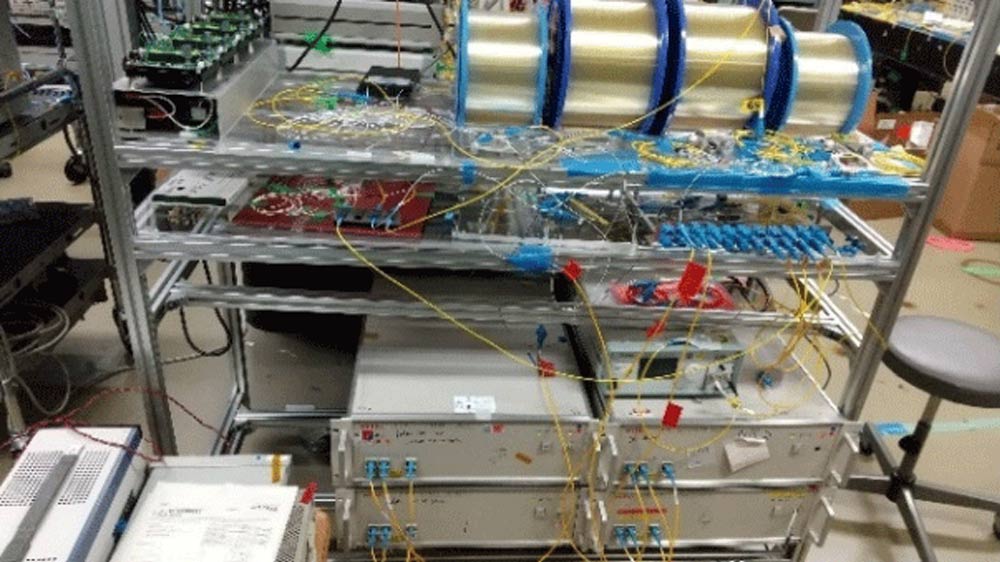
Although high-speed wireless technologies are still in many headlines, optical cables remain the backbone of the world's internet.
After all, most of the internet runs underwater.
And here, researchers from Japan’s National Institute of Information and Communications Technology (NICT), broke the speed record using a custom multi-core fiber optic cable.
The researchers successfully achieved the speed by not utilizing mixed-signal, multi-mode approach and instead reduced the transmission to just four "modes" each sent down to one of the four cores inside the custom fiber optic cable with a standard diameter.
And to ensure a stable speed, the researchers relied on some very technical optical amplification systems and signal modulation approaches.
With the hardware, the 1.02 petabits per second speed is equivalent to sending 127,500 GB of data every second, which, according to the researchers, is also enough capacity for over "10 million channels of 8K broadcasting per second."
What makes this speed staggering is that, the speed is also 100,000 times faster than the promised next generation of high-speed gigabit connections providing internet to home users.
This is a huge step up to what the researchers at NICT accomplished back in December 2020.
At that time, the NICT made the first successful 1 petabit per second transmission of data over a standard diameter fiber optic cable.
While a speed improvement to 1.02 petabits per second just a year-and-a-half later isn't a huge bump. But it's certainly an impressive achievement, due to the hardware being used, which opens the possibilities of even faster connections in the close future.

To put it in details, in 2020, the NICT researchers sent the data down a fiber optic cable with only one single core. To compensate, they used a multi-mode technique where multiple signals were mixed together during the transmission.
In total 15 "modes" were sent down the fiber together.
"The capacity of the standard single-core single-mode fiber currently used for short and long-distance optical communication systems is considered to be limited to about 250-300 terabits per second. In order to solve this problem, research has been advanced on multi-core fibers with increased cores (optical paths) and multi-mode, multi-core fibers," the researchers noted in a website post.
While the speed achievements were impressive, the multi-mode technique requires dedicated hardware to unscramble the signals and extract useable data within.
This requires the development and deployment of specialized integrated circuits across an entire network and expensive upgrades, making it a harder sell to internet service providers despite the massive bandwidth gains.
The upgraded hardware that boosted the speed to 1.02 petabits, doesn't have those issues.
The hardware used in the 1.02 petabits breakthrough is completely compatible with conventional transceiver hardware. No new fiber optic cabling is needed.
This breakthrough comes just in time when 5G has become more widespread, and with 6G just around the corner. With the demand of faster data transfer is high, NICT's research should provide internet service providers a sizeable head start.