An international group of scientists from Technical University of Denmark (DTU) and Chalmers University of Technology in Gothenburg of Sweden, have managed to push beyond the boundaries, and achieve a never-before-seen data transfer of 1.84 petabits per second.
To put it into another perspective, if pornography is one of the largest web traffic contributors of the world, 1.84 petabits per second speed allows the transmission of 230 million porn photographs delivered per second, or a lot more than one hundred 4K videos streamed per second.
It's also an equivalent of twice of the world's internet traffic into that one single fiber optic cable, every day.
The research used a single photonic chip (or "chip-scale light source"), and connected it to single 37-core fiber optic cable as a transmission channel.
The team then demonstrating the aforementioned data transmission speed to transfer data over a distance of 7.9 kilometers.
The research (PDF) was authored by Asbjørn Arvad Jørgensen and his colleagues, and is named "Petabit-per-second data transmission using a chip-scale microcomb ring resonator source."
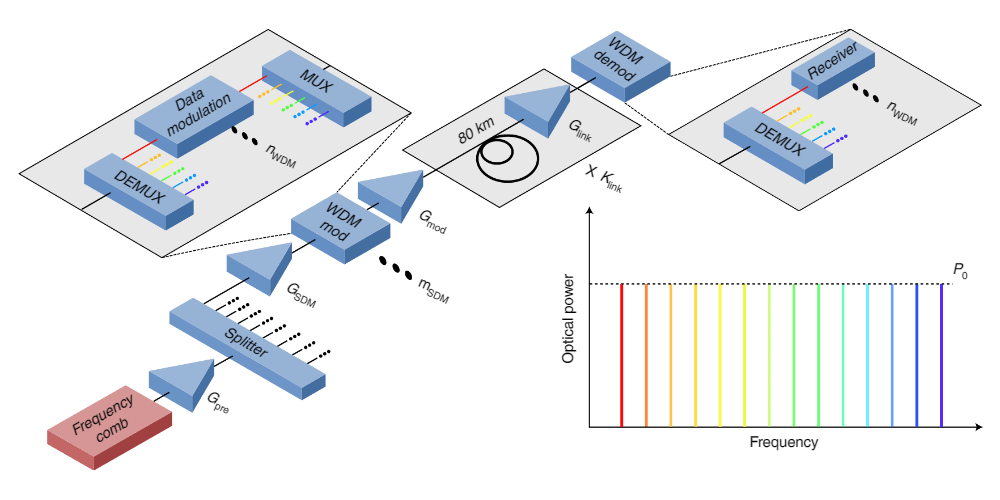
First, a laser is used to create a rainbow spectrum of many colors, i.e., many frequencies. Second, the scientists divided the data stream into 37 individual sections.
Each section has its own fiber-optic cable, and each of these channels was then split into 223 data chunks represented by the different frequencies in the electromagnetic spectrum through a "frequency comb."
It's this frequency comb of equidistant spikes of light across the spectrum that allowed data to be transmitted in different colors at the same time without interfering with each other.
In other words, the team managed to transmit the data in at the same time, without any interference, because of using different frequencies.
In turn, this massively increased the capacity of each core.
The final result, as Jørgensen explained, was the ability to send an amount of data so large that no computer technology existing at the moment of the research, can supply or receive.
As the proof-of-concept, the scientists instead passed "dummy data" through all the channels, before testing the output of one channel per time to confirm the data was actually sent and it could be recovered in its original form.
"The average internet traffic in the world is about a petabit per second. What we transmit is double that. It’s an incredibly large amount of data that we’re sending through, essentially, less than a square millimetre [of cable]. It just goes to show that we can go so much further than we are today with internet connections," the research explained.
According to Jørgensen, the entire system designed for the experiment needs a single laser firing continuously, a frequency splitter, and separate devices to encode data into the output streams.
But the components can be made simple and compact, all these could be integrated into a single chip.
This can be made possible because the entire apparatus is about the size of a matchbox.
But what is so special about the chip is that, it produces a frequency comb with ideal characteristics for fiber-optical communications, without having to be optimized for this particular application.
"In fact, some of the characteristic parameters were achieved by coincidence and not by design," said Victor Torres-Company. "However, with efforts in my team, we are now capable to reverse engineer the process and achieve with high reproducibility microcombs for target applications in telecommunications."
The experimental demonstration showed that a single chip that uses a contemporary state-of-the-art commercial equipment, could easily carry 1.8 petabit of data per second, that would otherwise require more than 1,000 lasers.
Theoretically, optimizations and tweaks could make this chip transmit up to 100 Pbit/s. This could be possible by creating more frequencies, and splitting the frequency comb into more spatial copies and then optically amplifying them.
The team also theorized that if their system is built to the size of a small server, it could easily transmit as much data as 8,251 matchbox-sized devices currently do when set in a single parallel system.
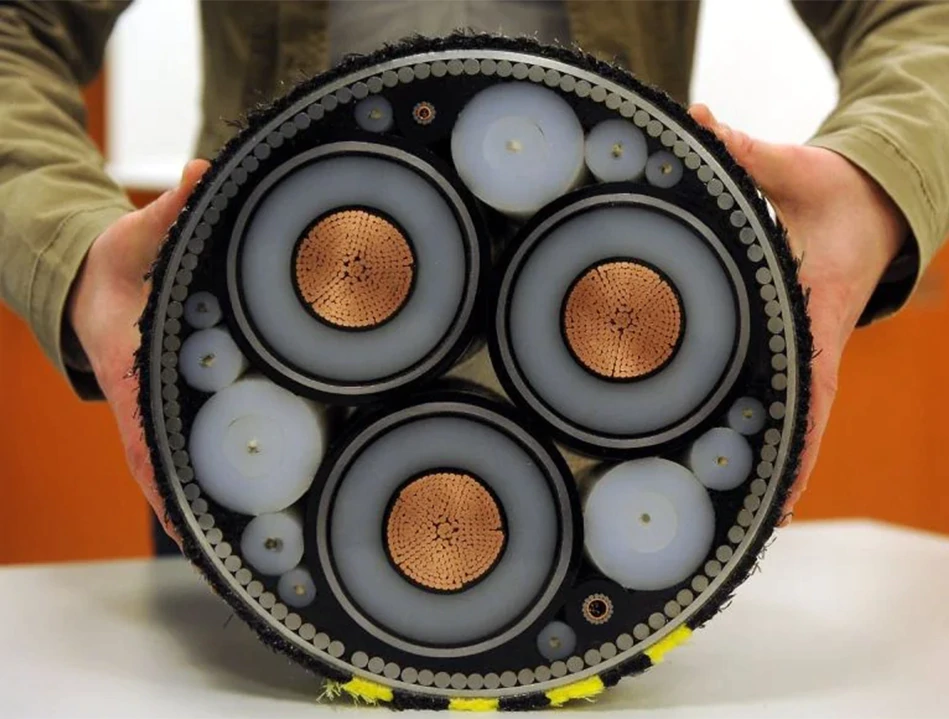
As the research also explained, the entire world is already connected, and that is possible using "optical fiber communication" as "the backbone of the internet."
The thing is, essential core technologies are approaching their limits in size, speed, and energy efficiency.
With more and more data being transmitted through these underwater cables, new cables should be spanned, or new technologies breakthroughs are needed to further scale the data transmission capacity, slash energy cost, and increasing the bandwidth..
And this work by the scientists from the Denmark and Sweden, shows that "a single optical frequency-comb source based on a silicon nitride ring resonator" can bring internet technology into a new height.
And that height, is the petabit-per-second realm.
The researcher assured, that the unprecedented feat could help bring silicon photonics one step closer to reality with massive improvements for everyone.