The Northrop B-2 Spirit, better known as the Stealth Bomber, is more than just a marvel of modern aviation—it's the quiet specter of American airpower.
Engineered to silently slip through the world's most fortified airspaces, this flying wing is built to carry out long-range missions with devastating precision, armed with either conventional or nuclear payloads.
With its sharp, alien silhouette and radar-defying skin, the B-2 doesn’t roar across skies—it glides like a phantom. Conceived in the crucible of Cold War tension, it represents the pinnacle of aerospace stealth technology, combining strategic reach with near-total invisibility.
To America’s adversaries, the B-2 isn’t just an aircraft. It’s a ghost in the sky.
And this time, someone wants to sell it on Facebook.
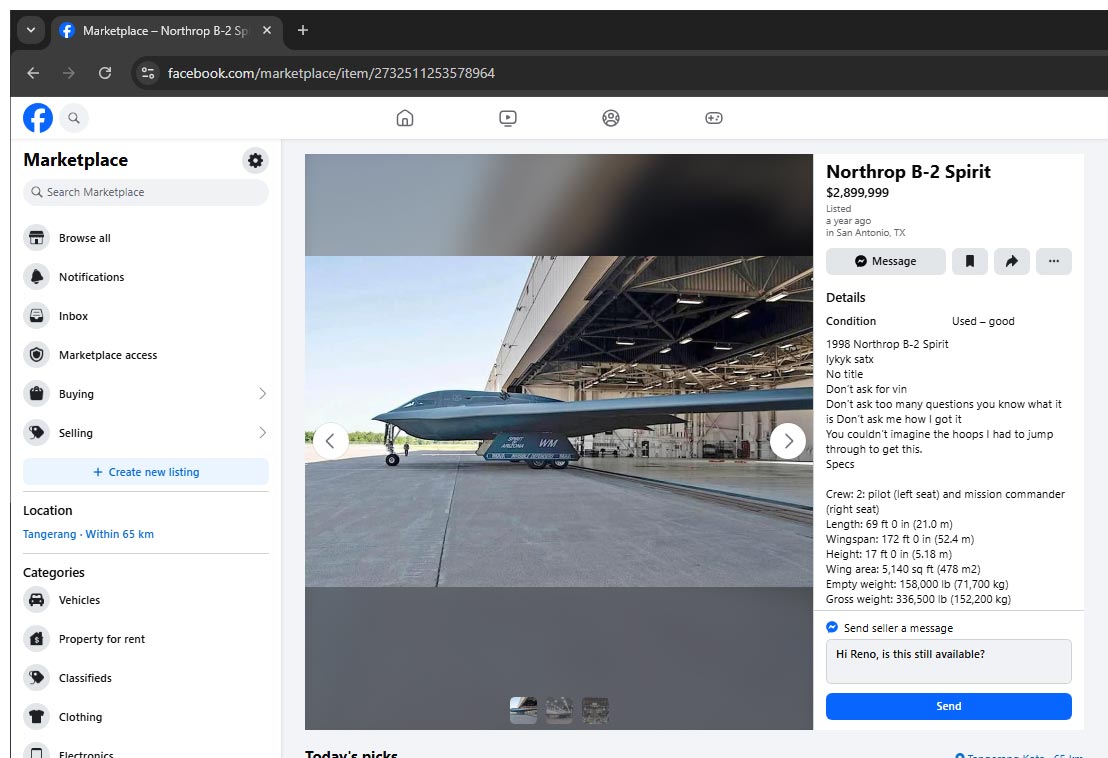
"Don’t ask too many questions you know what it is. Don’t ask me how I got it," the seller says. "You couldn’t imagine the hoops I had to jump through to get this."
And the internet couldn't be more astonished, if not amused.
The B-2 bomber is no doubt, one of the most iconic marvels of the sky.
The heavy strategic bomber has a unique shape, meticulously sculpted to make the aircraft nearly invisible to radar and other detection systems.
Its matte charcoal-black paint is designed to reduce visual detection at night, and blend with the sky's ambient light, especially at high altitudes. It's also purposefully chosen to minimize light reflection, which could give away its position to the naked eye or optical sensors. And not only that, because the paint is also a classified, radar-absorbent material (RAM), which absorbs incoming radar signals instead of reflecting them, drastically reducing radar signature.
In other words, it's equipped with stealth technology, meant to penetrate sophisticated anti-aircraft defenses.
And in order to be what it is, the B-2 is designed to be a subsonic bomber, since exceeding the speed sound (supersonic speeds or Mach 1+) will create shockwaves and significant heat, both of which are extremely detectable by radar and infrared sensors.
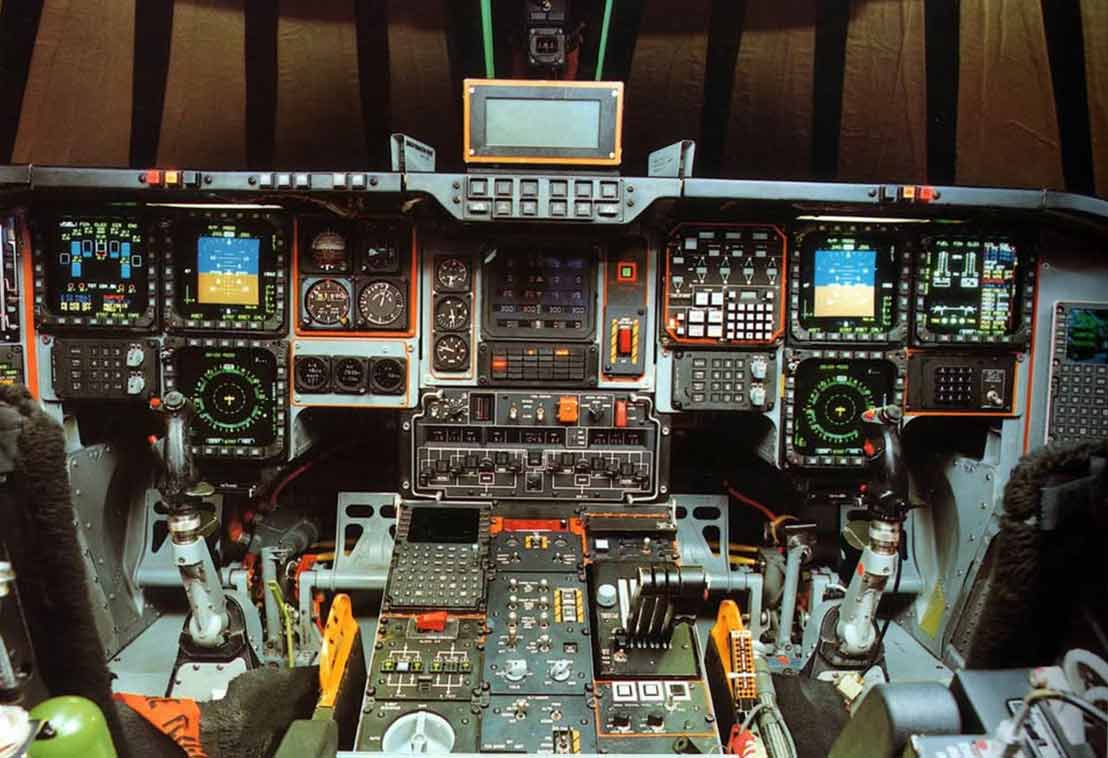
The crew of two plane was produced from 1988 to 2000, with the ability to drop conventional and thermonuclear weapons, such as up to eighty 500-pound class (230 kg) Mk 82 JDAM GPS-guided bombs, or sixteen 2,400-pound (1,100 kg) B83 nuclear bombs.
At this time, the B-2 is the only acknowledged in-service aircraft that can carry large air-to-surface standoff weapons in a stealth configuration.
With a price of $2.1 billion per unit, including development, there is no chance anyone can sell it.
This happens for a few good reasons.
No one can legally sell the B-2 Spirit, because it remains one of the most classified and tightly controlled military assets in the world. The aircraft is governed by the strictest security protocols under U.S. law, including ITAR (International Traffic in Arms Regulations), which prohibit the transfer of sensitive defense technologies to unauthorized parties.
Its stealth architecture, radar-absorbent materials, and nuclear strike capability are all considered critical national security secrets.
While the U.S. occasionally sells high-grade military equipment to close allies, the B-2 remains exclusively American, with no exports, no foreign operators, and no exceptions.
All operational units are kept under heavy security by the U.S. Air Force, and even decommissioned airframes are either dismantled or kept sealed in military facilities.
Civilian ownership is not only illegal—it’s practically unthinkable. Not even museums are allowed to display one, which further underscores how irreplaceable and secretive the aircraft truly is.
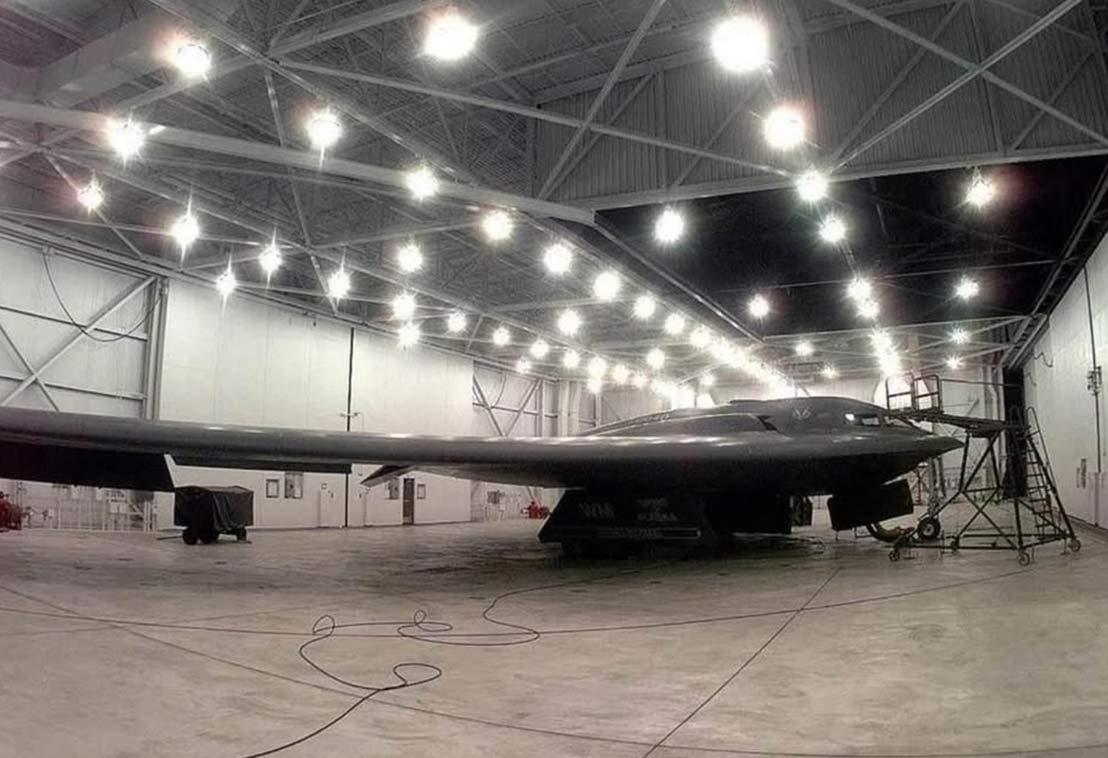
The original B-2 production was veiled in secrecy.
Contractors used front companies to source parts, personnel operated in plainclothes, and workers at the assembly facility were subjected to polygraph testing.
The first operational B-2 was delivered in December 1993, and the aircraft made its combat debut during NATO’s 1999 bombing of Kosovo. Since then, it has flown missions over Iraq and Afghanistan. As of 2024, the Air Force has 19 B-2s in service, with 12 to 14 available for combat operations at any given time.
With only 21 units ever built, the aircraft is so valuable and secretive that if one crashes, recovery teams are deployed immediately to secure or destroy any sensitive components. In short, attempting to buy, sell, or even possess parts of a B-2 would likely be considered espionage or arms trafficking under U.S. and international law, and could result in severe legal consequences.
Due to these facts, the U.S. Air Force swiftly debunked the Facebook post. Ann Stefanek, a Pentagon spokesperson, made it clear: “The Facebook Marketplace postings are false. Private citizens may not purchase Air Force aircraft.”
Retired Air Force Chief of Staff General Ronald Fogleman added that it was simply not possible for a B-2 to be in private hands.
"There are no spare B-2s floating around anywhere," he said. Given the bomber’s staggering unit cost—selling one for under $3 million "doesn’t make a whole lot of sense."
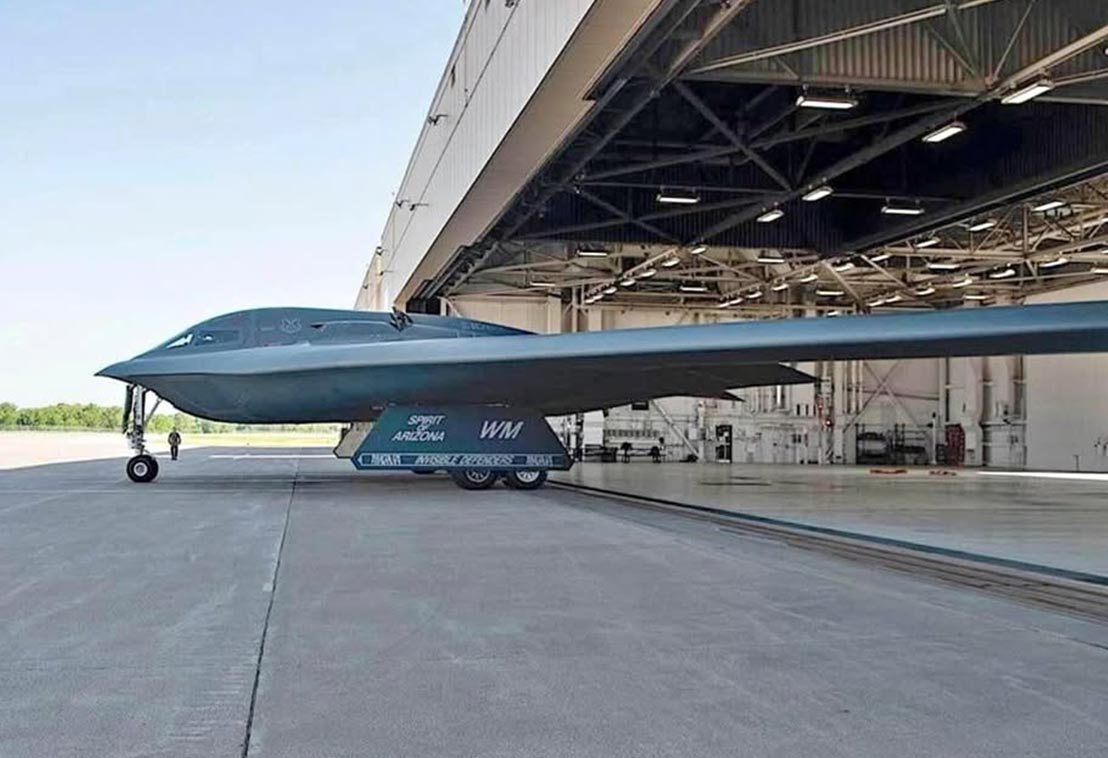
It's worth noting that the B-2 allegedly listed for sale is nicknamed "Spirit of Arizona" (Serial 82-1067), designated as AV-2.
First flown in 1990 and officially named in 1998 during a ceremony at Davis-Monthan AFB, it began its career as a test aircraft used to evaluate flutter characteristics, structural loads, landing gear, and weapons-bay doors before transitioning into active combat service.
It later took part in key missions such as Operation Allied Force in Kosovo (1999) and Operation Iraqi Freedom (2003).
Thanks to its exceptional range and stealth capabilities, the Spirit of Arizona was able to carry out precision strikes across the globe—entering and exiting hostile airspace undetected, just like the ghost it was designed to be.






















































































































































































































































































