
Meta has introduced a new designed to allow users to engage in conversations with the company's AI assistant, but by emphasizing in privacy.
The feature, called 'Incognito Chat with Meta AI,' is meant to be an addition to the platform's long-standing focus on secure communications, which started with end-to-end encryption for user messages a decade earlier. The feature addresses a growing reality in how people interact with AI tools, where queries often involve sensitive topics such as personal finances, health details, or work-related information that users might prefer to keep confidential.
At its core, Incognito Chat creates a temporary and isolated session for interacting with Meta AI.
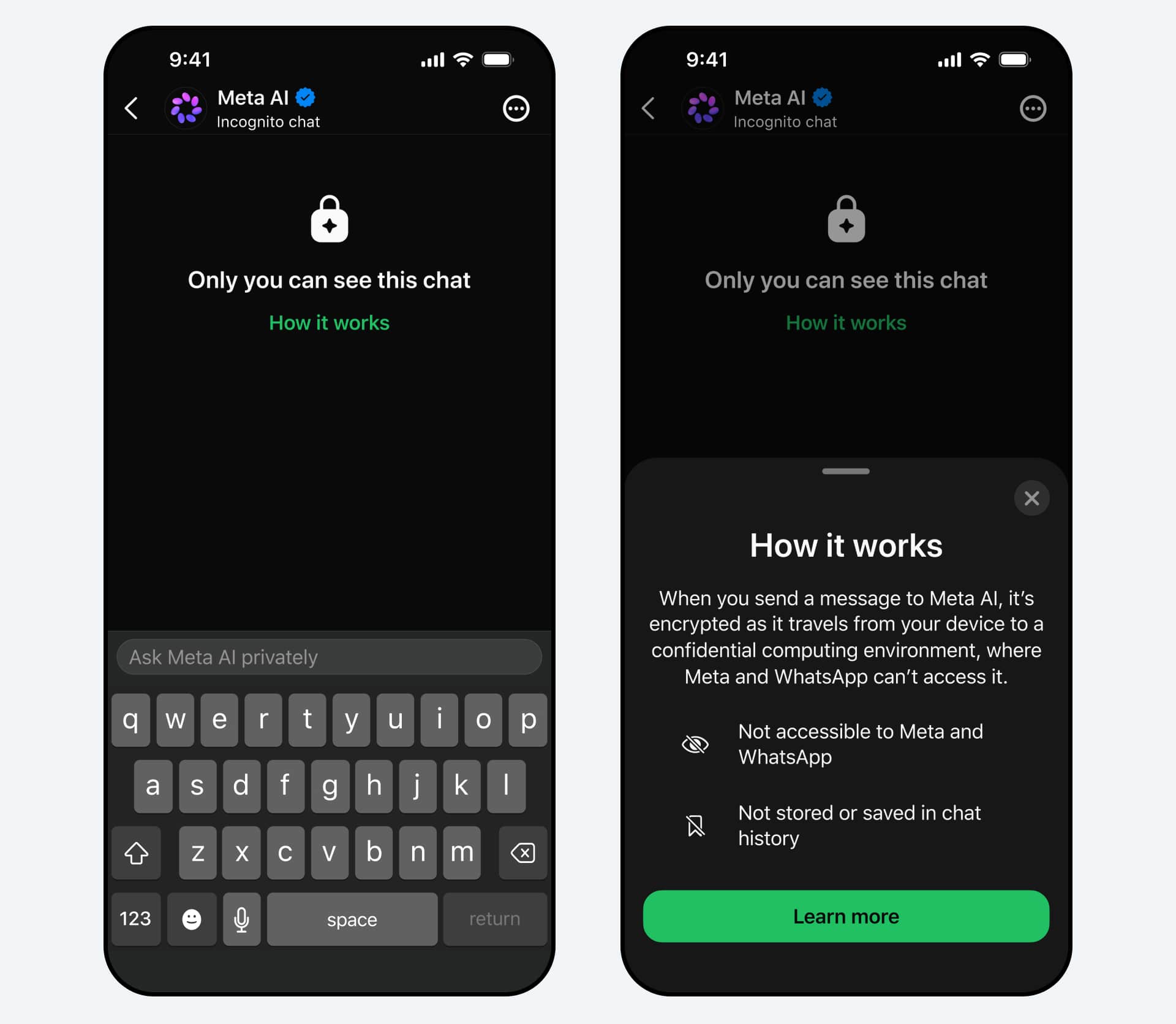
Once initiated, typically by selecting a dedicated icon within a one-on-one chat with the AI, the conversation becomes visible only to the user.
The rollout began on May 13, 2026, and is gradually becoming available on both the WhatsApp messaging app and the standalone Meta AI app over the coming months.
today we're launching Incognito Chat with Meta AI, a new way to have completely private conversations with AI. built on top of our Private Processing technology, Incognito Chat lets you talk to Meta AI in a way that is invisible to anyone else.
when you start an Incognito Chat…— WhatsApp (@WhatsApp) May 13, 2026
When using this Incognito Chat feature, messages are handled through a system known as Private Processing, which routes them into a secure computing environment that the company states even Meta cannot observe or access.
Unlike standard AI chat interfaces on other platforms, where service providers might still review inputs and outputs for various purposes, this setup ensures that no one else, including WhatsApp or Meta staff, can read the exchange. The conversations are not stored on servers, and by default, all messages vanish when the session ends, leaving no persistent record on the user's device or elsewhere.
This approach differs from typical incognito or private modes offered by competing AI services, which often still permit the underlying company to monitor or log the data in some form.
WhatsApp has positioned Private Processing as an extension of its encryption principles, applied specifically to generative AI interactions.
The technology relies on specialized secure environments for processing AI requests, with the goal of preventing any visibility into the content. In practice, the platform indicates that it can only detect whether a user has accessed the feature at all, without gaining insight into the details of what was discussed.
A future enhancement, referred to as Side Chat, is also planned under the same Private Processing framework. It would enable private AI assistance within existing group or individual conversations, pulling context from the discussion without interrupting the main thread or exposing the AI input to others.
The launch comes amid broader discussions about privacy in AI applications. Meta AI has been integrated into WhatsApp for some time, but earlier versions raised questions among users about data handling and the inability to fully disable the assistant in some cases.
With Incognito Chat, the company aims to provide an option for those seeking heightened confidentiality when exploring ideas or asking questions that might not suit a logged or shareable format.
Official materials note that this setup is intended to foster a space for unrestricted thinking, free from external oversight. Technical documentation, including a white paper on the underlying processing methods, has been made available for those interested in the specifics of how the secure environment operates.
Public responses to the announcement have varied.
Some users have welcomed the added layer of control over AI interactions, viewing it as a step toward aligning AI tools more closely with messaging app standards for discretion. Others have voiced ongoing skepticism, pointing to Meta's history with data practices and questioning whether any corporate assurances of inaccessibility can be fully verified without independent audits.
The company has invited third-party reviews of the system to build confidence in its claims. As the feature continues to deploy globally, its practical impact will depend on how users incorporate it into their routines and whether it meets expectations for true isolation in an era when AI assistants are increasingly embedded in everyday digital tools.






















































































































































































































































































