
It’s wild to think that after nearly four decades, a fresh secret has emerged from Super Mario Bros.: The Lost Levels, a game many assumed had been dissected down to its very bytes.
Yet, the gaming community is witnessing a discovery worthy of legends.
What makes this so stunning is that The Lost Levels (a.k.a. the Japanese Super Mario Bros. 2, later ported to the West via Super Mario All-Stars) has long been considered a game whose mysteries were already exposed. But speedrunner Kosmic has peeled back another layer. In a video released, the YouTuber reveals how a glitched "Minus World" in The Lost Levels was finally unlocked.
In this world, Mario ventures in a a hidden sub-universe, tucked behind the game’s normal structure.

The Minus World (Japanese: マイナスワールド) is one of gaming’s most legendary glitches.
It's originally a mysterious, endlessly looping level hidden within the original 1985 Super Mario Bros., which can be accessed from World 1-2 by performing a precise maneuver that tricks the game’s collision system into sending Mario through a wall and into the wrong warp pipe.
On the NES version, this leads to a water stage that loops infinitely, making it impossible to finish. The Famicom Disk System version, however, behaves differently due to how data is stored. Instead of looping forever, Mario passes through three unique levels before reaching the game’s ending.
The glitch happens because of how the game’s simple 8-bit collision detection works.
Mario’s sprite checks only a few points for solid objects, so under just the right conditions, the game mistakenly places him inside a wall and ejects him on the other side. That, combined with how the game reads warp destinations, causes the "−1" world to appear, though internally, it’s actually "World 36-1," with the blank tile representing the "minus" symbol.
When first discovered, the Minus World captured players’ imaginations.
It was featured in early Nintendo Power issues, sparking rumors that Super Mario Bros. contained more hidden levels waiting to be found.
Creator Shigeru Miyamoto denied it was intentional, but later mused that since the glitch doesn’t crash the game, it might as well count as a feature.
In the original Super Mario Bros., in the international NES version, this Minus World is a single underwater stage that loops endlessly with no exit. However, in the Japanese Famicom Disk System version, the same glitch loads entirely different data, resulting in three Minus Worlds: -1, -2, and -3. Unlike the NES version, these are fully playable, and completing -3 loops the player back to World 1-1.
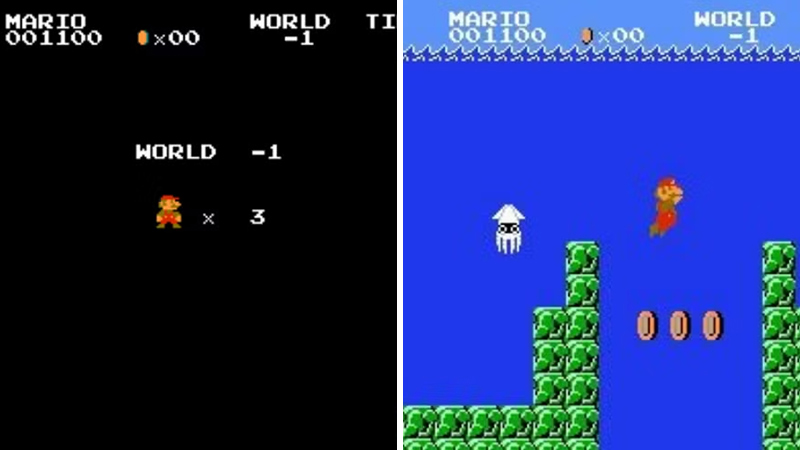
The difference came down to how each system stored its level data, turning the same glitch into two very different curiosities.
By the time Super Mario Bros. 3 arrived in 1988, Nintendo had learned its lesson.
The game’s level system was far more sophisticated and structured, effectively preventing the kind of memory overflow that created the original Minus World. As a result, there are no "legitimate" Minus Worlds in Mario 3.
Over time, the term "Minus World" became a piece of gaming folklore, extending far beyond Mario.
The term has come to represent any hidden, out-of-bounds area in video games, influencing titles like The Legend of Zelda and inspiring developers such as Jim Stormdancer (Frog Fractions) and Derek Yu (Spelunky) to chase that same feeling of hidden magic.
It’s even been referenced in Super Paper Mario’s “Underwhere” and Super Meat Boy’s “Minus Warp Zones.”
Nearly forty years later, the Minus World remains a perfect symbol of that lost era of gaming: where curiosity, not code, led players into the unknown.
And this time, Kosmic finally found a hidden world in Mario 2, when nobody though one ever existed.
Kosmic’s path into this shadow realm isn’t simple or brute force. It’s a delicate dance of memory, warp pipes, and clever reload tricks.
The trick hinges on how the game’s level/world counter operates: finishing a standard course by grabbing the flagpole increments the second digit of the world label, while clearing a castle by grabbing an axe increments the first digit. Manipulating which kind of exit the player takes, and doing so mid-transition, can scramble how the game loads its next "world."
In this case, Kosmic begins in the realm of World B, pushing past its castle, but not via the normal exit sequence, but by resetting the world while retaining the level counter.
This allows him to advance into levels like B-5, or levels that in normal play don’t exist, or more precisely are shells of other stages with odd numbering.
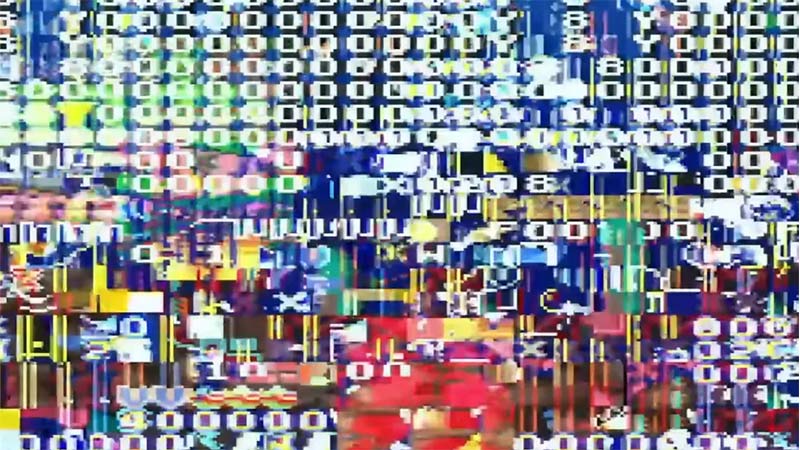
After looping through enough of these transitions, the second digit eventually goes beyond “9” and turns into letters (B-A, B-B, …) until the game’s code finally shatters under its own logic.
But here’s the twist: while some of these glitched levels are mere retexturings of normal stage layouts, the real revelation comes in the All-Stars version.
Because the SNES port allows saving, quitting, and reloading from the menu, the behavior of levels, especially the glitched ones, changes in ways the original Famicom version couldn’t replicate.
Through this reload mechanic, Kosmic is able to bypass "softlock" glitches, or gaps or jumps that would be impossible in the original warp chains, and push further into the hidden content.

Once he reaches World B-D (which corresponds to D-4 in the standard world map), the game begins generating entirely new, corrupted levels.
Visuals melt, overlapping sprites and noise effects flood the screen, physics behave oddly, and yet parts of the level layouts remain recognizable, where "fragments" of existing stages are stitched together in bizarre ways.
This Minus World in Lost Levels is like peering at the ghost layers of the game’s architecture.
In fact, in All-Stars, there’s a known hidden level labeled B-E, which appears as a land version of 6-2 (originally underwater). Fish enemies become Bullet Bills in midair; Blooper enemies still float overhead; the transition is jarring but interpretable.
Why did it take so long for someone to find this?
Kosmic suggests that the trick is deeply technical, buried behind obscure memory manipulation, and requires you to get very far into the game before triggering it. The Lost Levels never had as broad a player base as Super Mario Bros. itself, so fewer people poked around that deep.

This Minus World has existed, waiting, hidden in plain sight on old cartridges and ROMs, for a whole 39 years.
This is literally a lot longer than the age of any modern gamers alike, as Lost Levels is already considered a legacy of what Mario is now: a franchise, a mascot of what Nintendo has become.
The discovery doesn’t just add to Mario lore.
It literally shatters the assumption that classic NES-era games are fully "known." Even on hardware decades old, secrets persist.