xAI has one again showcased what Grok Imagine can do, and things eerily scary, if not astonishing.
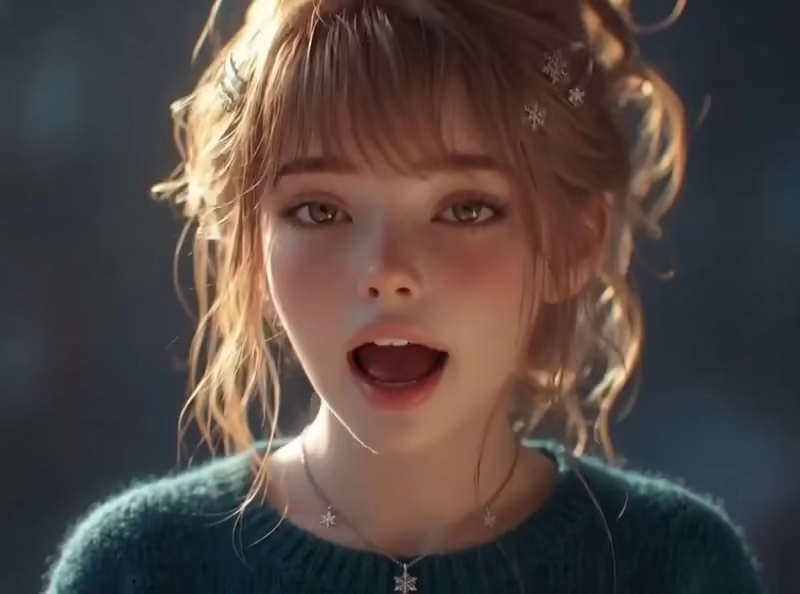
A post from Elon Musk has captured attention by showcasing clips generated with Grok Imagine, where animated characters deliver tongue twisters with precise mouth movements and clear audio. The demonstration features a young girl with freckles and snowflake accessories reciting lines that demand rapid shifts in pronunciation, her expressions shifting naturally from focused to animated as she gestures with her hand.
Other segments include a woman in a pink robe pouring coffee, while delivering another tongue twister, with each sequence highlighting how spoken words align exactly with facial movements and ambient sounds.
These examples reflect ongoing refinements to xAI's multimodal tool for creating short audiovisual clips from image prompts.
And by showcasing how Grok Imagine can now generate images of figures speaking tongue twisters, certainly marks up the ante.
Grok Imagine pic.twitter.com/mlYX1xVqUp
— Elon Musk (@elonmusk) April 27, 2026
Updates introduced in early 2026, including Grok Imagine version 1.0 in February, brought more natural voice generation, built-in synchronization of dialogue with visuals, and the addition of music or sound effects within a single process.
Prior to that, the system had started with basic animated clips in late 2025 before expanding to videos around ten seconds in length.
On April 25, further changes emphasized cleaner audio tracks and tighter lip synchronization across image-to-video outputs. Dialogue now follows mouth shapes more accurately, while background elements like breathing sounds or scene-appropriate noises integrate without noticeable gaps. This addresses a common issue in AI-generated video, where mismatched timing between speech and visuals often disrupts the overall flow.
Around the same period, another set of adjustments focused on making the results feel more cohesive and less artificial.
Reports noted improvements in how emotional tones come through in voices and how subtle details, such as facial micro-expressions or environmental audio, contribute to a unified performance. The system has also shown progress in handling speech across different languages, with mouth movements adapting dynamically to different phonetic patterns.
Tongue twisters are phrases designed to be difficult to articulate clearly, especially when spoken quickly. They challenge the speaker's pronunciation through rapid repetition of similar sounds, consonant clusters, and rhythmic patterns. This makes them an excellent test for AI video tools like Grok Imagine, as they demand precise lip synchronization, natural facial expressions, and accurate audio timing.
Observers have pointed out that these steps reduce the need for manual editing or separate audio layering, allowing generated content to emerge more ready for use. In the X demonstration, for instance, the characters' performances maintain consistency even during challenging phonetic sequences, a capability that aligns with the reported emphasis on audiovisual harmony.
As the tool continues to evolve through incremental releases, it illustrates a measured approach to bridging gaps that have persisted in similar technologies, particularly around speech realism in dynamic scenes.