The U.S. Department of Energy (DOE) has laid out a blueprint for a “virtually unhackable” national quantum internet. With it, officials and scientists can begin laying the groundwork for a more secure "second" internet.
At a press conference, government officials said the network would run alongside the existing web, working as a parallel internet to transmit sensitive government and financial information.
While quantum technology seeks to harness the distinct properties of atoms, photons and electrons to build more powerful computers, a quantum internet relies on photons exhibiting a quantum state known as entanglement.
This allows points of interactions to share information over long distances without needing a physical connection.
To secure the connection, the complex phenomenon of quantum entanglement enables the transmission of information more securely than on existing networks.
The agency is said to be working with universities and industry researchers on the engineering for the initiative. And in the technical report of the project, the prototype is planned to be ready within a decade.
“In this quantum world, particles can exist in multiple states at the same time, like on and off but simultaneously. And they can be entangled, that is, they can share information with one another—even over very long distances and even without a physical connection,” explained David Awschalom, a senior scientist at Argonne and professor at the University of Chicago’s Pritzker School of Molecular Engineering, at the event.
“So while this special world is invisible to us, a quantum internet is going to harness these strange properties to build new types of devices with powerful applications and communication, national security, finance and medicine.”
Using quantum technology, information can be encoded into photons. In a quantum network, photons that are entangled are inextricably linked. So when one keeps one photo and send the other an entangled photon, anything that is done on the photon will instantly happen on the other photon.
In other words, anything that happens to one photon will affect the state of the other, even if they are separated by an enormous distance.
This quantum entanglement prevents anyone from tampering with the data, since any change to the data will break the entanglement.
The DOE said that the process of transmission through sub-atomic particles will enable the quantum internet “to control and transmit information more securely than ever before.”
"One of the hallmarks of quantum transmissions is that they are exceedingly difficult to eavesdrop on as information passes between locations," according to the Energy Department statement. "Scientists plan to use that trait to make virtually unhackable networks."
Back in February 2020, scientists from the University of Chicago and the DOE's Argonne National Laboratory took a step closer into recreating this physical phenomenon, when they entangled photons across a 52-mile (83-kilometer) “quantum loop” in the Chicago suburbs.
This essentially established one of the longest land-based quantum networks in the U.S..
With the blueprint, the DOE plans to connect that network to a particle physics and accelerator lab in Illinois, to create an 80-mile quantum internet testbed for the future networks.
The department said early adopters could include the banking and health services sectors, adding that there would be applications for national security and aircraft communications.
"Eventually, the use of quantum networking technology in mobile phones could have broad impacts on the lives of individuals around the world," the statement added.
The DOE and its 17 national laboratories will serve as the backbone of the coming quantum internet, which has initial government funding.
“This is one of the most important technology innovations of the 21st century,” said Argonne National Lab Director Paul Kearns during a news conference unveiling the announcement in Chicago. “It'll lead the way to many remarkable benefits for society at large.”
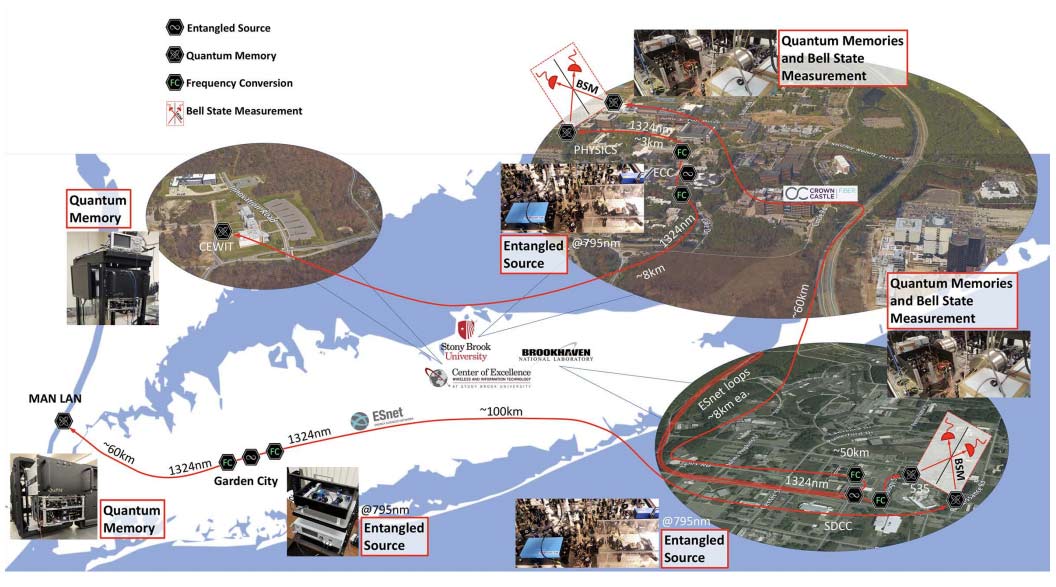
And regarding the fund, it was said that it's getting its share from the $1.275 billion budget for the National Quantum Initiative, a federal program to accelerate quantum research and development. But the DOE during the announcement didn't say anything about the figure for the project.
Speaking to reporters, Paul Dabbar, the Energy Department’s undersecretary for science, said that the federal government invests about $500 to $700 million a year in quantum information technology, suggesting that some of that money would fund this new Internet.
Dabbar added that there would probably be further funding announcements for the project in the future.
The 38-page document that laid out the research priorities and milestones to aim for in this project, doesn’t assign detailed tasks to particular parties.
The project aims to give the U.S. an advantage over China in the high stakes quantum race. The U.S. and China are already investing heavily in developing new technology, with the latter managed to break distance records for quantum networks.
One of which, was when China created the first long-range bidirectional quantum communication without using a satellite.
Quantum technology is regarded as the new key battleground in the competition between the two superpowers for technological supremacy, and with this "second" internet plan, the U.S. wants to leap forward.
Europe too is also pursuing the research, one of which, was by launching the Quantum Internet Alliance to also create the blueprint for a quantum internet.






















































































































































































































































































