The large language models (LLMs) war intensifies to a degree that mere chatbots are no longer useful.
Since the arrival of OpenAI's ChatGPT in late 2022, the AI's conversational breakthrough prompted an intense race among tech giants and startups alike. Companies invested billions to scale models that could not only generate coherent text but also reason through problems, summarize documents, write code, and support creative work.
Within months, competitors released their own versions, each promising greater speed, accuracy, or specialized capabilities.
But then, the focus expanded from simple chat interfaces to tools that could integrate with workflows, analyze data, and assist across professional domains.
And as LLMs matured, attention turned toward agentic systems capable of taking meaningful action rather than merely responding to prompts.
Manus has approached these challenges with a focus on practical continuity in agent behavior.
Read the blog here: https://t.co/fHAGM27XSqhttps://t.co/fHAGM27XSq
— Manus (@ManusAI) May 18, 2026
Now operating as part of Meta, the platform has introduced an upgrade to scheduled tasks, known as 'Scheduled Tasks 2.0,' which targets the gap between timed triggers and sustained intelligence.
Rather than running isolated instances on a clock, the system emphasizes execution in the appropriate environment while preserving necessary background information.
A recurring process can resume directly within an existing conversation thread, drawing on accumulated instructions, attached files, prior decisions, and evolving results. This design supports more reliable outcomes for workflows that build progressively over days or weeks.
The upgrade extends scheduling beyond standalone tasks into broader project structures and custom web applications built on the platform. In a project setting, scheduled work reuses shared elements such as uploaded documents, specialized skills, data connectors, and predefined output formats.
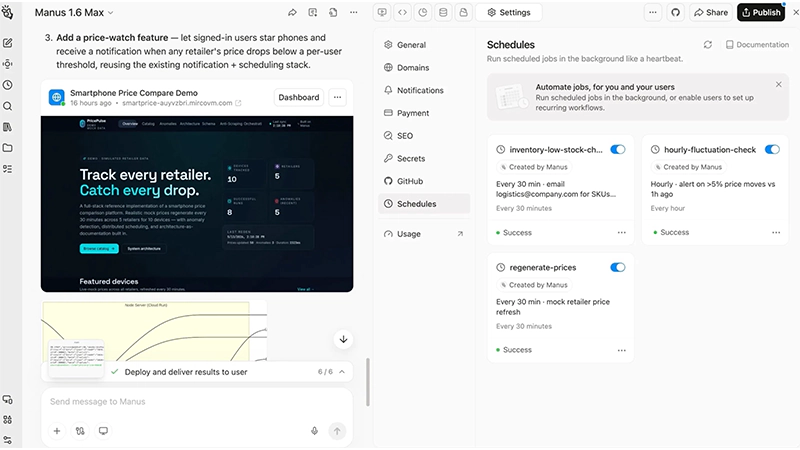
For web apps, it enables background operations that keep interfaces current without manual restarts. A dashboard might refresh metrics each morning, or a reporting tool could compile and distribute summaries on a weekly cadence, all handled internally by the agent.
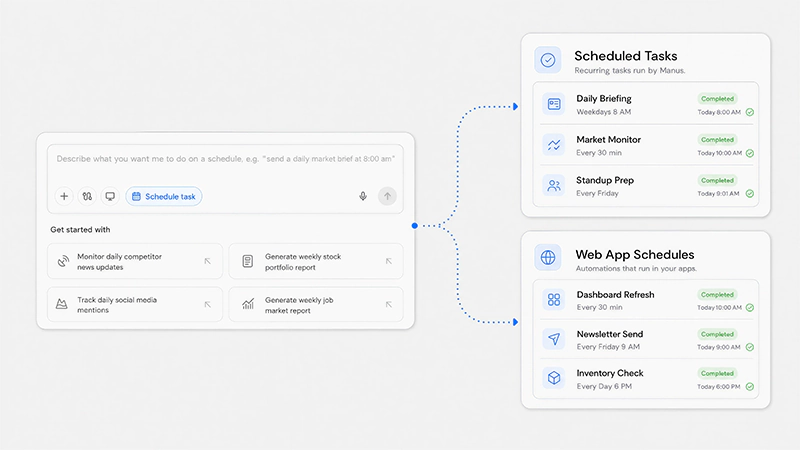
Users establish these automations through straightforward natural language instructions.
Within a task, project, or app, one might direct the agent to review open items every weekday morning and highlight priorities, or to compile customer feedback each Monday by referencing existing files and maintaining consistent formatting. The agent incorporates connected data sources where relevant and adheres to any established standards for presentation.
For well-understood routines, confirmation steps can be bypassed, allowing fully automatic progression while still providing visibility into outcomes.
Visibility improvements help users monitor activity without disruption.
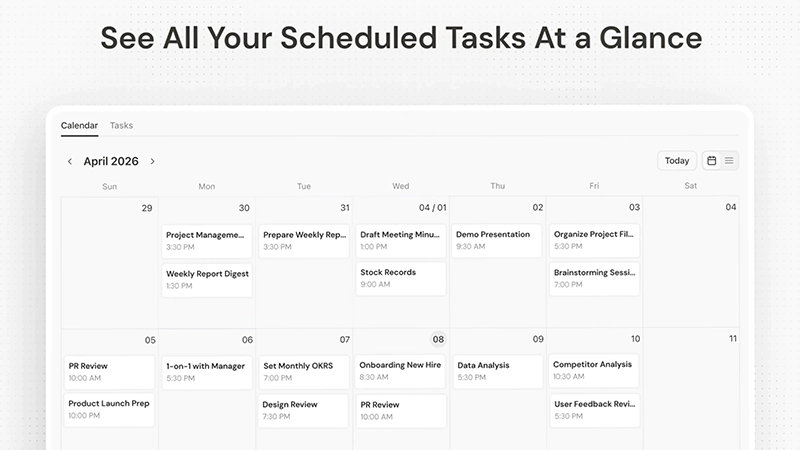
A dedicated side panel displays active schedules and their associated runs. Calendar-style and schedule views clarify upcoming executions alongside completed ones. Each run appears as a traceable card or label that links directly back to its originating context, enabling quick review of results or adjustments as needed.
Editing options allow refinement of prompts, timing, or execution details after initial setup, including choices about whether runs continue in the same thread or generate fresh instances.
What sets this approach apart is the deliberate handling of context across repeated executions.
Many scheduling systems spawn independent sessions, requiring the agent to reload everything each time and risking outdated assumptions. Manus instead maintains continuity where it adds value, keeping the agent aligned with the history and resources that shape the work.
This reduces the common friction of context loss while still permitting independent runs when isolation makes sense. It reflects a step toward agents that function more like persistent collaborators than episodic responders.
Additional controls enhance flexibility. Connectors integrate external applications as live data inputs. Execution environments can leverage cloud resources for demanding tasks.
Projects serve as centralized hubs, letting schedules inherit configurations without redundant setup. These elements combine to support diverse applications, from daily personal summaries to enterprise-scale reporting and app maintenance.
The feature is now accessible across all user levels in tasks, projects, and web apps.
By addressing continuity alongside timing, it advances agentic systems toward more dependable automation. As the broader competition among AI platforms continues, developments like this highlight the growing importance of execution reliability over isolated intelligence.
The result is a tool that integrates more seamlessly into ongoing work rather than sitting apart from it.

















































































































































































































































































