
In the world of South African broadband frustrations, few stories captured public anger quite like what happened in Howick back in 2009.
Durban based IT company Unlimited IT had grown tired of Telkom's painfully slow ADSL speeds. Instead of filing another complaint destined to disappear into customer support limbo, the company decided to turn its frustration into something unforgettable.
They staged a race between a homing pigeon named Winston and the internet itself.
The challenge was brilliantly simple.
Unlimited IT needed to transfer 4GB of data from its call centre in Howick near Pietermaritzburg to its main office in Durban, roughly 100 kilometres away.
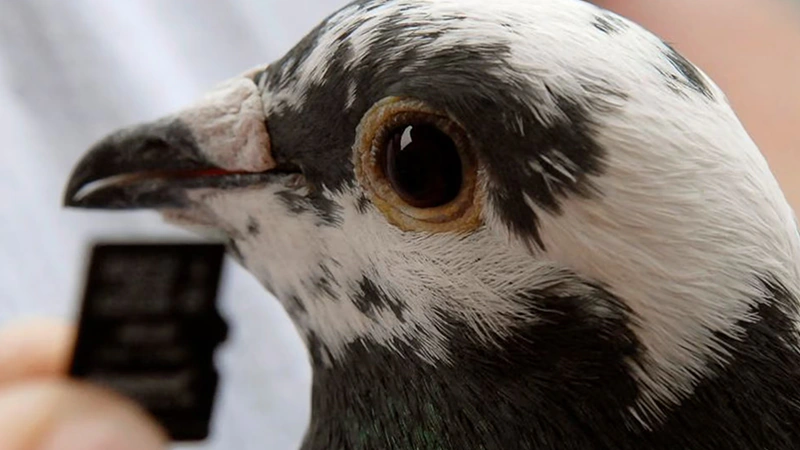
Like many South African businesses at the time, Unlimited IT had spent months dealing with sluggish connections, failed uploads, and endless promises from Telkom about future upgrades that never seemed to arrive.
During one particularly frustrating day, someone joked that a pigeon could probably move the data faster than the broadband line.
Instead of laughing it off, the team paused, and decided to test it.
They chose Winston, an eleven month old homing pigeon that had already proven reliable during shorter training flights. A tiny memory stick containing the data was carefully strapped to his leg using a lightweight harness designed not to slow him down or cause discomfort.
At the exact same moment Winston was released into the clear September sky, a staff member began uploading the identical four gigabytes over Telkom's ADSL connection.
Cameras rolled. Bets were placed. The clock started ticking.
Winston did not disappoint.
The pigeon completed the journey in just one hour and eight minutes, arriving safely with the memory stick still attached. Once the team copied the files from the drive onto a computer, the total transfer process took two hours, six minutes, and fifty seven seconds.
By that point, Telkom's ADSL upload had completed only 4% of the transfer.
Four gigabytes versus four percent.
The contrast was impossible to ignore.
What made the story resonate so strongly was how relatable the frustration felt.
Millions of South Africans were already familiar with painfully slow internet speeds, stalled downloads, and endless buffering. The pigeon race was never intended to be a scientific experiment. It was a publicity stunt born out of genuine irritation, but it landed with perfect timing.
In one absurd demonstration, a pigeon carrying a flash drive had embarrassed one of the region’s largest telecommunications providers.
The story spread rapidly across tech forums, newspapers, blogs, and radio stations. Winston became an overnight celebrity, complete with fan pages and internet memes. For many people, the race symbolized something much larger than a quirky stunt.
It reflected just how far behind South Africa's broadband infrastructure still felt in the global internet race.
Telkom eventually responded by saying it had previously offered advice to Unlimited IT and that broader network improvements were already underway. But public opinion had already chosen its winner.
People flooded online discussions with their own horror stories about slow connections, overnight downloads that never finished, and unreliable service that had become part of daily life.
Ironically, the stunt also reminded people of something surprisingly practical. Sometimes physically transporting data, often jokingly called "sneakernet," can still outperform digital transfers under the right conditions.
And Winston’s victory was not just a funny accident. It reflected why humans trusted pigeons for communication for thousands of years.
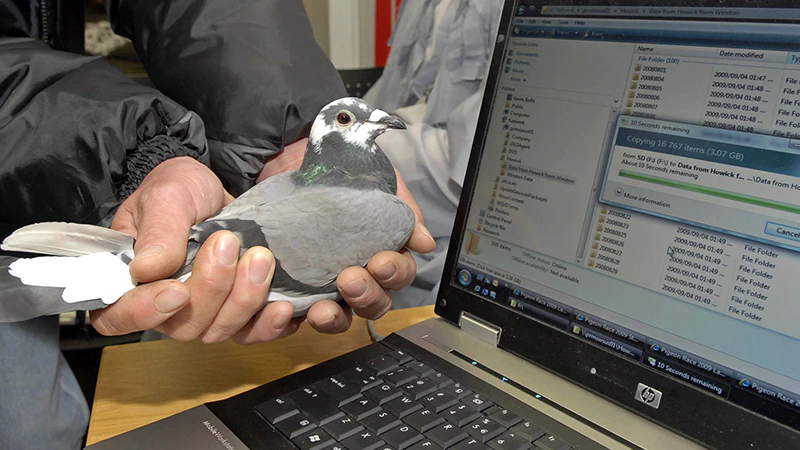
Homing pigeons, often called carrier pigeons, have been used since at least ancient Egypt around 1350 BC. The Persians, Greeks, and Romans all relied on them to carry military updates, commercial news, and messages across long distances. Julius Caesar reportedly used pigeons during his campaigns in Gaul.
By the Middle Ages, organized pigeon post systems existed throughout parts of Europe and the Middle East. In the nineteenth century, newspapers even used pigeons to deliver stock prices and race results faster than trains could move.
During both world wars, pigeons became essential military messengers when radio signals failed or communication lines were destroyed. Some birds became famous for saving lives under impossible conditions. One of the most celebrated was Cher Ami, a war pigeon during World War I that delivered a critical message despite being severely wounded in flight.
What made pigeons so reliable was their extraordinary homing instinct.
A pigeon raised in a particular loft can return home from hundreds of kilometres away, even when released in unfamiliar territory. Messages were usually stored inside tiny capsules attached to the bird’s leg, allowing them to travel quickly without significant extra weight.
Unlike telegraphs, telephones, or internet infrastructure, pigeons required no cables, no electricity, and no complex systems beyond training and care. They simply flew home.
Modern technology eventually replaced pigeons for everyday communication, but Winston’s victory in 2009 served as a hilarious reminder that some of the oldest delivery systems in human history still work remarkably well. Especially when the internet does not.
The Winston versus the internet has an archive website dedicated for it.