
Scientists in China have started creating an internet that should be invulnerable to hack. Using quantum networking, it relies on a complex concept that takes the ‘signal’ out of sending data.
Without signal, hackers can't intercept or steal anything because data never travels. By taking the signal out of the equation, quantum networking relies on the source and destination, are one in the same.
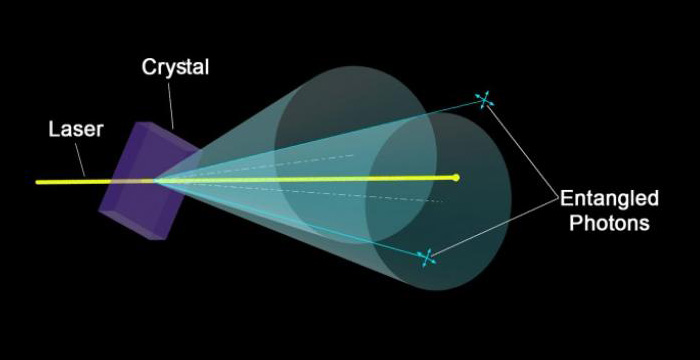
Instead of sending information in the form of data and information, the scientists create pairs of photons that mirror one another. This is called quantum entanglement. Keeping one photon, the scientists send the other entangled photon to someone else.
What happens next, anything that is done on one photon will instantly happens to the other photon.
The use quantum cryptography for encryption is secure against any interception because the information is encoded in a quantum particle in a way that it'll be destroyed as soon as the system detects any intrusion attempts.
In the first experiment, the scientists first used a fiber-optic cable to send the photons. This approach was revolutionary, but limited. The largest problem with the fiber optics method is that it has a range of around 100 miles.
Photons should travel through fiber optic cables by bouncing back and forth, and this process degrades the signal as it gets further from the source.
Then Professor Jian-Wei Pan of Hefei University and his team came up with a method of using quantum entanglement that relies on the vacuum of space to overcome the terrestrial problems with quantum networking.

The satellite named Micius or Mozi (Chinese: 墨子), was launched in 2016. Dubbed the "Quantum Science Satellite", it is meant to experiment on quantum networking, and the results have not only been positive, but also broke previous records of technology.
The scientists realized that photons don't lose signal strength when transmitted through space and atmosphere.
This is how Pan’s work has advanced the technology far beyond what was previously possible. The Chinese team created entangled photons aboard the satellite by passing lasers through special crystal optics.
Then, they beamed some of those particles down to Earth.
The satellite was over 300 miles above the Earth when it beamed the signal to two different ground locations which were 750 miles apart. The scientists confirmed that both photons remained entangled.
The transmission rate was up to 20 of magnitudes more efficient than that expected using an optical fibers of the same length.
In theory, if this process could be repeated over any distance, the technology could enable instant communication and information transaction. What's more, it's also laying the basis for the next generation of encryption based on quantum cryptography.