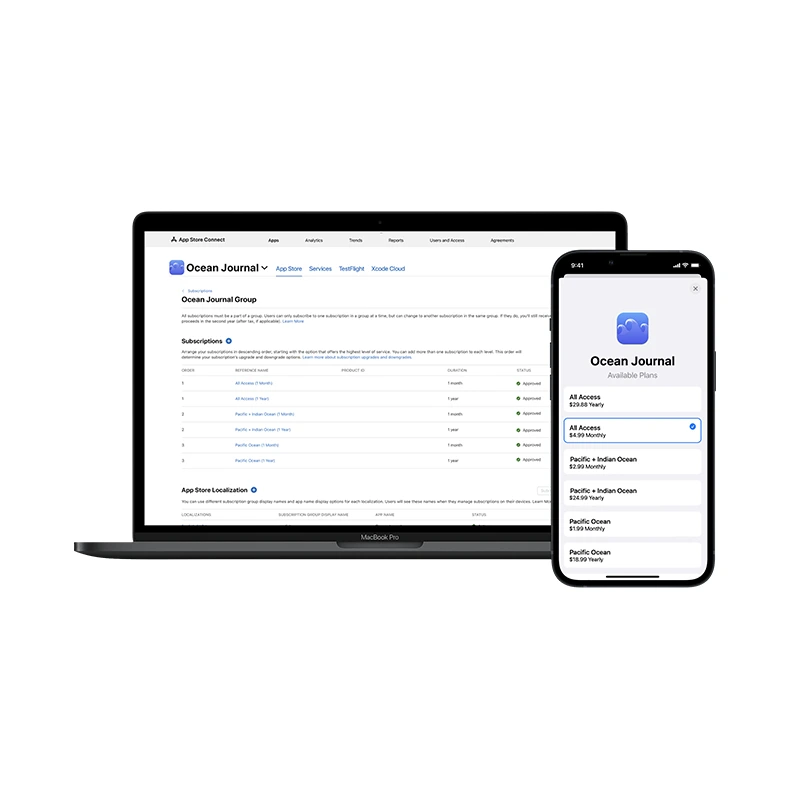
Apple has introduced a new type of auto-renewable subscription for the App Store that lets developers offer monthly billing with a required 12-month commitment.
This way, developers can now offer a new type of auto-renewable subscription through the App Store, one that combines elements of both monthly and annual billing models. Under this option, users pay a discounted rate, which is equivalent to what they would get with a traditional annual subscription, but the payments are spread out over 12 equal monthly installments rather than being charged all at once upfront.
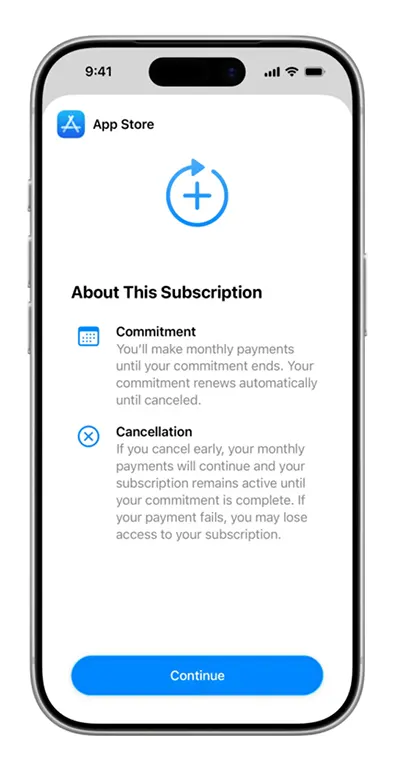
The key requirement is a firm 12-month commitment: once a user signs up, they are obligated to complete all 12 payments even if they decide to cancel the subscription partway through the term.
Cancellation simply stops any automatic renewal after the full commitment period ends, but the remaining monthly charges continue to process until the 12 months are fulfilled.
This structure gives users access to lower per-month pricing without the immediate financial burden of a large single payment, while still providing developers with the assurance of a committed revenue stream over the full year.
To understand how this fits into the existing App Store subscription landscape, it helps to compare it directly with the two longstanding auto-renewable options that have been available for years.
Standard monthly subscriptions let users pay on a recurring basis with no long-term obligation; they can cancel at any point and owe nothing beyond the current billing cycle. Traditional annual subscriptions, by contrast, lock in the discounted yearly rate but demand the entire amount be paid immediately, which can feel prohibitive for some users who prefer smaller, predictable charges.
The new 12-month commitment model sits squarely in the middle.
It delivers the same lower effective rate as an annual plan but breaks it into monthly deductions, creating a hybrid that developers can now choose to implement alongside their other offerings.
For example, a service that previously charged $10 per month or $100 for the full year could now also be offered at roughly $8.33 per month for those willing to commit to the full 12 payments, giving users the savings without the lump-sum hit.
From the user perspective, the process is designed to maintain clarity and control.
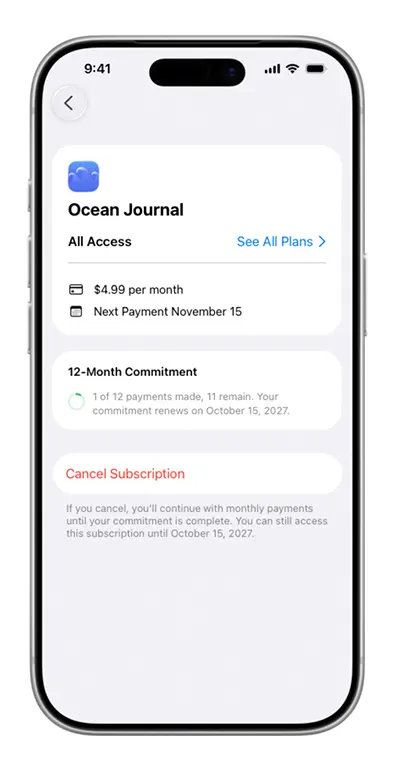
Anyone subscribed under this new format can check their Apple Account at any time to see precisely how many of the 12 payments have already been completed and how many remain in the cycle. Apple has also committed to sending email reminders about upcoming charges, along with optional push notifications on the device if the user has enabled them.
These notifications are timed to alert subscribers before each renewal point, helping them stay informed without needing to dig through settings.
If a payment fails for any reason, such as an issue with the linked payment method, access to the subscribed content may be restricted in line with standard App Store policies, potentially affecting app updates or downloads until the balance is resolved.
Importantly, users retain the ability to cancel whenever they choose through the standard subscription management tools in their Apple Account or within the app itself; the commitment only enforces the payment schedule already agreed to, not an unbreakable lock on continued service beyond the term.
Developers gain access to this option starting immediately.
They can configure the new subscription type directly in App Store Connect, define the pricing tiers that align with their existing annual discounts, and test the full user flow, including purchase, cancellation, and payment tracking, using Xcode. The implementation draws on the same in-app purchase frameworks Apple has long provided, so integration should feel familiar for teams already working with subscriptions.
No changes were announced to Apple's commission rates or the broader App Store policies that govern in-app purchases, meaning developers will continue to operate under the existing revenue-sharing structure for whatever subscription model they select.
The feature itself was first hinted at in the initial iOS 26.5 beta released last month, giving some developers an early opportunity to experiment before this official rollout.
On the availability side, the new subscription format will reach end users with the public release of iOS 26.5, iPadOS 26.5, macOS Tahoe 26.5, tvOS 26.5, and visionOS 26.5 expected in May. Devices will need to be running at least iOS 26.4 or the equivalent on other platforms for compatibility. The option is rolling out worldwide with two notable exceptions: it will not be available in the United States or Singapore at launch, and Apple has not yet provided a timeline for when those markets might gain support. Once live, the feature applies to third-party apps and could potentially extend to certain Apple services that already use annual-style plans, though the primary focus of the announcement was on tools for external developers.
Overall, the introduction of monthly subscriptions with a built-in 12-month commitment reflects an incremental evolution in how the App Store handles recurring payments.
It expands the pricing flexibility available to developers without altering the core mechanics of auto-renewal or user consent.
By allowing the discounted annual rate to be distributed across monthly bills while enforcing the full-term obligation, Apple is addressing a practical pain point for both sides of the transaction: users who want savings spread out and developers who want predictable longer-term engagement, while embedding straightforward transparency tools to keep the process clear.
As the May software updates begin to reach devices, more apps are expected to begin experimenting with the new format, adding another layer to the range of in-app purchase choices that have steadily grown over the past decade.






















































































































































































































































































