
GitHub has created a huge stir in the developers' community.
The platform known for being the world's largest code hosting service, the heart of open source, and a beloved home for millions of developers has just dropped a major pricing change that many are calling a betrayal. Starting June 1, 2026, GitHub Copilot is fully transitioning from its previous flat-rate / Premium Request Units model to usage-based billing powered by GitHub AI Credits (where 1 credit = $0.01).
Basic code completions remain unlimited, but chat, agentic workflows, code reviews, CLI usage, and other advanced features now consume credits based on actual tokens (input + output + cached context) and the model being used.
"This change aligns Copilot pricing with actual usage and is an important step toward a sustainable, reliable Copilot business and experience for all users," said Microsoft in a blog post.
While the decision brings the economics of coding assistants closer to the pricing models already common across large language model APIs, the change from the largely predictable subscription model to usage-based billing marks a significant shift in how AI coding tools are being priced.
And this can change how things work on GitHub.
The shift may signal the end of an early phase in AI software pricing.
As coding assistants become more autonomous and computationally intensive, the industry appears to be moving away from unlimited-style subscriptions toward models that treat AI usage more like cloud infrastructure: measurable, metered, and increasingly tied to consumption rather than access alone.
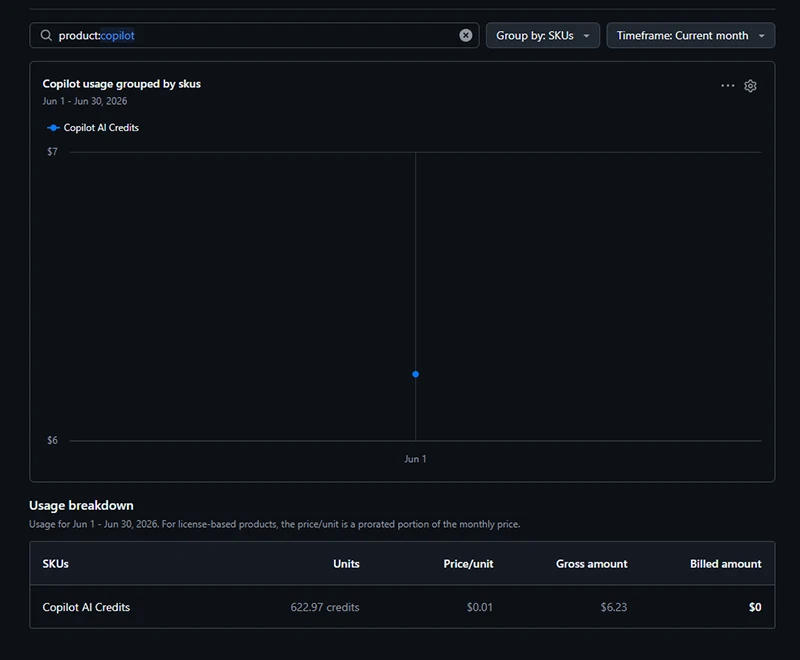
Under the new structure, usage is measured through tokens, including input, output, and cached tokens.
GitHub argues that Copilot has evolved beyond simple code completion into a platform that supports longer, more autonomous workflows, often involving multiple tools, large codebases, and extended reasoning processes. According to the company in the announcement, a flat request-based system no longer reflects the underlying compute costs of these increasingly complex interactions.
The change arrives as AI-assisted development becomes more agentic.
Instead of generating short code suggestions, modern coding assistants increasingly handle multi-step tasks, repository-wide analysis, debugging sessions, and autonomous coding workflows.
These activities consume significantly more compute resources than traditional autocomplete features, creating a growing gap between subscription revenue and infrastructure costs.
GitHub's public explanation frames the pricing transition as an effort to align customer charges with actual resource consumption.
Developer reaction has been mixed.

In the discussions, some users acknowledge that heavily subsidized AI services were unlikely to remain inexpensive indefinitely, many others have expressed concern about the loss of cost predictability.
Under the previous model, developers generally knew what they would pay each month. With token-based billing, costs depend on prompt size, model selection, context windows, generated output, and the behavior of autonomous agents. Several users in GitHub’s community forums and social media discussions argue that estimating monthly usage has become substantially more difficult.
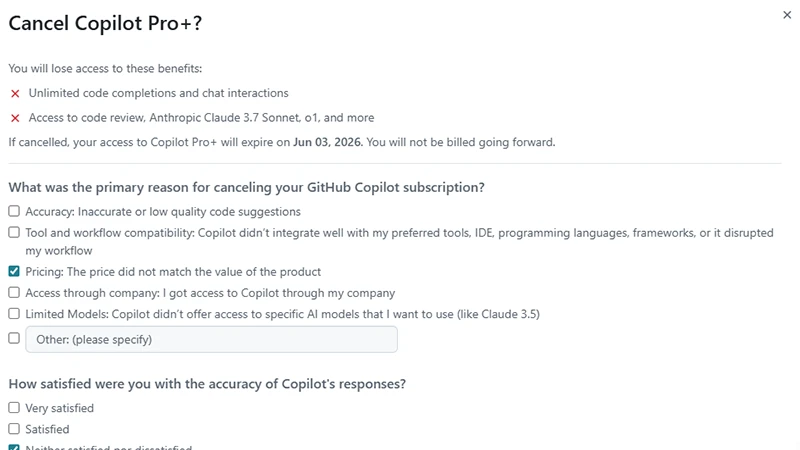
The strongest criticism has come from independent developers and small teams that built workflows around flat-rate access.
Reports circulating across Reddit, GitHub discussions, and technology publications describe projected monthly costs rising far beyond previous subscription fees for some heavy users. Although many of these projections are anecdotal and depend on unusually intensive workflows, they have fueled concerns that advanced Copilot usage may become financially impractical for certain developers.
At the same time, some developers argue that the new pricing structure simply exposes the true cost of large-scale AI inference that was previously hidden behind subsidized subscriptions.
Discussions within the community suggest that long-running agentic sessions, repeated iterations, and large context windows can consume substantial computational resources. From this perspective, usage-based billing represents a correction toward pricing models already used by providers such as OpenAI and Anthropic rather than an entirely new approach.
The debate also highlights a broader tension emerging across the AI industry.
Companies have spent the past several years competing aggressively on access and adoption, often offering generous usage terms while absorbing large infrastructure costs. As AI products mature and usage volumes grow, providers are increasingly under pressure to connect pricing more directly to compute consumption.
GitHub's move may be one of the most visible examples of this trend because of Copilot’s large developer base and its role in everyday software development workflows.
Questions around transparency have become part of the discussion as well, since token-based pricing depends on metering systems that many users cannot independently verify.
Some suggests users to dump GitHub Copilot and use products from rivals, like from OpenAI or Anthropic.

















































































































































































































































































