Back in the early days of the internet, the best way for websites to be discoverable, was by registering themselves to internet directories.
At that time, Yahoo! was the game changer. It gave that huge boost of interest for people to create websites and have web presence. Everything was relatively pleasant for the tech giant, until Google was founded and disrupted the sphere with a search engine.
Using what it calls Google Search, websites are no longer required to be proactive. As long as they adhere to proper practices of web development and web marketing, they can just let Google's crawlers do their job.
But with the advancements of technologies, people want more than just results compiled by some AI-powered algorithms. They want more.
They want to speak with the AI itself, and communicate what they want, and share what they think, and explain what they wish to see.
After OpenAI introduced ChatGPT, and Bing introduced its own ChatGPT-powered Bing AI, which can be emotional at times, followed by Opera with its own ChatGPT-powered feature, it's Brave's turn.
But with a slightly different approach.
"The new AI Summarizer, which does not use ChatGPT, processes ‘multiple sources of information present on the web’ to avoid ‘unsubstantiated assertions’." https://t.co/AJeOhJNm9w
— Brave Software (@brave) March 3, 2023
Brave is the underdog of browsers. But despite lesser fame, the browser does come with unique features.
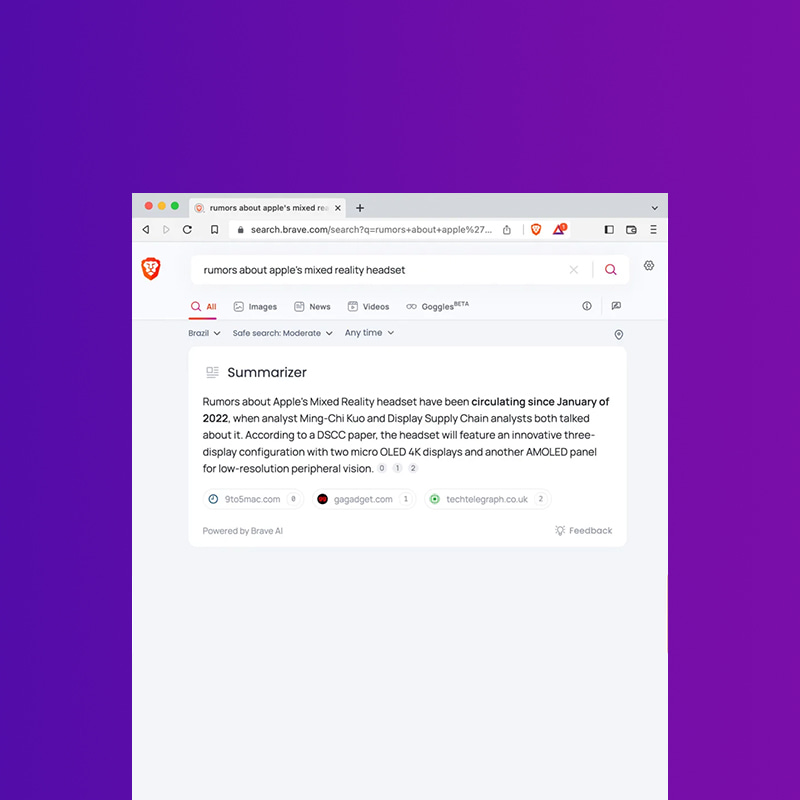
And this time, it has added language-processing abilities directly into the browser, which is able to summarize search results.
The feature, called 'Summarizer', is able to generate some abbreviated explanations for questions in some search results, to then combine that with footnoted links to its information sources. Summarizer is also designed to offer richer snippets of text that users usually see in ordinary search results.
In a website post, Brave said that:
"In addition, the provenance of original sources of data is cited at all times via links. This maintains the rightful attribution of information, and helps users assess the trustworthiness of the sources, both of which are needed to mitigate the authority biases of large language models."
"The Brave Summarizer is available today for all users of Brave Search, on desktop and mobile. For users who would prefer not to use the Summarizer, they can easily turn it off by opting out in settings."
And according to Josep M. Pujol, Chief of Search at Brave:
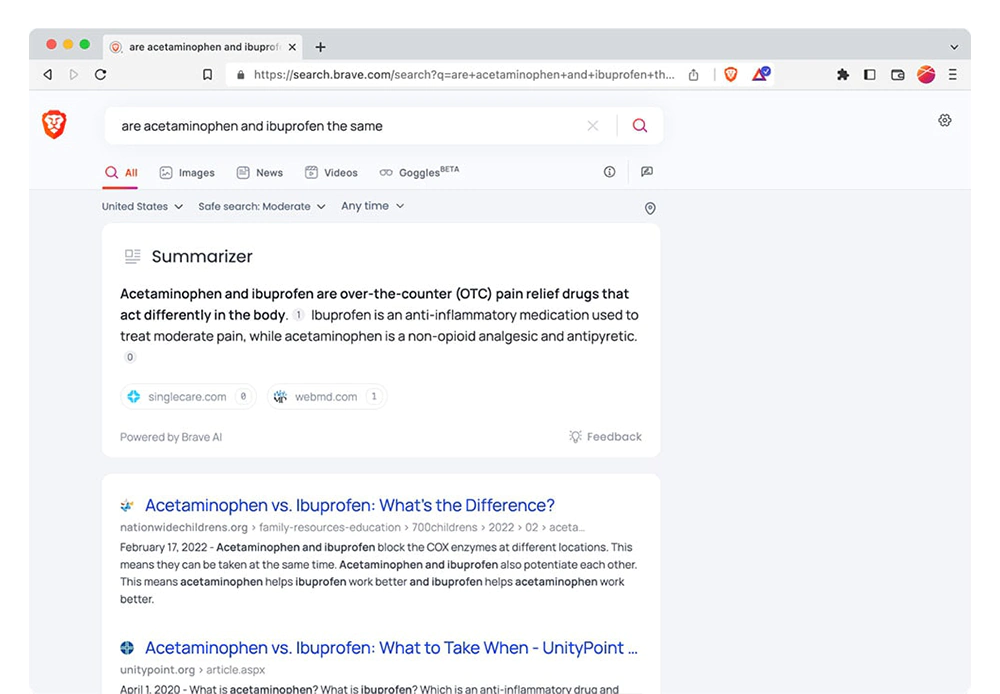
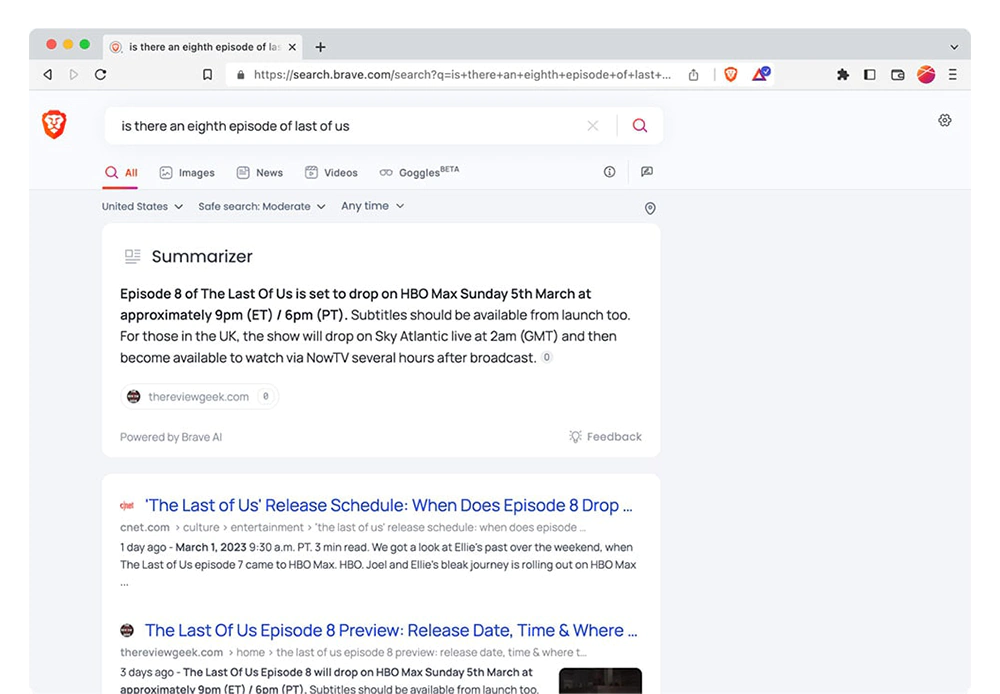


Here, Brave's AI approach is unlike Bing and Opera which use ChatGPT's large language models (LLMs).
Brave's Summarizer uses a different LLMs. In fact, it's composed of three different LLMs.
The first one is a question answering model, which allows the AI to extract answer from text snippets. This model has already been used by Brave Search to power its knowledge graph and features snippets feature.
Then, Brave adds another LLM to classify answers collected by the first model, by filtering them through a variety of criteria.
After that, results are ultimately processed by a summarizer/paraphrasing model, which tries to rewrite the input so that repetition is removed and that language is kept uniform to improve readability.
In the end, Summarizer is designed solely to provide summary, and not to interact or provide a chat experience.
Because of this, Brave boasts that it doesn't rely on third-parties, nor it limits user access due to scalability concerns.
"The Brave Summarizer relies on our owned and operated models that are highly tuned to be as efficient as possible at inference time," Brave said.
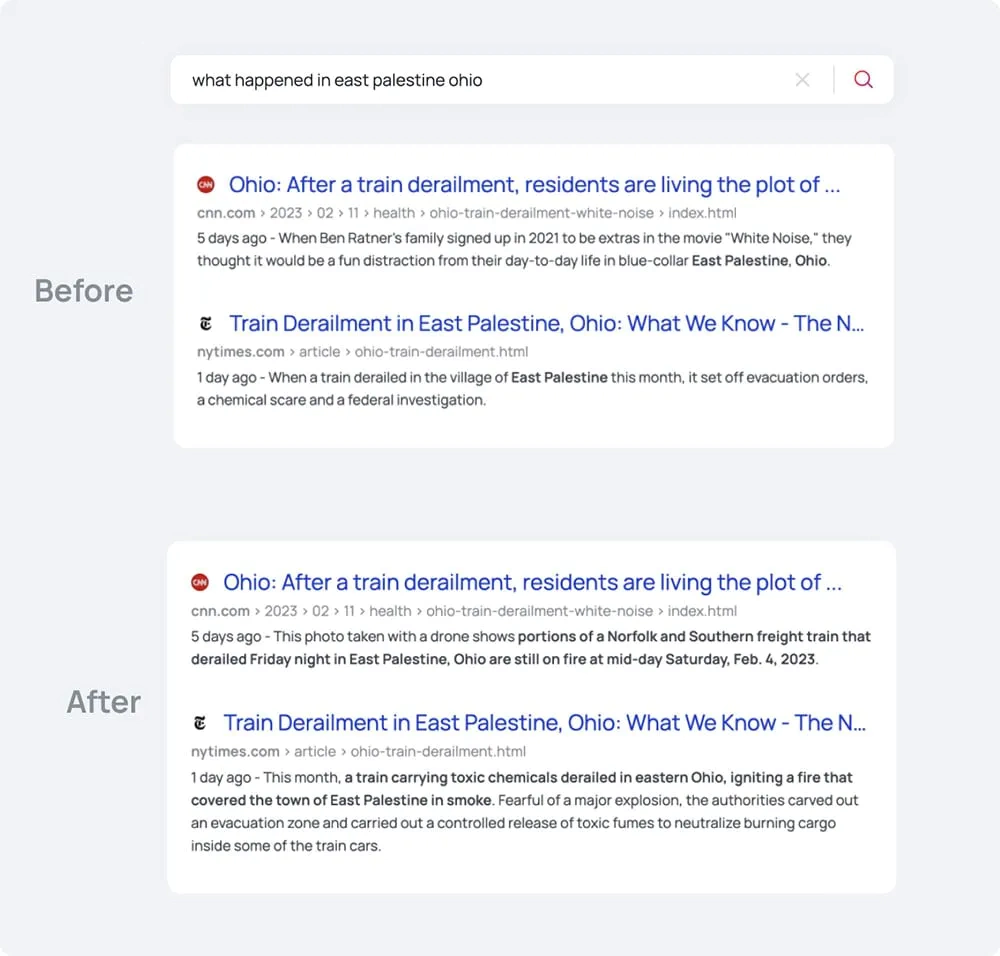
As a web browser competing with others, Brave is certainly aware of ChatGPT, and the hype it creates. But it believes that the traditional way of searching the web cannot be replaced by some talkative chatbots.
"However, if used properly, these new models can help the user navigate results, which is the approach we follow with the Summarizer. Chat-like interfaces and oracle-based search remain unproven and, as of today, we remain skeptical that they’ll be useful for all search tasks."
The company believes that newer, and more advanced technologies can certainly help users satisfy their needs, but the advancements aren't yet reliable.
Because of this, instead of competing with Bing and Opera, and others who wish to use ChatGPT-powered features, including Google with its Google Bard, Brave wants to enhance search capabilities using LLMs by creating assistant-like capabilities of LLMs that can be truly fruitful and revolutionary.
"It's crucial to remind users that one should not believe everything an AI system produces, in much the same way one should not believe everything that is published on the Web," Brave said of Summarizer. "At the risk of stating the obvious, we should not suspend critical thinking for anything we consume, no matter how impressive the results of AI models can be."




















































































































































































































































































