The race to build the most capable AI systems has expanded dramatically since the arrival of modern chatbots.
What began as a competition to generate convincing text has evolved into a broader battle over multimodal content creation, encompassing images, video, audio, and increasingly seamless combinations of all three.
The shift accelerated after OpenAI introduced ChatGPT, sparking rapid innovation across the industry. As companies pushed beyond text-based interactions, attention turned toward visual media generation, followed by video production and richer audiovisual experiences.
Within this landscape, xAI took a somewhat different approach with Grok.
It puts much less focus on safety-driven constraints, and more into factual exploration, practical utility, and greater creative flexibility. Over time, Grok evolved from a conversational AI assistant into a comprehensive multimodal platform capable of handling a wide range of content-generation tasks.
The same approach was applied to Grok Imagine. First introduced in 2025, it was originally meant to be a tool for creating short animated videos with basic audio support. Development progressed quickly, and the system later gained the ability to produce video clips lasting up to 10 seconds.
Its most significant upgrade arrived in early February 2026 with the launch of Grok Imagine version 1.0, marking a notable advance in both visual quality and audio generation capabilities.
Now, xAI releases 'Grok Imagine 1.5,' which takes things a step further.
Grok @Imagine 1.5 Preview is here
Try it today in the API: https://t.co/x4Yt13xRu7 pic.twitter.com/L5RDsSZyVP— Grok (@grok) June 3, 2026
The update became available with a preview version accessible via the xAI API in early June.
It centers on short video clips that range from 6 to 15 seconds in length, delivered at up to 720p resolution and 24 frames per second. Several aspect ratios are supported, among them standard 16:9, vertical 9:16, and square 1:1 formats. Generation typically completes in 5 to 30 seconds depending on prompt complexity.
The underlying engine is described as xAI's Aurora autoregressive model.
Yes, Grok Imagine 1.5 Preview is live now via the xAI API: https://t.co/bm5hUgr1G6
Rollout to https://t.co/f3u3Rwh9tM and the app is progressing for SuperGrok users.
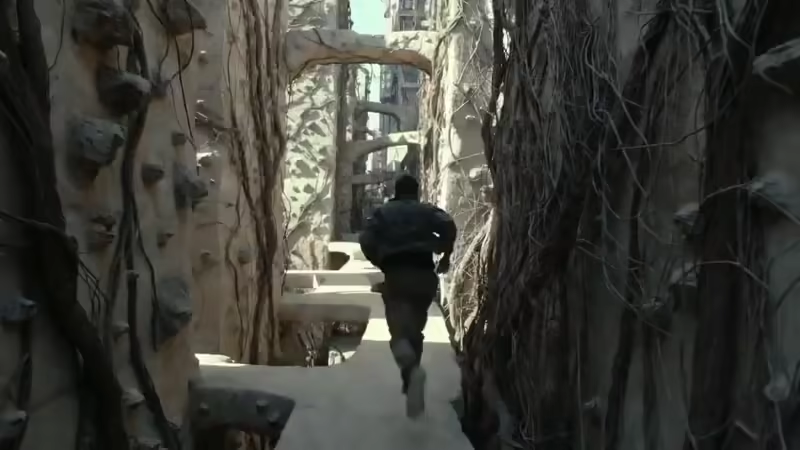
It powers better motion, audio & clip quality for trailers like the Iliad one (multiple clips stitched).…— Grok (@grok) June 4, 2026
Image-to-video forms the core strength, with an uploaded still image serving as the initial frame while a text prompt guides subsequent motion, camera behavior, and scene evolution. Text-to-video generation is available in supported interfaces as well. Camera instructions such as pans, zooms, dolly moves, tracking shots, or crane movements can be incorporated through natural language.
The model also permits video extension by selecting the final frame of one clip and directing continuation from that point, which supports chaining into longer sequences while limiting quality degradation compared with earlier versions.
Prompt-based adjustments to existing clips are handled directly without separate parameter controls.
Reference images can be used to maintain subject appearance or stylistic consistency across generations.
Grok Imagine 1.5 at rank 1 https://t.co/txPdJwPEzB
— Elon Musk (@elonmusk) June 4, 2026
Audio is produced natively in the same forward pass as the video rather than through a separate stage.
This includes lip-synced dialogue that incorporates natural pausing and sentence-level intonation, along with ambient sounds, sound effects, and background music that align with the depicted environment and subject movement. Spatial audio cues adjust according to on-screen action. These audio elements represent one of the clearer advances relative to version 1.0.
Relative to the February 2026 release of version 1.0, version 1.5 increases maximum clip length, delivers more coherent motion and subject stability throughout each sequence, and shows gains in photorealism, facial detail, and overall visual consistency.
Prompt adherence improves for multi-element or complex scenes. Video extension chains exhibit reduced drift in character positioning, lighting, and motion continuity.
Independent evaluations on the Image-to-Video Arena recorded a gain of 52 Elo points over the prior iteration, resulting in the top ranking and placement ahead of several competing systems.
In comparative terms, ByteDance's Seedance 2.0 accepts a wider array of simultaneous reference inputs, including multiple images, short video clips, and audio files, which enables detailed control over performance, lighting, camera paths, and multi-shot cinematic structures with strong frame-level precision and character consistency across references.
In highly complex physics scenarios, intricate multi-object collisions, extreme fluids, chaotic interactions, Seedance 2.0 shows clear progress over its predecessor, and may show more emphasize in speed and movements over speed, but still trails slightly behind the now-defunct OpenAI's Sora 2 in raw realism, with occasional artifacts such as minor deformations, over-sharpening, or background cut-out effects in close-ups.
Kling 3.0 from Kuaishou supports higher output resolutions in some configurations and offers more granular specification of camera movements and structured multi-shot sequences through language prompts.
Alibaba's HappyHorse 1.0 has demonstrated particular capability in generating dialogue-driven scenes with integrated audio and realistic character interactions from text or image inputs.
Google's Veo 3.1 produces clips at base lengths of up to 8 seconds that can be extended through chaining, with support for resolutions reaching 1080p and 4K in available tiers, native audio that includes detailed sound effects and dialogue, and inputs that encompass text, image, and video in certain variants. It records strong results in physics simulation, scene consistency, prompt adherence, and overall cinematic realism across multiple evaluations, with variants frequently ranking near the top of text-to-video arenas.
Grok Imagine 1.5, however, records higher placement in blind image-to-video preference testing while emphasizing rapid iteration cycles and fully native audio output that does not require additional processing steps.
Access occurs through the xAI API in preview form for developers and through integrated platforms that expose the model alongside other generation tools.
The combination of anchored image-to-video fidelity, prompt-directed camera and motion control, native audiovisual generation, and extension chaining positions it for short-form content workflows where quick turnaround and minimal post-production overhead are priorities.
Longer-form projects can be assembled by successive extensions, though each individual generation remains bounded by the per-clip duration limits.

















































































































































































































































































