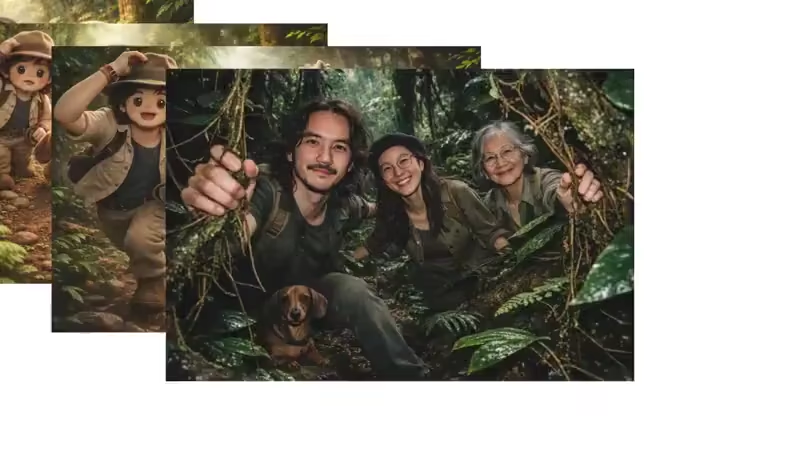
The battle for AI dominance today feels almost cinematic compared with the early days of generative models.
When OpenAI first launched ChatGPT in 2022, it transformed what had been a niche research breakthrough into a mainstream productivity tool almost overnight, reshaping expectations around writing, coding, problem-solving, and creative work. That moment triggered an industry-wide scramble, as major technology companies rushed to respond and redefine their own AI roadmaps.
In the years that followed, the competition intensified. Models grew more capable, reasoning improved, context windows expanded, and multimodal abilities: vision, audio, and tool use, which have now become stakes rather than novelties.
By late 2025, the rivalry reached a new flashpoint with Google’s release of Gemini 3, a model praised for its reasoning depth, multimodal understanding, and deep integration across Google’s ecosystem. Reports suggested the launch set off a strategic "code red" inside OpenAI, prompting leadership to refocus engineering efforts on strengthening its core models rather than incremental features.
The moment echoed an earlier inversion of history: ChatGPT’s rise had once triggered a code red at Google, and now OpenAI was feeling the same pressure from a formidable rival.
Born out of that renewed focus was GPT-5.2, a clear signal that OpenAI intended to defend its position at the top of the AI stack. But large language models were only part of the battlefield.
Visual generation has long been plagued by slow iteration, inconsistent edits, and unreliable text rendering. OpenAI sees this as another critical front in the race for dominance.
That context makes OpenAI’s latest release especially significant. The company has unveiled a new and revamped ChatGPT Images experience, powered by 'GPT Image 1.5.'
— OpenAI (@OpenAI) December 16, 2025
This model is designed to address the most persistent frustrations of AI image generation.
Rolling out globally starting December 16, the update delivers image generation speeds up to four times faster than before, while dramatically improving how well the model follows instructions and preserves visual consistency across edits.
At the heart of GPT Image 1.5 is a focus on precision.
When users ask for changes, like for example, adjusting lighting, swapping clothing, adding or removing objects, the model now alters only what is requested, while keeping composition, color tone, facial likeness, and overall structure intact. This seemingly subtle shift unlocks a far more practical workflow, allowing creators to iterate on a single image without watching it drift further from the original vision with every edit.
Text rendering is another area where the model marks a meaningful leap forward.
GPT Image 1.5 handles smaller fonts, denser layouts, and structured designs far more reliably than earlier versions, pushing ChatGPT Images beyond purely artistic experimentation and into real-world use cases like marketing mockups, product visuals, posters, and editorial layouts.
While results are still not flawless, the reduction in garbled or unusable text is immediately noticeable.
The new image generation model in ChatGPT adheres more reliably to your intent, changing only what you ask for while keeping elements like lighting, composition, and people’s appearance consistent across inputs, outputs, and subsequent edits.
It also excels at different types of…— OpenAI (@OpenAI) December 16, 2025
OpenAI has paired these model improvements with a redesigned user experience inside ChatGPT itself.
A dedicated Images section in the sidebar now acts as a visual workspace, offering preset styles, filters, and trending prompts that let users explore ideas without relying entirely on carefully engineered text prompts.
The goal, according to OpenAI, is to make image creation feel less like trial and error and more like shaping a concept in real time.
For developers and companies, GPT Image 1.5 is also available through the API, bringing the same gains in speed, consistency, and edit control to production workflows.
This positions the model squarely against competitors like Google’s Nano Banana Pro, particularly in areas where iterative refinement and brand consistency matter most.
We’re also introducing a new Images surface within ChatGPT. Just tap “Images” in the sidebar and have fun.
And make sure you update your app!— OpenAI (@OpenAI) December 16, 2025
Taken together, the release underscores how far the generative AI race has evolved.
What once revolved around novelty and raw capability is now about reliability, control, and integration into everyday creative work.
With GPT-5.2 reinforcing its language foundation and GPT Image 1.5 elevating visual creation, OpenAI is making a clear statement: in this increasingly cinematic battle for AI dominance, it intends to compete on every front.
For example: pic.twitter.com/qcEEjfG8g0
— Sam Altman (@sama) December 16, 2025






















































































































































































































































































