
Discord has introduced a comprehensive age verification system as part of its efforts to create safer online environments, particularly for younger users.
The platform began rolling out "teen-by-default" settings globally, with phased implementation starting in March 2026. Under this approach, accounts are automatically placed in a restricted "teen-appropriate" mode unless the user can demonstrate they are an adult. This means unverified users face limitations such as restricted access to age-gated servers and channels, content filters on sensitive material, moderated direct messages, and inability to participate fully in features like stage channels.
The change aims to protect minors while allowing adults full platform functionality, driven by growing regulatory pressures around child safety online, though Discord emphasizes it is not universally mandatory.
Most adults may bypass explicit checks through an internal age inference model that analyzes account age, device data, activity patterns, and other non-intrusive signals.
To verify age when required, users have two primary options:
- A facial age estimation process, where a short video selfie is taken and processed entirely on the device using AI to estimate an age range without the data leaving the phone.
- Uploading a government-issued ID for more precise confirmation.

Discord partners with third-party vendors to handle these verifications securely, insisting that biometric data remains on-device for facial scans and that IDs are deleted quickly after use, often immediately following confirmation.
The system builds on earlier regional trials in places like the UK and Australia, where similar checks were tested to comply with local laws, but the global expansion marks a significant shift toward broader age assurance.
And this is where things go south.
Findings suggest a significant exposure related to one of Discord's age verification partners, Persona.
I'm sharing all email correspondences between @vmfunc and myself in advance of @vmfunc's later blog posts because without context, a signed statement from myself has only created more conspiracy theories regarding Persona. pic.twitter.com/nDJorLEP4H
— Rick Song (@rickcsong) February 19, 2026
The researchers realized this when users began reporting prompts directing them to Persona's service for age checks during what Discord described as a limited test. Shortly after, a group of hacktivists and researchers, including figures from the cybersecurity community, discovered that Persona's frontend code and components tied to the Discord integration were publicly accessible on the open web.
This leak exposed technical details about how the verification flow operates, including request formatting, validation steps, and the integration of facial estimation and ID processing.
While the exposed frontend did not directly release user personal data like submitted IDs or selfies, it provided insights into the system's architecture that could potentially aid malicious actors in understanding or exploiting vulnerabilities.
Researchers described Persona's security as inadequate in this area, allowing easy access to these implementation details. Further investigation revealed broader concerns about how Persona handles collected biometrics, including alleged practices of flagging data for suspicious behavior and cross-referencing against watchlists, suggesting surveillance extends beyond simple age confirmation.
"It was initially meant to be a passive recon investigation," said vmfunc, a cybersecurity researcher and one of the hackers, "that quickly turned into a rabbit hole deep dive into how commercial AI and federal government operations work together to violate our privacy every waking second."
This has fueled debates about the privacy implications of third-party vendors in age verification, especially given past incidents where Discord's previous partners suffered breaches exposing user IDs.
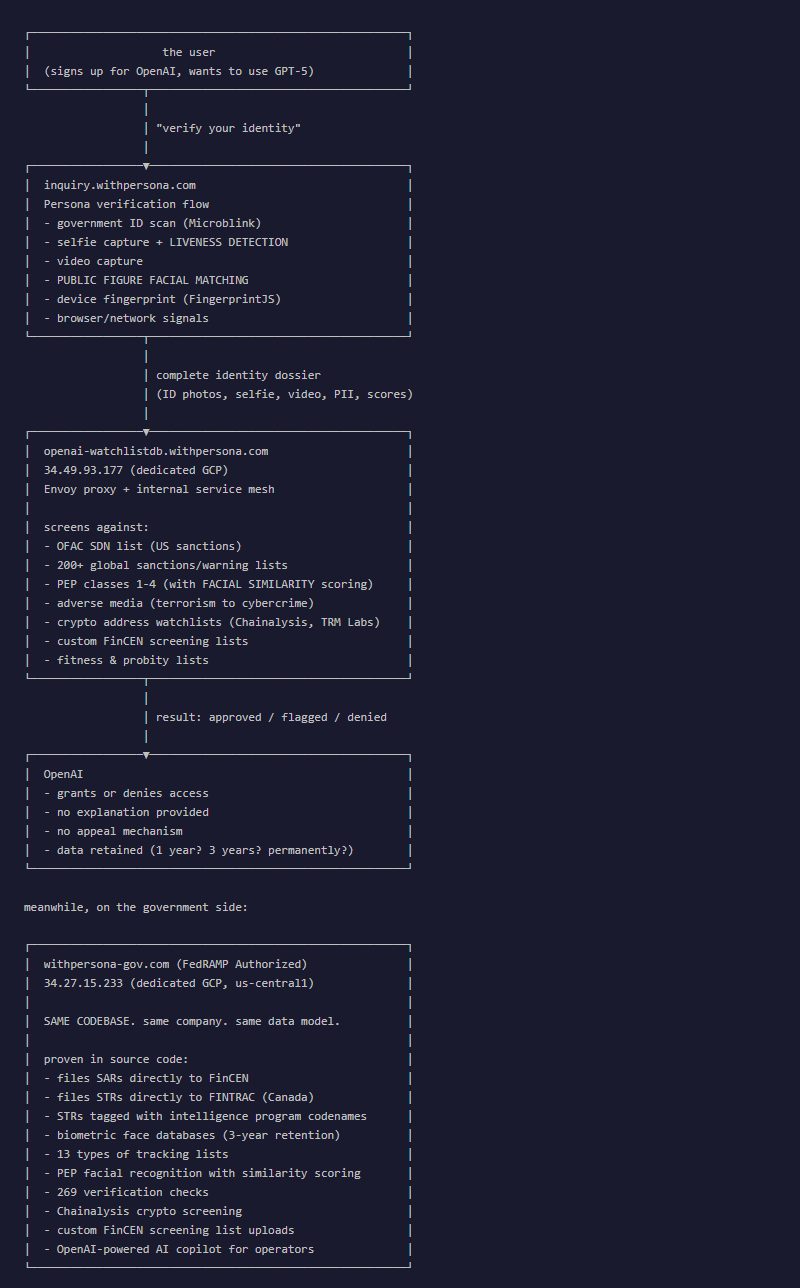
Persona’s API documentation, hosted publicly at docs.withpersona.com, makes clear just how much data its verification pipeline can return.
When a customer such as OpenAI runs a government ID check through Persona, the response is not a simple yes-or-no age confirmation. Instead, the API can deliver a full identity profile that includes legal identity details such as full name (including native script), date and place of birth, nationality, sex, and even physical attributes like height.
Beyond basic identity fields, the response can also contain complete address information, covering street address, city, state or region, postal code, and country.
Government document data is similarly detailed, including document type and number, issuing authority, issue and expiration dates, visa status, and, where applicable, vehicle classes, endorsements, or restrictions.
This effectively mirrors the contents of the underlying ID rather than abstracting it into a minimal verification signal.
The media component of the response is particularly extensive.
the watchers: how openai, the US government, and persona have been secretly running an identity surveillance system since nov 2023.https://t.co/Zz04WDF8Lz
researched by @vmfunc, @MDLcsgo, @DziurwaF pic.twitter.com/og0Dk6b9Fh— celeste (@vmfunc) February 16, 2026
Persona’s API can return URLs to the front and back images of the identity document, a selfie image with associated metadata, and even a video recording of the identity capture process. Alongside this media, the system provides metadata such as confidence scores, granular pass-or-fail results for individual checks, the capture method used, and precise timestamps covering each stage of the verification lifecycle, from creation to redaction.
Persona's own published case studies emphasize the scale and automation of this system.
The company states that OpenAI "screens millions monthly" and that more than 99% of users are "automatically screened behind the scenes in seconds." These screenings can be customized with filters ranging from simple partial name matching to more advanced facial recognition techniques, depending on the customer’s configuration.
None of this is hidden behind leaks or confidential disclosures.
The capabilities are documented openly and marketed as a feature set. What makes the situation contentious is not secrecy, but visibility: the fact that such comprehensive identity dossiers can be generated, processed, and acted upon at massive scale, quietly and almost instantaneously. In that sense, the system is not concealed at all.
This information is hiding in plain sight.
Once again, I forget that this platform has a cap on 4 images. I missed this one -- sorry. pic.twitter.com/Kjd53AGmO6
— Rick Song (@rickcsong) February 21, 2026
Discord responded by stating the test with Persona had concluded and that any collected user information would be wiped from servers within seven days.
The company distanced itself from ongoing use of Persona, with no new contracts in place, and reiterated commitments to minimal data retention and on-device processing where possible. Persona acknowledged the exposure, thanking the researchers for identifying it, and clarified that its engagements focus on secure verification without broader ties to controversial agencies in this context.
The incident has intensified backlash against the age verification rollout, with critics arguing it erodes the platform's tradition of anonymity and community trust, especially following a prior 2025 vendor breach that leaked tens of thousands of user IDs.
As Discord pushes forward with the March enforcement, many users and advocates worry about the long-term balance between safety measures and personal privacy in online spaces.




















































































































































































































































































